Wednesday, November 13, 2013

Video Game Myth Busters - The Space Invaders Yen Shortage


Space Invaders was one of the most influential arcade video games in history. So huge was its impact that I consider its release to be the incident that separated the bronze age of video games from the golden age.


?


Over the years, a number of stories have appeared about the game’s history and impact, especially in Japan. For some, these stories seem a bit too good to be true and some have been dismissed as nothing more than video game urban myths. Some examples:

·         What was the primary inspiration for the game? Atari’s Breakout? Atari’s Avalanche? The US space program? The 1953 film War of the Worlds? The release of Star Wars? The 1972 Taito EM game Space Monster? All have been suggested at one time or another.

·         How many copies did it sell? Figures range from 55,000-65,000 for the US and 200,000-400,000 worldwide.

·         Did the game really cause a wave of juvenile delinquency in Japan? Did kids steal yen from their parents? Or run away from home to play the game? Or pump upwards of $80,000 in to the game? Or extort other kids for game money?

·         And finally, probably the most controversial story of all (if there even is such a thing as a video game history controversy). Did the game cause a national shortage of the 100 yen coin in Japan, forcing the government to triple production?


In this post, I’ll take a brief look at the last two questions, especially the fourth one.

I should say up front, however, that I will not be able to give a definitive answer here, primarily because I don’t have access to the contemporary Japanese sources that would be required to find one. Nonetheless, I will summarize what I was able to find in US sources.

The story of SI causing a 100-yen coin shortage has been repeated in almost every major history of video games, including Tristan Donovan’s Replay, Kent’s Ultimate History of Video Games, and Russel DeMaria’s High Score. But is it true?

Wikipedia

The Talk section for the Wikipedia article on the game includes a brief discussion of the issue, but it is short on supporting evidence. One person (Alistair Rae) even claims that the game “…didn’t cost 100 Yen to play. At the time in Japan 100 yen bought what about $10 buys today.”  Rae apparently didn’t do his homework on this, because his claim doesn’t stand up to even five minutes of scrutiny. Exchange rates in 1978 averaged about 200 yen per American dollar. Not to mention that I have found a number of contemporary articles confirming that the game cost 100 yen to play.

Even is SI did cost 100-yen, did it cause a national shortage?

Recent Articles

Charles Paradis – circa 2013

A recent article by Charles Paradis of the Currency Museum of the Bank of Canada titled “Insert Coin to Play, Space Invaders and the 100 Yen Myth” dismisses the whole thing as a myth.


 While Paradis may be right in his conclusion, his article seems at bit wanting, particularly in identifying the original source of the story. I think his biggest contribution to the whole issue is that he actually contacted the Japanese Mint’s PR office and the Bank of Japan. The latter could find no evidence confirming the story. The former claimed that the increased yen production of the late 1970s (which I discuss below) had nothing to do with Space Invaders and cited an interview with Toshiro Nishikado (the game’s designer) in which he “indicated he believed it all to be a wild rumour.” Is this the last word on the issue? Maybe, but he is relying on a current claim about an event that happened 35 years ago and doesn’t mention how the mint concluded that the shortage had nothing to do with SI.

As an aside, note that the article also claims that the story of the original Pong overflowing its cash box is a myth because (he claims) Nolan Bushnell debunked it and was in Chicago at the time. I suppose I can’t fault him for taking Bushnell’s word, but IIRC Al Alcorn (who was there) confirms the story and Nolan’s version of the facts is often disputable, (though Paradis may have misunderstood him). He also quotes from All Your Bases Are Belong to Us, which makes the dubious claim that the whole Pong story was a fake (a story the author got from e-mails he pilfered from Ralph Baer’s computer and which the alleged source has admitted was unsubstantiated). I have already discussed my own qualms about the Pong story elsewhere, but I think Paradis dismisses it too easily.

 But back to the yen story. There are actually at least two claims in dispute here: whether or not Space Invaders caused a yen shortage and whether or not the government had to increase production to counter it.

Let’s start with the last question. Finding out the government’s reasons for increasing yen production might not be easy but we should be able to find out if there was an increase at all. If not, then we can consider this part of the myth busted.
 
World Coin News – February, 2012

In regards to this question, Paradis cites another article from the February, 2012 issue of World Coin News by Mark Fox titled “Space Invaders Targets Coins”


First of all, I have to say that it warms my heart to see that a numismatic journal would publish a whole article on the subject. The article includes a summary of production of the 100 yen coin in Japan (the source is the 1995 Krause coin guide). In 1977 Japan minted 440 million 100-yen coins. In 1978 the figure dropped to 292 million, in 1979 it rose to 382 million, and in 1980 it rose again to 588 million. Space Invaders was released in Japan in June, 1978. The numbers show that there was an increase in yen production from 1978 to 1980, though nowhere near a threefold increase. However, a glance at the chart reveals that the 1978 figure was atypically low.

NOTE – I should mention here that it appears that Fox was not the first one to come across this info. The same chart appeared in a 2009 LiveJournal post by The Eidolon;


In his article, Fox dismisses Space Invaders as a factor in the increase. Instead he offers another reason (suggested by a coin dealer who had lived in Japan for 40 years). In 1967, in response to rising silver prices, Japan had begun making 100-yen coins out of copper and nickel (they had previously included small amounts of silver). In response, people began hoarding the older coins, sometimes melting them down to extract the increasingly valuable silver. The Fox article speculates that the increase in yen production was an effort to counter this hoarding. As for the shortage, Fox cites a quote from Chris Kohler of Game Life who said that his ““…understanding of [the shortage] was always that there had not been an increased production of coins, but that certain Tokyo newspapers had simply reported on spot shortages of coins.” Is Kohler correct?

Tracking the Source of the Legend

So where did the yen-shortage story come from?

Scott Cohen’s Zap?

When you are dealing with potential video game history myths, one source that always comes to mind is Scott Cohen’s Zap! The Rise and Fall of Atari. I did a quick search of my digital copy and Cohen does indeed repeat the story:

“When Taito first introduced the game in Japan a year earlier, the reaction was so phenomenal it caused a coin shortage. The Japanese government had to quadruple the yen supply, just so kids could feed the machines”

In this case, however, Cohen is not the original source of the claim. Zap was published in June of 1984 and the story goes back much farther than that.

(typically, however, Cohen exaggerates the claim saying that Japan quadrupled rather than tripled production)

Martin Amis?


In his article Paradis decries the lack of a reliable source for the yen shortage claim, noting “The rare instances where these examples give any citation, they tend to reference Martin Amis’ Invasion of the Space Invaders.”

I don’t have time to go into Amis’ book here (suffice it to say that it is one of the more interesting books in video game history) but I doubt if he was the first to make the claim. Amazon reports that Invasion of the Space Invaders was published on November 1, 1982. There were at least two other books published the same year that also included the story, and at least one was published before Amis' magnum opus.
Steve Bloom and Craig Kubey

Both Craig Kubey’s The Winner’s Book of Video Games and Steven Bloom’s Video Invaders mention the 100-yen story. Amazon lists Video Invaders as being published on September 1, 1982 (predating Amis). It does not list an exact publication date for Kubey's book (other than "1982"), but if Amis’ book was published in November, it seems likely that Kubey also predated him.

Newspapers and Magazines
In any event, the three books mentioned above are likely irrelevant since it is unlikely they got their info directly from a firsthand source. It seems more likely that they repeated a story they heard elsewhere. But where?

New Scientist, December, 1980

Pardis mentions an article in the December 18-25, 1980 issue of New Scientist titled “The games that aliens play”.

Luckily, the magazine is available on Google books:


The relevant sentence reads:

“The Japanese company Taito developed the original Space Invaders for coin-operated machines – they became such a craze in Japan that the mint had to treble its supply of 100-yen coins.”

Can we find an earlier source? Yep.

Various Sources, November, 1980


In early November of 1980, a number of stories appeared making nearly identical claims about the 100-yen rumor.

Two of them were reports on the national Space Invaders tournament.
One was by UPI reporter Ed Lion (the earliest version I found of this story was from the November 10 issue of the Springfield (IL) Morning Union). It claimed that Space Invaders:
“…caused an immediate sensation and the Bank of Japan had to triple its production of 100-yen pieces – the coin used for the game in pinball arcades – just to meet the demands of Space Invaders-crazed players. One Japanese man poured $80,000 into the machines."

Another from the November 9 New York Times  by Dudley Clendenen (since they sell articles, I only posted a portion of it) reported

"Last year it is said to have caused the Bank of Japan to triple its production of 100-yen coins to satisfy the demand"

A third from the November 7 Youngston (OH) Vinidcator says

"The Bank of Japan had to triple its production of 100-yen pieces to meet the demand of Space Invaders players."

Note that the article quotes Tom Halfhill of Cleveland Magazine. - a possible source for the quote.

The fact that three different articles made the same claim within three days of one another indicates that the source of the quote came from somewhere else.

Gannett, October, 1980


Going back another month, I found a story from the October 19, 1980 Rockford (IL) Register by Evelyn Short of Gannett News Service.

“When it was unveiled in Japan in 1978, Space Invaders nearly caused `economic chaos. A government investigation into an unusual shortage of 100-yen coins found that the money was lying in limbo inside thousands of Space Invaders machines.”

Aha, not only does this article mention the increased yen production, but now there was a “government investigation”. Note, however, that there is no mention of tripling the supply.
On an interesting side note, the article also mentions the 23rd UFO trick and claims that it was discovered in December, 1979 by a group of (MIT?) students

Sydney Morning Herald, September 9, 1980


This one's on Google News.
From Sydney (Australia), September 9, 1980

"The craze reached such heights there at one time the country faced a serious shortage of 100-yen coins. A Government inquiry found that people were pouring all their coins into the Space Invaders."

Again we have a mention of a "government inquiry" and no mention of trebling the supply.
Sadly, no source is given for any of this info and before September, 1980 my trail runs cold. I found a number of articles on the game from early 1980 and 1979 but none directly mentioned the yen story.

However, I did find one other article that might be relevant

Pacific Stars and Stripes, July, 1979


This article (another UPI article) from the July 20, 1979 Pacific Stars and Strips has a number of interesting claims in regards to delinquency that we will discuss below. For purposes of the yen question, however, note the following intriguing quote from a Japanese hotel clerk:
“We’ve got plenty of bills but we often run out of the coins and have to wait for the machine to be emptied.”

It doesn’t say anything about a national shortage, but it does show that individual locations often ran short of 100-yen coins, lending credence to Kohler’s speculation that these local shortages were reported by the Japanese media and got blown out of proportion. Of course, that still doesn’t explain the whole “government investigation” business. One possibility (and this is pure, unsubstantiated speculation) is that the story (assuming it’s not true, and I’m not saying that’s the case) resulted from a combination of reports of local shortages and a government effort to curtail the hoarding of coins containing silver (though the last claim is also speculative).
 Delinquency?

What about the claims of the delinquency caused by the game? This story hasn’t been as widely disseminated but it may be even more interesting.

Among the claims I found were the following

Invasion of the Space Invaders

·         This one is second hand, since I haven’t read the book (it costs over $100 used on Amazon) but Amis supposedly wrote that a 12-year old in Japan held up a bank with a shotgun demanding his loot in coins so he could play the game.

Play Meter – August, 1979


·         Police concerned by juvenile delinquency caused by the game “…have ordered an investigation”

·         “The education Ministry has asked local teaching authorities to do what they can to stop children playing the game”

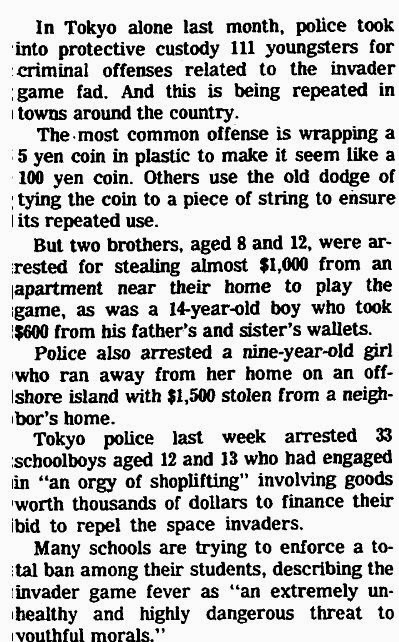
·         “Japanese newspapers have been carrying reports on cases of delinquency related to SI and state that in the past three months about 250 school children were placed under protecting police guidance and custody in Tokyo alone.”

·         In March a 10-year old boy was arrested for stealing 230,000 yen from his neighbor’s house to play the game,

·         Later a 9-year-old girl ran away from home with 300,000 and traveled several hundred miles to Okinawa to feed her Space Invaders habit

·         The NAIA restricted access to the game for those under 15 unaccompanied by an adult

·         (My favorite) The most common offense was stealing cigarette lighters, which could be used to rack up free credits on the game


 Pacific Stars and Stripes, July, 1979

·         Students cutting class to play the game

·         “two workers from the Japanese National Railways stole cameras, wristwatches, and other valuables from fellow railway workers at a dormitory, and pawned them to get money to play ‘Space Invaders’

·         “12-year old children in one school terrorized a group of 8- and 9-year olds, extorting 100-yen (U.S. 50 cents) coins to feed the game”


Christian Science Monitor, June 13, 1979


·         The story of the 9-year old runaway appears again (this time in US dollars)
·         The story of wrapping a 5-yen coin also appears again
      ·         Could the 8 and 12 year olds here be the same story as the 10-year-old in the Play Meter story? The amount of money is about right.

So many details of this story almost match what is in the Play Meter story that I wonder if this was their source. If so, they made a number of subtle changes, which could be a sign of a legend in the making.
 
 
Finally, here’s one of the earliest articles I could find, from the April, 1979 RePlay. It mentions nothing about a yen shortage or any delinquency.


Sunday, November 10, 2013

Addendum to Ultimate History of Allied Leisure/Centuri

I am getting ready to post the next part of my ultimate history of Allied Leisure/Centuri, which will start covering the Centuri years, but I recently came across some new information about the Allied Leisure era that I thought I'd pass along.

I am currently reading Brian Bagnall's excellent Commodore: A Company on the Edge. While the book is mostly about the early years of Commodore (I think it covers mostly the PET/Vic-20/ C64 years) it actually has a surprisingly lengthy section that discusses Allied Leisure.

Why would a book about Commodore even mention Allied Leisure?

As it turns out, Chuck Peddle actually did contract work for Allied. For those who don't know, Peddle was the designer of the 6502 microprocessor (the processor used in the Apple II, Atari 800, and Commodore PET). While he was working at MOS Technology (developers of the 6502), Peddle visited Allied Leisure to try to sell them the chip. At the time, they were investigating the use of microprocessors in their games and were talking with a number of other companies. To convince them to go with MOS, Peddle designed a prototype pinball game that used the 6502. Unfortunately, the book doesn't give the game's name or even when it was produced (though it was probably 1975, the year the 6502 debuted). It does mention that Peddle demoed it at the National Computer Conference but doesn't say when. I'd love to find more info about the game. It may be the same game I mentioned in the Allied Leisure post designed by Ian Richter. It could also have been a prototype for Rock On or Dyn-O-Mite but that seems unlikely to me since I've never heard that Peddle was involved in those games.

Perhaps more interesting is that Peddle's brief stint at Allied may have altered the course of personal computer history. While at Allied, Peddle befriended a young engineer named Bill Seiler. While Peddle was working on his pinball prototype at night, Seiler had ordered an early kit computer from a company called The Digital Group. Released in 1975, the computer was much more user friendly than the recently-introduced Altair 8800. The Digital Group computer offered the choice of 4 CPUS, a warm boot, and interfaces for a cassette deck (for storage), keyboard, and monitor. After Seiler built the kit, he wrote a few programs then was unable to find anything else to do with it (there was no software at the time). Watching Seiler play with his new toy convinced Peddle that there was a market for a user-friendly personal computer and he returned to MOS Technology and began work on the Kim 1, an early personal computer released in 1976. Later, when he moved to Commodore, he recruited Seiler to work on the PET design team.

Bagnall's book has more information about Seiler's years at Allied and you can buy the book if you are interested (it's available as an e-Book). I thought I'd pass along one quote, however. When Seiler worked at Allied, he was shocked by the poor design of their games and the inexperience of their technicians (many of whom were Cuban exiles). At one point he describes the repair techniques used by a colleague:


[Bill Seiler] There was this Cuban guy who didn’t know anything about logic...He had this little book, and if a videogame like a Pong game was doing something funny, he would just change three chips and it would fix it. He did this other thing where he would rub on a chip with a pink pencil eraser and it would start working again for a few seconds, and then it would go away and he knew that was a bad chip. I said this is voodoo man[1]

Anyway, I have added the above info to my earlier post, but if you want to read more or have any interest in Commodore, I heartily recommend Bagnall's book. He conducted extensive interviews with a number of the major players (the only downside so far is that he spends little time on the pre-computer years).
Unfortunately, it looks like there won't be a sequel. Bagnall was working on one and was scheduled to release it several weeks ago, but he posted on his blog that the project has been shelved indefinitely.

It's too bad since (aside from the Commodore info), part 2 would likely have included interviews with Dave Needle and maybe more info about his early video game career.


[1] Bagnall, Brian, Commodore: A Company on the Edge (p. 42). Independent Publishers Group. Kindle Edition.


Sunday, November 3, 2013

URL's Video Action - The First US Consumer Video Game after Odyssey?

Today’s post is about Video Action, a line of consumer/arcade video games made by URL from 1974-76. Normally this blog covers arcade games and does not veer into consumer (part of the reason I started the blog was because there are already so many sites, blogs, and books dedicated to home games). Occasionally, however, the two overlap, primarily when a coin-op company also makes consumer games, as was the case here.

Not only was Video Action made by a coin-op company but it was one of the earliest, if not THE earliest consumer video games to hit the US market after the Odyssey (though consumer Pong games had appeared on the European market earlier).
I actually thought I’d already posted on this, but I couldn’t find the post, so sorry if this is a repeat.
 
The Pong Story Website
 Usually, the go-to source for consumer Pong games is David Winter’s excellent Pong Story website. With Video Action, however, the Pong Story’s story seems a bit muddled.  Let’s look at what the site has to say about the game.

Here’s what is says about Video Action and Video Action II:
“They [URL] also produced their first Video Action arcade game, model VA-I, housed into an octagonal table. A few thousands were produced. After the Allied Leisure fire and other financial problems, URL found itself with millions of dollars of electronic components. URL had to do something with this inventory, so one of its co-founders quickly decided to get into the consumer market. Thus was born the second Video Action game, model VA-II. It was first announced in 1974, and released later in 1975 in two forms: one with a TV set and a coin box for use in bars, and a home version which could use any TV set. The former was more successful as it was designed to make money. The latter didn't sell as well as the former because of its high retail price of almost $500 (the circuit board itself cost around $200 to manufacture).”
The site then shows a photo of Video Action II and goes on to talk about Video Action III and Indy 500 (aka Video Action IV).
There is no photo of the initial game (Video Action).
Is this information accurate? Much of it appears to be, but some (particularly the info on the first unit) seems to be off. In researching my book and the game, I tried to verify this info but was unable to find anything definitive. I did find some things, however, that seem to indicate that URL’s first consumer game came out sometime earlier than Winter’s timeline indicates.
 
Bill Olliges
The first time I heard anything about a URL consumer video game was several years ago when I interviewed URL cofounder Bill Olliges. At the time (circa 1999) I barely knew who URL was, much less that they had produced a consumer video game. Here’s what Olliges told me when I asked how URL started in video games.
[Bill Olliges] We saw a game from Nutting called Computer Space and decided we could do the digital logic that was necessary to do that kind of game…So we started on a game called Paddle Battle and that graduated into a 4-player called Tennis Tourney. Paddle Battle really seemed to take off…and we were shipping boards down to Allied Leisure in Florida like there was no tomorrow. Suddenly we couldn’t find enough ICs to continue at the pace we were at so we began to buy much, much bigger lots. Somewhere along the way, Allied had a major fire that shut down their manufacturing operations and we had inventories of ICs coming out of our ears so I decided “As long as we have the parts we might as well build a consumer game” So that’s what we did. We built a board and chassis in a kind of a pedestal – a flat tabletop that you could put a small black-and-white television on and you had your own arcade game. . .It was a 2 or 4 player paddle game.

Olliges’ story seems to comport with Winter’s account except for a couple of things. First, he makes no mention of a cocktail game or any other video game made by URL before the Allied fire, other than the ones they did for Allied itself. He also mentions that “you could put” a TV on their game, indicating that it could be attached to a standard TV. This does not appear to be the case, however, at least not at first.
 
Flyers
One of the first sources I always check when researching a game is TAFA (The Arcade Flyer Archive). TAFA has two flyers for Video Action. The first is dated 1975.


Normally, I would suspect that this was the source of Winter’s claim that the cocktail arcade version came first. The cabinet doesn’t exactly seem “octagonal” to me but I could see where some might say it was. The flyer, however, includes no model number, “VA-I” or otherwise.
The second flyer (also dated 1975) is a four-page flyer with much more info.


It lists five models:

·         VA-II: their basic home or “waiting room” model

·         VA-IIC: the same model, but with a coin box

·         VA-T: the cocktail game from the first flyer

·         VA-TC: coin-op version of same
All four of the above include three games: Tennis, Soccer, and Hockey

·         VA-MP: A second cocktail model with different games (Volleyball and 4-Court Tennis) plus a “robot” option

Note that there is no model “VA-I” listed (though if there was a VA-II, you’d think there would have been a VA-I). Also note that the VA-MP model does indeed come in an unarguably octagonal cabinet.

Of course, we still don’t know when these games were released. The flyers are listed as being from 1975 but a) that isn’t very precise, b) this flyer was likely produced some time after the first game was available, and c) TAFA flyer dates (especially in the 1973-75 period) are often off by a year.

Trade Magazines

My next source for games is usually the trade mags. Unfortunately, they are probably not going to give us the full story here since Play Meter didn’t start until December, 1974 and RePlay until October, 1975. Vending Times and Cash Box were around earlier in 1974 but I don’t have the full issues with me right now. I do, however, have some scattered issues as well as my notes (which include all the release dates I could find). A bigger issue is that those magazines covered the coin-op market so they might not have listed a game that was available only as a consumer unit (though they generally did so if it was made by a coin-op company).

Here’s what I found.

The February, 1975 issue of RePlay contains an announcement that Control Sales (more on them later) “introduced” Video Action II at the winter CES in January (the same show, by the way, where Atari was showing Home Pong).


Essentially the same article appeared in the February, 1975 issue of Vending Times.
The most interesting line for purposes of this article is:
“Video Action II, which carries a suggested retail tag of $299, is priced considerably under its predecessor model which included a television receiver. The customer can now buy the electronic game and connect it to his television receiver at home.”
The “predecessor model” had a built-in 12” TV and, it was built-in – not an option – a seemingly fatal decision for a consumer product.  Especially given that over 90% of homes already had TVs.
The Pong Story claims that Video Action II cost “almost $500” (I read somewhere that the exact figure was $499) even without the television and indicates that the $200 board was the main reason. No mention is made of the consumer version being available with a built-in TV.
Reading the RePlay article, I’d guess that the “predecessor model” (presumably Video Action) was basically the same as Video Action II except with a built-in TV and a $500 price tag (the article does mention that the Video Action II was priced “considerably under” its predecessor).

The May, 1975 RePlay had the following:


So it looks like the arcade cocktail table version (VA-TC) was introduced around May (Cash Box reported the same thing), not prior to the Allied fire. Unless, of course, there was a previous cocktail version. The only other cocktails mentioned in the 4-page flyer are VA-T, which was a consumer cabinet and VA-MP, which I’d guess came out later given that it had 2 different games, plus a “robot” feature (a feature URL included on its Video Action III home unit in 1976).

These articles indicate to me that the original game was not a cocktail game, but instead was a version of VA II with a built in TV. The evidence, however, is far from conclusive, so we have to dig further.

Newspapers

One good source for info on consumer games is newspapers. While searchable, online newspaper archives are becoming more and more common and comprehensive, however, they still only have a fraction of total amount of data that’s out there in print form, so I didn’t have high hopes when I started searching.
Nonetheless, I did manage to find some good (if scant) info.
The first mention I found was this ad from the September 2, 1974 St. Charles (Missouri) Journal.


The photo isn’t the best, but that seems to be the same game as Video Action II and clearly includes the TV set (note how they try to make this a selling point). Too bad they didn’t list an SRP (though if it was $499, you can see why they might not want to).

The most interesting thing here is the date. September 2, 1974 was over a year before Atari introduced Home Pong and over four months before they showed it at the CES. And given that this was the only 1974 ad I could find, it may well have shipped even earlier.
Could this have been the first US home video game after the Odyssey?
The Pong Story doesn't seem to list an earlier one (at least not in the US, it does list ome 1974 models from Europe). Vendel and Goldberg state flatly that it was the first home tennis game on the market after Odyssey.

Of course, consumer games aren't my specialty so I may well be forgetting some obvious early home games.

The next ads I found for any version of the game weren’t until November, 1975 when I found a number of ads for Video Action II.
Here's one from the 11/2/75 Omaha World Herald


And here's a photo that was part of an article on the game in the 11/18/75 Galveston paper.


Given the above, it looks to me like the original Video Action came out sometime around the fall of 1974, included a built-in monitor, and had an SRP of around $499. They may have produced a coin version as well.
Video Action II looks to me like the same game but without the TV and at a lower price (probably created after URL realized how silly it was to produce a consumer game that couldn’t be connected to a TV).
Courtroom Testimony

In late 2014 (long after the original post), I came across some new information that pushes back the dates for Video Action even further. On June 14, 1974 Allied Leisure head honcho David Braun gave a deposition in the Magnavox v Bally case. During the deposition, plaintiff's lawyers presented a two-page brochure for Video Action by Control Sales. The first page included a photo, description, and technical specifications while the second included more specifications and a warranty. It is uncertain if the game was actually

on sale at this point. If it wasn't, it was likely close to being sold.


Sidebar – Control Sales and Venture Technology

OK, so what about Control Sales. Control Sales handled the marketing of the games (which were manufactured at URL).  Control Sales was a manufacturer’s representative organization founded in 1968 by Ron Rutkowski.

TAFA actually has another flyer that touches on this topic. It's from a company called Venture Technology. This one is a 6-page flyer but I’m only showing the most relevant page.


 The game here appears to be the same as URL/Control Sales model VA-MP. Note the claim that they sold “over 3,000” units, which comports with Winter’s claim of an octagonal cocktail game that sold “a few thousands”. (As I said, I suspect the flyers were the main source of some of Winter’s info).

But who is Venture Technology?

First, if you look at the rest of the flyer, you’ll not only see photos of the original Video Action but of a number of coin-op titles made by Electra Games. Electra was the coin-op division of URL, set up in early/mid 1975.

Look a little closer and you’ll see that Venture Technology and Control Sales were both in Des Plaines and in fact had the same address. A search through Replay reveals that both were headed by Ron Rutkowski, so I suspect that there were basically the same company.

I plan on trying to contact Rutkowski sometime soon and may even try to recontact William Olliges. If so, I'll report back what I hear.


Tuesday, October 29, 2013

More Photos And Undocumented Games

Donkey Kong on the production line

 
1979 ad for Funspot


Another shot of the Atari Theatre Unit, from April, 1976
 
Some undocumented games:

Electrocoin's Minesweep (1977)
 

Infinity 1 from Nova Games of Canada (1984)
 
1976


Technical Design Corp's Whiz IV, from the 1975 MOA show

 
From Vending Times, May 1979
This sounds like the same game as the Warp Speed prototype in MAME

Finally, a few that are documented but rare

A photo of Sente's Shrike Avenger at the 1984 AMOA show
 
This Sega Car Hunt cabinet is different than the one on Arcade Flyers

Tuesday, October 22, 2013

Forgotten Gems - Stern's Dark Planet


            Chicago’s Stern Electronics may not have had as many coin-op hits as Atari, Midway, or Nintendo, but during the video game heyday of the 1980s they produced a number of solid efforts, both in-house (Berzerk) and through their relationship with Konami (Scramble, Super Cobra etc.)  One game that wasn’t a hit was 1983’s Dark Planet. What it lacked in sales, however, it made up for in innovation. While companies like Atari and Midway with their massive production facilities and huge design staffs could crank out mega-hit games by the truckload, smaller firms like Stern often had to turn to novel gameplay elements in an attempt to catch the fickle fancy of the jaded gaming public. Dark Planet was a space shooter with genuine 3D effects in the mold of Sega’s Subroc 3D (though it used an entirely different technology). The game was the brainchild of toy designer Erick Erickson. At the age of 9, Erickson had begun taking art classes at the Art Institute of Chicago before moving on to the Kansas City Art Institute where he graduated in 1974 with a degree in industrial design, Erickson had begun looking for work in his native Chicago. At the time, Erickson's portfolio consisted primarily of toys, novelties, and the like and a number of people suggested that he apply for a job at a company called Marvin Glass & Associates. Erickson had never heard the company's name but he certainly knew their products, which included some of the most legendary toys of the 1960 and 1970s such as Lite Brite, Toss Across, Rock 'Em Sock 'Em Robots, Mouse Trap, Operation, STP Racers, Ants in the Pants, Evel Knievel Stunt Cycle, Simon, Mr. Machine, Mystery Date, and even the original chattery teeth.

Marvin Glass, the man, from an article by Erickson himself at http://www.spookshows.com/toys/glass/glass.htm


Unfortunately, Marvin Glass didn't hire new college graduates at the time and suggested that Erickson come back after he had a few years of experience under his belt. Disappointed, Erickson took a job at Embossagraph Display Mfg Co, whose primary business was making point-of-purchase displays for breweries in the Milwaukee area. The company was looking to get the toy market, however, and Erickson was put to work designing cereal premiums and Cracker Jack prizes. Two years later he was hired by Marvin Glass. For a toy designer, it was pure heaven. His first major success was The Slime Monster Game, a board game released by Mattel in 1977 to make use of the popular "slime" product they had released the previous winter. At the center of the board was a green plastic monster with slime oozing from his mouth. The goal was to move your characters from the high school to the armory to pick up a landmine and knock over the creature before it "slimed" you. The game's success landed Erickson his own office.


As Erickson continued to design toys for Marvin Glass, he noticed that the video game field was exploding and suggested that the company enter the new market.

[Erick Erickson] I was watching the video game business go crazy in 1979. We were in Chicago and all the major video game manufacturers were in Chicago…Instead of selling something that retails for $20 now you can sell something that retails for $4,000. Look at the difference in royalties you can make on it.

Marvin Glass took Erickson’s suggestion and before long, he had about two dozen people working for him creating video game concepts for companies like Bally/Midway and Williams (the first was for a game called Mothership, which eventually turned into Midway’s Kozmik Krooz’r, but that’s another story). Then the firm's partners called a meeting, inviting everyone from the cooks to the accountants to the game designers and announced that all video game projects were to be shut down immediately. Erickson was stunned. Rather than coming to him in private and telling him about the decision, they had done so in a public meeting and he felt humiliated. He was also frustrated that he would no longer be allowed to work on video games when he knew that there was a goldmine out there just waiting to be tapped - especially in Chicago, the center of the coin-op universe. Then a coworker named Dan Langlois began encouraging Erickson to leave and start his own video game design company and before long the two of them did just that.

Erick Erickson, from http://www.houseofmasks.bizland.com/homabouterick.html

            Erickson felt he needed something big to start his company - something phenomenal. He and Langlois had just cut their apron strings and had no job to fall back on. Inspired by the asteroid scene in The Empire Strikes Back (where Han Solo flies the Millennium Falcon into what he thinks is  a crater, only to find it is the mouth of a reptilian creature), Erickson created an elaborate concept for a 3-D game that involved fighting aliens on the surface of an asteroid. Now he and Langlois needed to sell the concept. There was one problem. Neither of them were programmers and they lacked the engineering skill and materials to make a coin-op video game. They could have drawn up a proposal on paper, perhaps supplementing it with a storyboard of two, then shown it to one of the Chicago area video game manufacturers. Instead, Erickson took a much more innovative approach, based on something he had learned from Marvin Glass himself. When trying to sell toy concepts, Glass didn't want to leave anything to the imagination because he never expected executives to have any imagination. So he had his designers create prototypes that were as close to a finished product as possible. Erickson took the same approach with his video game idea. He decided to create a demo model that was as close as possible to a real arcade video game, but without the circuitry or programming.

[Erick Erickson] …what I did was [to] always create an illusion. Each cabinet was an illusion…in order to portray the illusion what I would do is rotoscope a puppet show … I took a super 8 mm camera and shot live action of me manipulating the icons on wands to get the rhythm, pace, and feel of the movement and then I would photograph that and …translate [it] to stop-motion…so it looks like it was pixelated in those days but what I'm doing is showing a video tape of a movie that I made that creates the illusion. When a client would come up to see one of my machines it would appear to be a full working machine with graphics and everything. The headers would light up. Everything would be in place so all the boss had to say is "Could I sell that". So I made it real easy for them.

Using stop-motion animation, models, rotoscoping etc. the duo created a video tape of simulated gameplay then mounted it in a full-fledged cabinet, complete with all the bells and whistles. Erickson even included a tape recorder with electronic music and sound effects. Most video games at the time used simplistic, upbeat music. Erickson wanted something more fitting for the game's theme. Something like Darth' Vader's theme from Star Wars or the electronic music of Alan Parsons Project's I, Robot (which Erickson was listening to at the time). In later years, when the two were designing electromechancial games, Dan Langlois would sometimes crouch behind demo units with a control box, making the game elements appear to move in response to the player's actions.

Working in the basement of Erickson's house, the pair had a demo unit ready in about two weeks and began calling various coin-op companies in Chicago. When they contacted Gary Stern, he was interested enough that he took a limo to Erickson's house to take a look. He bought the concept on the spot and gave the pair an advance and a contract granting Stern first refusal rights on any game they developed in the next year.  With an advance and a monthly check, Erickson and Langlois moved into their own office in a seedy neighborhood in Chicago's manufacturing section near the various coin-op factories (they had to chase prostitutes of their gangway every morning where they got to work turning their demo into an actual video game.


            The final game, Dark Planet, would incorporate a number of ideas from the demo, including the use of actual models inside the cabinet. Using urethane, Erickson sculpted an alien landscape, then used mirrors to create the illusion of a full planet curving away into space. The player peered through a small viewport to see the playfield, where green and red filters produced a 3D effect.


[Erick Erickson] I divided the red and blue colors through filtration. If I wanted something to be on the surface of the planet I would make it blue and if I wanted it to be flying above the planet I would make it red…You're flying above the planet your laser is focused [on the surface] and causing all kinds of havoc through its crackling fire scarring the face of the planet...There was a vacuum tube on the side built into the wall...you can fly into [the tube] and it transports you down to the lower [level where] you've got this civilization…building tracks so they can bring out the laser train...One system starts and you try to keep it under control, then the other system starts and you have to try to keep IT under control…and the third system starts…it's like spinning plates. You have to be everywhere at once. Then the volcano starts to erupt...you blast into the mouth of the volcano…and it's okay for a while but then it will erupt again and if erupts and covers your whole screen you don't know where you are and are going to get blown up…then the cannons on the rim start shooting - it's just a mayhem of a battle…you keep controlling this situation that's looking like it's out of control...it's a 3D wonderland and when people saw it they went ape


            Meanwhile, Stern needed someone to program the game. They turned to Bill Jahnke and consultant Dale Jurich.  Jurich, a computer science graduate of the University of Illinois, had opened an arcade called the Apple Duck in the Urbana-Champaign area in the early 1970s along with Andy Dallas (who went on to become a world renowned magician, hypnotist, and escape artist). After cofounding a company called Small Systems Services (where he developed one of the first microcomputer versions of FORTRAN) and working for Intel, Jurich founded his own consulting company called Dale Jurich Associates. Jurich (who was living in Oregon) landed a contract at Stern where his friend Bill Jahnke was already working. Jurich and Jahnke were tasked with turning Erickson and Langlois' video tape concept into software. It was an interesting coincidence that Jurich's first game involved a volcano. In 1980, he had witnessed the eruption of Mt. St. Helens from the second floor of the Intel facility in Aloha, Oregon and his first college roommate, volcanologist David Alexander, had died in the eruption.

Dark Planet programmer Dale Jurich (from his LinkedIn page)

            Working from Jahnke's home in the Chicago Suburbs, the two worked on the game for the better part of a year, creating one of the more interesting, if lesser known, games of the golden age. Stern showed Dark Planet at the 1982 AMOA show and "released" it in January of 1983 but only in limited numbers. Despite high hopes for the game, it never went into full production (Erick Erickson recalls that around 350 were sold). One problem was the high production costs. Some reports also claim that aligning the games optics proved difficult. Another problem was that the player had to be a specific height to be able to actually see the 3D effect properly. Players who were too tall had to bend over and players who were too short couldn’t reach the viewer at all (though a slide-out stool was reportedly included in some versions). While Dark Planet had failed to catch fire, Stern didn’t abandon the idea of 3D graphics. Even more ambitious was their attempt at a hologram-game that actually projected the image of a plane over the top of the monitor. Once again, however, engineers experienced technical problems with the game’s optics and it never made it into release.


            As for the team that created Dark Planet, Dale Jurich never programmed another coin-op video game (though he did program PC Pool Challenge for the IBM PC). After their contract with Stern ended, Erick Erickson and Dan Langlois inked another deal with Williams Electronics where they submitted a number of video game concepts (such as Cockroach - a bug-squashing game involving a kind of early touch screen). None of them were ever released- though Williams did release their Still Crazy pinball game. Today, Erickson designs high-quality custom sculptures and masks based on life masks of famous individuals (http://www.houseofmasks.bizland.com/). Marvin Glass later decided to give video games another go and designed a number of titles for Bally/Midway, including Journey, Wacko, Tapper, Domino Man, and Timber. While it may not have sold many copies, Dark Planet stands as one of the more interesting creations of video games' golden age.


See a video of Dark Planet's gameplay here: http://www.youtube.com/watch?v=8wO69GrbYiA
Thanks to Erick Erickson and Dale Jurich for taking the time to provide information for this article.

Extra - Kickstarter Projects

Finally, I thought I'd mention three Kickstarter projects that might be of interest to readers of this blog (though they likely already know about them). Two have already been funded and one still has about two weeks to go.

The one that still hasn't reached its goal is for a new retro gaming magazine called Retro It looks very promising and they have some impressive contributors lined up:
http://www.kickstarter.com/projects/socalmike/retro-the-multi-format-throw-back-video-game-magaz

The other two are already funded.
One is a documentary about the Nibbler high score attempts (but it also includes interviews with the designers)
http://www.kickstarter.com/projects/playlandpictures/man-vs-snake-the-long-and-twisted-tale-of-nibbler?ref=live

The other is for a book on "The Untold History of Japanese Game Developers" consisting of a number of exclusive designer interviews
http://www.kickstarter.com/projects/1748556728/the-untold-history-of-japanese-game-developers?ref=live