Saturday, October 10, 2015

The Ultimate (So-Far) History of Gremlin Industries Part 3

Before I jump into today's post, I wanted to mention a book I recently read that had some additional info on Nasir Gebelli, including why he left Sirius and why Gebelli Software failed. It is 1985's Software People by Broderbund co-founder Doug Carlston. If you have any interest in computer games of the 1970s and early 1980s, I highly recommend it.  have updated my earlier post on Nasir Gebelli with this new info.

Speaking of computer games, another source you need to check out if you haven't already is Jimmy Maher's outstanding blog "The Digital Antiquarian" (www.filfre.net). It is one of my two favorite blog's on video game history. It mostly concentrates on interactive fiction and other games with a story/interactive element, but it also dives into the general history of various publishers. It is generally well researched and very well written.

And while we're on the subject, my other favorite video game history blog is Alexander Smith's "They Create Worlds" (videogamehistorian.wordpress.com). This one takes a much broader approach, covering all three major segments of the video game industry (coin-op, home, and computer) as well as background information on the various threads that led to the industry's creation (i.e. the history of computers in general). Alex has recently started a podcast that is also well worth listening to.

On to today's post:

In the last two posts, I have reviewed the early history of Gremlin Games. When we left off, they were on the verge of being purchased by Sega. Before we look at the purchase, let’s backtrack a bit and look at some Sega history. In a series of earlier posts, I recounted the history of Sega’s predecessors (Service Games and Rosen Enterprises). After Sega was formed, the company had a long history in Japan but delving into that would take us too far off course. Instead, I will concentrate on Sega’s early attempts to enter the US market.

Cracking the US Market


In the late 1960s, Sega dominated the Japanese coin-op industry with relative ease, success in America came much more slowly. The biggest reason was probably the prevalence of piracy. Sega exported a number of games to America between 1966 and 1970 and most were initially successful. The success, however, never lasted. Time and again Sega would conduct months of research before introducing a game only to see their competitors build similarly-themed knock-offs (Midway’s S.A.M.I. for example, was basically the same game as Missile). In addition, the U.S. companies often undersold Sega (Rosen 1975). This was especially easy to do since domestic manufacturers could avoid the costs Sega incurred shipping their games from Japan to the U.S. (not to mention that they did not have to pay for R&D and that some of the copycat games were of less-than-stellar quality and thus cheaper to manufacture). After a disastrous experience of this kind with Jet Rocket, Sega pulled out of the U.S. market entirely. According to David Rosen, however, the "Jet Rocket fiasco" (as he called it) was not the primary reason. In Japan, the company’s arcade and amusement casino business was thriving and they did not have time to devote to the America market, which was an insignificant part of Sega’s total volume anyway (Rosen 1975). In any event, the company’s exit from the U.S. market was not to last long.


Going Public – Gulf + Western Buys Sega


After the success of Periscope, Rosen and his partners began to think about taking their company public, an unprecedented move for an American in Japan. It would have been the first time a coin-op company went public in Japan as well as the first time an American company of any kind did so after World War II. Rosen wanted to go public by acquiring another company and merging into his own. Sega's investment banker, Kidder-Peabody, suggested the opposite – find a company that might be interested in acquiring Sega. In 1969 and early 1970, Rosen and his partners sold 80% of the company to Gulf + Western Industries, though Rosen remained as CEO. Started in 1934 as Michigan Bumper Company, Gulf + Western went on to become the very definition of the word conglomerate (in Mel Brooks Silent Movie it was referred to as Engulf and Devour). Among the companies and brands it owned in the 1970s were Paramount Pictures, Simon & Schuster Publishing, Dutch Master Cigars, Paper Maid, Bohm Metals, Eagle Signals, and No-Nonsense pantyhose. Products made by these companies included food and agricultural products, tractors, air-conditioning equipment, books, movies, metal products, business machines, cables and connectors, musical instruments, public safety systems, wax museums, shoes, belts and the list goes on (and on, and on...). In its 1974 annual report, the list of subsidiaries takes up 9½ pages and includes almost 300 companies. Gulf + Western’s purchase of Sega would add yet another product line to its ever-growing list. One product that Gulf + Western did not make, however, (or want to) was gambling equipment. After acquiring Sega, they discontinued its slot machine line and, according to legend, Sega threw its slot machine molds into the Bay of Tokyo and began concentrating on arcade games.

Sega Enterprises, Inc.

Meanwhile, in 1974, a new corporate entity called Sega Enterprises, Inc. appeared on the scene, though it happened in a roundabout manner that only an accountant could understand. At the time, Gulf + Western, in partnership with David Rosen, was trying to establish a conglomerate in the Far East similar to Gulf + Western, with Sega as a subsidiary. When that effort failed, they decided to spin off Sega into a separate US company headed by Rosen (Kent 2001). One of Gulf + Western’s many holdings was a cosmetics company called the Polly Bergen Company, which they owned a 53.5% interest in via another subsidiary (naturally) called Consolidated Brands. By 1973, Polly Bergen was losing money and in March 1973 Gulf + Western sold its cosmetics business to Faberge, leaving Polly Bergen with no product line whatsoever. In March 1974, Gulf + Western transferred its Sega Enterprises, Ltd. subsidiary to the Polly Bergen Company. Then, on March 25, it effected a one-for-ten reverse stock split and acquired Polly Bergen for 1.7 million shares of stock, increasing its ownership of the company to 95%. The same day, they changed its name from The Polly Bergen Company to Sega Enterprises, Inc. with Sega Enterprises, Ltd. (Sega’s Japanese operations) as a subsidiary. (Annual Reports) While I am certainly no business expert, my guess (and that’s all it is – a guess) is that the reverse stock split was a way for Sega to increase its ownership of Polly Bergen by diluting that of any Polly Bergen Co itself or any other entities.

(Re)Entering the US Market: Sega of America 1975-77

In 1975, Sega decided to give the U.S. market another go. This time, hoping to avoid the problems that had led them to abandon the market earlier, they decided to build the games in America rather than shipping them from Japan. It seems that they initially tried to accomplish this through acquisition. Early in the year, Sega agreed in principle to acquire Seeburg’s Williams Electronics division but the deal was cancelled in the summer and in July, Sega opened its first U.S. manufacturing facility – a 50,000-square-foot plant in Los Angeles. At the 1975 MOA show, Sega debuted Bullet Mark, its first game manufactured in the US. A joint R&D effort between the US and Japan, Bullet Mark was a two-piece video gun game where one or two players used tommy guns to blast away at an oddly disparate assortment of targets (balloons, tanks, pirates, and jet fighters) (Rosen 1975). The guns featured a recoil effect for added realism and Sega later updated the game with new features like disappearing targets, machine gun sounds, and an IC containing new targets. The game arrived too late in the year, however, to have much of an impact on Sega’s bottom line (even if it had arrived earlier, it might not have had much of an effect as the game suffered from quality issues and its large size made it impractical for many locations).


In 1976 came more new video games. Tracer was a smaller, one-piece version of Bullet Mark, with different (and more sensible) targets (helicopters, submarines, bull’s-eyes, and jets). Road Race and Moto-Cross were driving games (automobile and motorcycle respectively) featuring a semi-first-person, behind-the-back perspective (itself somewhat unusual for the time). The latter featured motorcycle handlebar controls that vibrated after a collision as well as recorded sound effects on an 8-track tape. In the summer, Sega took advantage of Gulf + Western’s Paramount subsidiary and rebranded the game as Fonz, with cabinet graphics featuring the likeness of Henry Winkler of Happy Days (a Paramount property) fame. It was perhaps the first example of a celebrity-licensed video game. Sega even sponsored a "Ride with the Fonz" promo, cooked up by sales director Pat Karns (formerly of Atari). Participating arcades were given advertising posters and banners as well as Fonz T-shirts and free signed photos of Winkler to give as prizes and (hopefully) lure new players into the arcade (RePlay 12/76; 1/77). Tic Tac Quiz bore more than a passing resemblance to another TV property – Hollywood Squares (though the game show was produced by Filmways Television, not Paramount). Players agreed or disagreed with facts that appeared on the screen. If they were right, they got to choose where to put their X or O. The game shipped with 2,500 "questions" stored on a replaceable tape (Sega later offered a 1,500-question sports trivia tape).

Sega-Vision (and the Madman)


Sega also continued to branch out into other areas. In June, they acquired Muntz Manufacturing Inc. – a manufacturer of widescreen projection TVs. The company had had been founded by Earl "Madman" Muntz, a high school dropout who made a fortune selling cars, TVs, and stereos via his hyper-kinetic "Madman" persona. Muntz opened his first used car lot at age 20 and went on to become perhaps the most famous used car salesman in the country through a combination of publicity stunts (he once promised to smash a car to pieces on camera with a sledge hammer if he didn’t sell it by the end of the day) and a series of over-the-top TV and radio commercials. Bob Hope and Jack Benny incorporated him into their comedy routines and at one time his used car lots were the seventh most popular tourist attraction in Southern California. Underneath Muntz’s manic personality, however, was a shrewd businessman and a talented engineer. In a practice that came to be called "Muntzing," he would strip down complicated electronic devices to their bare essentials then sell them at a reduced price (he was the first to offer televisions that sold for under $100). Muntz also developed a 4-track car stereo called the Stereo-Pak that made him another fortune and led directly to the 8-track tape. After a fire damaged his offices, Muntz closed his Stereo-Pak business and turned his focus back to television. Taking a 15-inch Sony receiver, he added a mirror and a lens and projected the image onto a 50-inch screen, then housed the whole thing in a wooden console creating one of the earliest widescreen projection TVs. (New York Times 6/21/87; Erskine 2006; Rasmussen 2007)

One company that took notice was Sega, who was certain that the widescreen TV market was ready to explode. In addition to their use in homes, the sets could be installed in restaurants and hotels. Sega was also convinced that there was an untapped market for the devices in schools and corporations, where they could be used as a training aid. They later promoted their use in arcades for use in gaming tournaments. In June 1976, Sega purchased Muntz Manufacturing and began to develop its own widescreen TV, called Sega-Vision. In March 1977 they opened a Sega-Vision retail outlet in Los Angeles. Unfortunately, the world did not share Sega’s vision and did not buy its Sega-Vision. The anticipated market explosion did not happen (at least not in the late 1970s) and in mid-1978 Sega suspended production of the Sega-Vision. (Annual Reports; Play Meter 9/76)


Sega Centers


Sega’s U.S. arcade operations were much more successful. Not surprisingly, given its extensive experience operating arcades in Japan, expanding into arcade ownership was a major priority in Sega’s plan for competing in the U.S. market. The key was the family-oriented mall location. With the mall increasingly becoming the hang-out spot of choice for young people across America, mall owners were offering more activities outside of shopping (including movies, restaurants, arcades etc.) to take advantage of the new opportunity (what Sega called, in typically bloodless corporate-ese, "short-time-span entertainment").

Sega started in July 1975 by purchasing 50% of the Kingdom Of Oz Company, which operated about 70 arcades in shopping malls throughout California. They transformed six of them into Sega Centers – a chain of company-run arcades that Sega hoped would match its success in Japan. Rather than just opening a location and hoping kids would wander in, however, Sega aggressively promoted Sega Centers with tournaments, advertising, and other marketing tools. They also conducted extensive research into the playing habits and demographics of their clientele. In the summer of 1978, for instance, they ran a promotion offering free prizes to those who filled out a survey but the real purpose was to gather information on players’ likes and dislikes. Sega’s arcades were the only segment of their U.S. operations that turned a profit in 1978 and revenues for arcade operations rose 50% over the previous year. (Annual Reports)

Meanwhile, Back at Gremlin

And what about Gremlin? By the end of 1977, Gremlin had grown to almost 200 employees, but things were not all well. The wall game market was collapsing (again) and the computer division was doing poorly (it would be shut down in 1978). Gremlin’s video games were selling well, but none had matched the success of its initial effort, Blockade. Ultimately, however, sales may not have been the real problem.

[Gene Candelore] We were growing so rapidly we couldn’t sustain the cash flow… [We were growing at] something like 300% a year. Then there was a very bad winter. The transformers in our monitors were coming out of Chicago and Canada. With the bad winter that they had our supplies coming in were being held up and the games that we did produce…were caught in snow storms and they were sitting in Denver, and Kansas City, and St. Louis and not getting to our distributors. So on one hand we didn’t have any supply to build any more games and on the other hand we weren’t getting any income because our games weren’t getting into the hands of distributors. So that one winter really took us right down. We survived…but the next winter was the same thing. The second winter almost put us under, we almost went bankrupt. So we tightened up our belts and started working again so when Sega came to us and they were looking to acquire someone it was just a perfect fit at the time. (Candelore 1998-2002)

In September 1978, Gremlin got a new lease on life and a new corporate owner when they were purchased by the Japanese giant Sega, a company that was experiencing problems of its own.

[Gene Candelore] Sega had started a factory up north and over a period of two years they lost about $5 million. So, rather than trying to start a factory up and get into microprocessors, they decided, "Let’s buy the technology." (Candelore 1998-2002)


Sega Acquires Gremlin

So far, Sega’s plan for U.S. domination had not gone very well. In fiscal year 1977, Sega actually lost almost $800,000 overall and its American arm was responsible for almost all of it. Sega-Vision TVs were not selling and many operators were reluctant to take a chance on a new game in the midst of an industry downturn. As a result, Sega released just two new games in the American market in fiscal year 1978. If Sega was going to compete in the U.S. market they needed to do something – and fast. On September 29, 1978 they did just that when they acquired Gremlin Industries and began producing video games under the Gremlin/Sega name. (San Diego Union 8/9/78; Annual Reports; RePlay 10/78; Play Meter 9/1/78; 11/15/78).


The effects of the merger were not immediately reflected in Gremlin’s product line, however. At the 1978 AMOA show in November, they debuted three games and two of them were anything but revolutionary: Frogs, Fortress, and Gee Bee. Frogs cast the player in the role of the titular amphibian trying to spear insects (including an elusive dragonfly) with its tongue while avoiding falling off its lily pad. In Fortress, the player defended a castle against cannonballs fired from ships. While almost completely forgotten today, Fortress did have some innovative features - at least for Gremlin. Like most early video games, and all of Gremlin's previous games, Fortress was a timed game, but if the player got to the end of the time limit with part of his fortress remaining, they could earn extended playtime in which the enemy pirates were more aggressive. The feature, which had already been introduced in games like Midway's Sea Wolf, gave players at least the illusion that they could play forever. The game also incorporated a lesson Hauck had learned from Blockade. When playtesting the game, Hauck noted a mother and daughter who adopted an unusual play style.

[Lane Hauck] [They] would immediately head for each other on just the shortest path, and then they'd hit, hear the explosion sound, and laugh their heads off. Then they'd put in a quarter in do it again. (DeWyze 1982)

Hauck was about to approach the pair and tell them that they must not have read the instructions when he realized "Who am I to tell them not to put money in?" (DeWyze 1982). He decided that, in the future, he would try to play for unconventional play. He put this idea to use in Fortress. The game featured three cannons and Hauck figured that somebody would decide to get two additional players and put on each cannon.

[Lane Hauck] We want the player to feel that he'd figured something out and is really pulling something on us. Anything to get those next quarters. Discovering's an important thing in a game. For the macho arcade player you want to have some things that aren't laid right out. (DeWyze 1982)

On the other hand, despite the innovations, both Fortress and Frogs featured the same blocky, black-and-white graphics of earlier games. The one game that did look promising, Gee Bee (a video pinball game) was licensed from Namco. On the other hand, the ink was still barely dry on the Gremlin merger and its effects would not really be felt until 1979. When they did, things would change at Sega and in a big way. Meanwhile, in San Diego, Gremlin’s crosstown rival was introducing a major change of its own.
 Sources:
Aside from the sources mentioned above and in parts 1 and 2, additional sources include:

* Sega Inc Annual and 10-K reports
* Steven Kent's Ultimate History of Video Games
* An interview with David Rosen that appeared in the October 1975 issue of RePlay
* Chris Erskine. 2006. And the Pitch is…Wild. Los Angeles Times. June 21.
* Cecilia Rasmussen. 2007. An L.A. Legend You’ve Never Seen or Heard. Los Angeles Times. December 16.


Friday, September 25, 2015

The Ultimate (So-Far) History of Gremlin Industries Part 2

Continuing with our history of Gremlin, we take a look at their first video games and an almost forgotten personal computer.

Blockade


One person at Gremlin who was interested in video games was Lane Hauck. Since his arrival, he had been badgering management to get into the field, only to be told "not yet" every time. Nonetheless, Hauck continued to tinker with the idea, creating a computer blackjack game (DeWyze 1982). The idea that led to Gremlins first video game came when Hauck created an original-concept game that put the player in control of an on-screen “snake” that grew longer and longer as it slithered around the screen. The goal was to surround your opponent in such a way that they had nowhere to turn and were forced to run headlong into a wall, their opponent, or themselves.

[Lane Hauck] While we were designing wall games, I was tinkering in the back room with a video circuit that became our Blockade game board. I kept showing my work to Frank Fogleman and Jerry, pestering them with the “can we get into video now?” question. I made a 32x24 cell frame buffer with graphical characters. I was intrigued by the random walk in Physics…which said a drunk taking steps in random directions around a lamppost would gravitate to the lamppost. I decided to program an arrow to be the drunk, and watched it flit around the screen for about a minute before getting bored. Then I thought, what if the drunk can’t visit the same square twice? I made that adjustment, and watched the arrow move a bit and then get trapped. The step from there to Blockade was a small one. (Hauck 2012)

Frank Fogleman liked what he saw (he was the one who suggested the name Blockade) and agreed to test the game in public. After obtaining a cabinet from a company that had just gone bankrupt, the engineers slapped together a prototype.

[Lane Hauck] I think we bought an old Motorola TV set and we go some nail-on letters from the hardware store up the street. We put the game in a miniature golf center. We watched very carefully and we saw a lot of people put money in it and have fun with it. It was exciting. (DeWyze 1982)

Encouraged, Hauck began to turn his prototype into an actual game, enlisting the aid of his coworkers.

[Lane Hauck] I understood the importance of sound, so I asked our analog designer, Bob Pecoraro, to make a good explosion sound. In those days we did it all analog—a reverse-biased diode makes a decent white noise generator, which you can shape and apply an envelope to make a boom. I designed the tone circuit that sounded different pitches depending on player and direction with a couple of counters. (Hauck 2012)


By the time of the 1976 MOA expo in November, Hauck had not only completed the game but had also created a four-player version called CoMotion. Blockade was an instant success at the MOA. RePlay named it best of show and it provided Gremlin with the hit it needed to establish itself as a video game manufacturer. The video game newcomers returned from the show with 3,000 orders at $995 each (DeWyze 1982). Sounds from the game were later used in the introduction to a radio news program in Puerto Rico (Play Meter 6/77). The game’s quick success gave Gremlin an initial burst of confidence.

[Lane Hauck]  We were giddy, saying 'Wow, this video stuff is easy, you know!' I mean, you do a good game and you steal the show and people give you all these orders. Fantastic!" (DeWyze 1982)

 When they returned to San Diego however, reality sunk in as the company realized that it didn't know the first thing cabinets, TV monitors, or many other components of video games. As they scrambled to catch up, a bigger problem became apparent. While the game’s concept was original for the time, it was also very easy to copy, and knock-off versions began to appear within months. The fact that Gremlin had no experience making video games certainly did not help matters.

[Lane Hauck] We introduced Blockade at the AMOA show in Chicago. I watched every video game company president drag one of his engineers into our booth, point at Blockade, and say, “that one.” By the time we figured out how to manufacture a video game we were last to market with our own game. (Hauck 2012)

Ramtek’s Barricade, Meadows’ Bigfoot Bonkers, Midway’s Checkmate, and Atari’s Dominos were all on the market by February 1977 and others quickly followed. While Gremlin took measures to put a stop to the copycats, they were only marginally effective at best. In January 1977, they filed suit against Ramtek for trademark infringement over Barricade. While Ramtek claimed the suit had no merit, they voluntarily agreed to stop making the game and vowed that if they resumed production, they would call their version Brickyard (Play Meter 4/22/77). Gremlin found Atari’s Dominos particularly objectionable, given Nolan Bushnell’s public fulminations against copycats. Atari, on the other hand, claimed they had the technology for a blocking game before Gremlin released Blockade but offered Gremlin $100,000 in "conscience money," which Gremlin refused[1]. Not every video game company was so blatant, however. One of the few that actually bothered to license the game was Japan’s Namco, a somewhat unusual move for a Japanese company at the time. In any event, the incident taught fledgling video game maker Gremlin a valuable lesson.

[Gene Candelore] It was very, very successful but we were very naïve…When we got into the video games and took Blockade to the MOA show in Chicago, we were inundated with orders. Two weeks later, it was the National Amusement Game Show in New Orleans and again we were inundated with orders. We were doing $5 million a year in wall games and in those two weeks alone we took in something like $8 million worth of orders…Well the game was such a success that I think every video game manufacturer out there copied it…We did have a patent for a video game that as the cursor moved, it left a trail. So we did bring lawsuits against people and we won and they had to cease making the games. However, by the time everything was settled, so many games had flooded the market that our orders just disappeared. The distributor would call up and say, “I’m sorry, you can’t deliver next week so I’m buying something from somebody else.” So we learned in a hurry. (Candelore 1998-2002)

The copycats, however, may not have been the game's only problem. In January 1978, Malcolm Baines (Gremlin’s president of sales), told RePlay

[Malcolm Baines] We returned from the MOA back-ordered 3,100 units. People who never ordered more than five or ten pieces were ordering a truck a week…But we all learned something because actually everybody was wrong. It wasn't a good game from the standpoint of making money...The industry loved Blockade but the public yawned.

The public may have yawned, but they did not grow tired of the concept and the influence of Blockade lasted long past the video game “Bronze Age.” Perhaps the best-known use of the idea in a coin-op game came in 1982 with the light bikes sequence in Midway’s Tron. Later games, such as the PC games Worm and Snake Byte, Rock-Ola's Nibbler coin-op, and the Nokia cell-phone game Snake added the idea of a snake that only grew when it ate something.

Hustle


One result of the Blockade fiasco was that Gremlin was left with a huge inventory of boards, cabinets, and monitors and no demand for their games. To use them up they dashed off a handful of new games using the same hardware.

[Lane Hauck] [My main inspiration came from] walking through the stockroom and seeing which piles (of unsold material) were the highest.  That's creativity in a very applied context. (DeWyze 1982)


Above: Gremlin Girl Sabrina Osment

1977’s Hustle was another variant on the same theme that added targets that the player could surround to score a varying number of points. To make sure they could meet the demand, and determined not to get beaten to market again, Gremlin produced 1,000 units of Hustle before they started selling it. They introduced  Hustle in April 1977 via an innovative (for the time) marketing promotion. Gremlin conducted a 19-city tour (12 U.S. cities and 7 European) in which players competed against the “Gremlin Girls” – a pair of attractive young ladies (Sabrina Osment and Lynn Reid) scantily clad in T-shirts and short-shorts. Players skilled enough to win two out of three games from the girls took home a 100-dollar bill. The girls reportedly sent 1,233 challengers home in defeat against just seven winners (Play Meter 7/77; RePlay 6/77). Malcolm Baines claimed that Gremlin racked up $1.5 million in orders during the tour.

Depthcharge


While Hustle had helped to clear out inventory, it had done little to address the problem of the company’s inexperience. Despite the Gremlin Girls promotion, they still had no marketing to speak of and often ordered more parts than they needed. And while Hustle had done moderately well, to have lasting success in the video game world Gremlin was going to have to do something besides trot out more variations on the Blockade theme. They needed something new and different. With their next release, they got the latter, if not the former. With the Blockade board inventory used up, Hauck and Ago Kiss began to work on a new game board based on the 8080 microprocessor. The first game using the new hardware was Depthcharge (ca September, 1977) in which the player moved a destroyer left and right while dropping depth charges on enemy subs lurking below. Depthcharge was certainly different from Blockade, but it was not exactly new. It was basically Midway’s Sea Wolf in reverse (maybe Gremlin decided if you can’t beat ‘em, join ‘em). It did, however, feature a number of improvements over the original. One of the biggest was the excellent sound effects (again courtesy of Bob Pecoraro), which included an echoing sonar ping and the booming explosion of depth charges. To create the former, Gremlin had contacted the Navy and asked to borrow tapes of an actual sonar. The Navy refused but agreed to listen to what Gremlin created and tell them if they got it right (RePlay 9/77). Depthcharge had actually been ready a year prior to its release but after it fared poorly during field testing. The main reason was the controls, which included a lever that the player used to adjust the depth at which the charges exploded. Players hated it.

[Lane Hauck] The charges would go right by the subs. Players would pound the console! Every single player had this problem. They wanted the game to play the way they thought a depth charge would blow up - on contact. (DeWyze 1982)


Gremlin brought the back in for tweaking, completely redesigning the confusing controls (Reid 1977). After the success of its Hustle promotion, Gremlin decided to try the same thing with Depthcharge. A new “Gremlin Girl” (Michele Anderson) was hired to join Sabrina Osment on a multi-city tour. Perhaps mindful of the shellacking Osment had delivered to competitors during the Hustle challenge, Gremlin planned to select one name from all the nationwide challengers and award them an all-expenses-paid trip to Las Vegas, complete with $1,000 in chips (Reid 1977). While it may not have matched the success of Blockade (at least in terms of sales), Depthcharge provided Gremlin with another solid money maker. The game was licensed to Taito, who released it as Sub Hunter and in 1979 Gremlin created a sequel or sorts in Deep Scan, which added color and a miniature radar screen. On the other hand, the copycat issue still had not been completely solved. At the same time Gremlin released Depthcharge, Atari came out with Destroyer, a game with a nearly identical theme (at one point, Atari had even called its game Depth Charge) but improved graphics.

Safari and Blasto


Gremlin’s next release, Safari (ca November 1977), cast the player in the role of great white hunter gunning down charging boars and lions, as well as, somewhat paradoxically, snakes and vultures. Most of the game’s background graphics were painted on the screen rather than computer generated – including trees for the prey to hide behind and a small hut where the player could seek refuge. While the game concept was somewhat fresh, Play Meter referred to it as a one-player version of Gunfight (it used the same combination of joystick and pistol-grip control and may have actually been a licensed version of the Taito’s Safari, which had the same gameplay but different animals). Around April 1978 came a final game released on the Blockade hardware. Programmed by Bill Blewett, Blasto had the player maneuvering a space ship about a screen filled with mines, trying to destroy them all with their “gremmaray” before time ran out. Shooting a mine that was adjacent to another would initiate a satisfying chain reaction of explosions. Catching your opponent in the chain reaction, garnered you a plum 1,000 points. If you managed to blow yourself up, however, the points went to your rival. While Lane Hauck remembers that the game sold 3-4,000 units, it was not the major hit that Gremlin needed.

Noval 760 and Telemath


Coin-op games were not the only products Gremlin made. Realizing that the new 8080 game board they'd created was at least as powerful as the personal computers that were just beginning to appear on the market, Gremlin decided to create a home computer of its own and formed a division called Noval Inc. Lane Hauck, Ago Kiss, and programmer Terry Sorensen (who created the operating system) went to work and created a Z-80 based personal computer called the Noval 760. While little known today, the system was quite ambitious for the time. The units were mounted in an expensive cherry-wood desk with a rear portion that sprang open at the touch of a button (Gremlin used springs from automobile hoods) and a slide-out keyboard caddy. Each unit included a built-in 12” monitor, a 32-column printer, 16k of memory, eight IO ports, and a mag tape system for data storage (later models had 8-inch floppy drives). Noval's version of BASIC was available separately but for assembly language programmers, the 760 offered a novel feature called Instant-Edit. As each line was typed, the 760 checked the syntax and displayed an error if there was something wrong, providing a kind of interactive debugging. Unlike some other early PC manufacturers, Gremlin embraced the idea that people could play games on its system. While designed for the business market, the 760 also played computer versions of Gremlin coin-op hits like Blockade and Depthcharge (not surprising, since it also served as the development system for the coin-op designers for a time). Gremlin exhibited the Noval 760 at the first West Coast Computer Faire in the spring of 1977 (the now legendary event that witnessed the debut of the Apple II and, some say, if inaccurately, the birth of the personal computer industry). Gremlin introduced the Noval to the general public with a four-page ad in the June 1977 issue of Byte. While the personal computer industry was still in its infancy, it was nonetheless a crowded field. The same issue had ads for over a dozen other computers by companies like Cromemco, Ohio Scientific, and Polymorphic Systems. Despite its innovative features, the Noval 760 fared poorly, The Telemath, an educational computer system sold to the San Diego School District as part of a math education program, did better. The computers were installed in a number of San Diego elementary schools, where a select group of students were allowed to use them. In Gremlin-designed software titles such as Fraction Football, the students were presented with a math problem that they had to solve. The teacher could select what kind of problem they received. When the students’ progress was compared to similar groups that did not use computers, the students had much higher rates of retention. While most of the Telemath units were sold to the San Diego School District, a few (less than a dozen) were sold to the general public. In the end, however, neither the Noval 760 nor the Telemath had much lasting impact on the personal computer world and they remain almost-forgotten relics of a bygone era. Whatever chance Gremlin had to compete in the nascent home computer industry came to an end when Sega acquired the company and shut down the computer division entirely. (Hauck and Nash 1977; Craig 1978; Hauck 2012)


[1] As per the letter column in the March 1977 Play Meter, which attributes the information to "a high placed Atari official."


Sources
In addition to the sources cited in Part 1, additional sources include:

John Craig. "Around the Industry: The Noval 760: Here it Comes". Kilobaud May 1978.
Lane T. Hauck and James D. Nash. "System Description: The Noval 760". Byte. September 1977.
Lynne Reid. "The Emergence of Gremlin". Play Meter. November 1977.

Sunday, September 20, 2015

The Ultimate (So-Far) History of Gremlin Industries Part 1

After a few digressions, I thought it was high time I got back to my main topic - the history of the coin-op video game industry. Since I covered the early history of Sega in some recent posts, this time I will talk about Sega's US "partner" Gremlin Industries. In this post, I'll look at the company's pre-video-game years and will follow-up next time with their early video games up to the Sega buyout.

Gremlin Industries


Not all of the California video game companies were located in Silicon Valley. Gremlin Games was located far to the south in sunny San Diego. And unlike the many other companies that sprang up like weeds in the California sun of the 1970s only to quickly wither and die, Gremlin would outlast the Pong era to become a major force in the video game world and, after being absorbed by Sega, would last into the golden age of the 1980s. One reason for the company’s success may have been that, unlike the majority of the California coin-op companies, Gremlin was not initially founded to produce video games and did not start producing them until after the ball-and-paddle craze had run its course. Gremlin’s origins, in fact, can be traced to an earlier company called Aeromarine Industries.

Frank Fogleman and Aeromarine Industries

H. Frank Fogleman got into the video game business in a roundabout fashion. In the late 1940s, he studied engineering at East Tennessee State in Johnson City, a rural town nestled in the heart of the Appalachian Mountains (today the school offers degrees in bluegrass music and storytelling). In 1950, two-thirds of the way to his degree, Fogelman dropped out of college to serve with the navy in Korea. After the war, he finished his studies and moved to California where he worked for various electronics companies in San Diego and L.A. In October 1959, he started his own company in San Diego called Aeromarine Electronics[1]. For a year and a half, he toiled alone in a one-car garage in Pacific Beach, where he designed temperature control devices for spacecraft, rockets, and missiles. By May 1961, he was doing well enough to hire two assemblers and move into a 1,000 square-foot building (Macomber 1964). Throughout the 1960s Aeromarine continued to expand and began making other products like electronic switching devices and marine navigation aids. In the late ‘60s, the company began losing money but the incident that eventually pushed Fogleman into the video game business came when he landed a contract to develop a portable phone that could be carried in a suitcase. The project caused Fogleman nothing but grief. It started when a pair of armed bandits broke into the plant one night and stole two prototypes. Luckily for Fogleman, their intelligence did not match their daring. Authorities nabbed them in Las Vegas after they tried to use the phones. Fogleman's troubles were just beginning. The Los Angeles company that manufactured the phones decided to make them on its own and terminated its agreement with Fogleman and his engineers. Fogleman's firm sought an injunction but could not afford the fees and had to find another firm in Palo Alto to make the phones. Just when production got underway, Fogleman hit upon a brilliant idea. He approached Hertz and suggested that they include portable phones in their rental cars. Hertz was interested but wanted to know the company’s production capacity before sealing the deal. When Hertz executives paid a visit to the Palo Alto factory, the production lines were nowhere in sight and the company claimed they had never heard of Fogleman or his phone. They then made a phone of their own and sold it, leaving Fogleman (whose contract with the firm was not solid enough to enforce) in the lurch. (Rhoades 1980)

The Founding of Gremlin Industries

Gremlin founders Gerald Hansen, Gene Candelore, and Frank Fogleman (3rd, 4th, and 5th from the left)


Fogleman had had enough. Determined to establish a business where he owned and controlled the entire production process, he rented a building in Kearny Mesa and started a new electronics contracting company in March 1970. Joining him in the venture was Carl Grindle[2], another astronautics veteran who had previously worked at Cohu Electronics, a large San Diego electronics company founded by Lamotte T. Cohu, former president of TWA and former chairman of Northrup Aircraft. Fogleman and Grindle’s new firm was incorporated as “Gremlin Industries” a name that came as the result of a humorous accident.

[Gene Candelore] We were in the lab working on a game and two of the majority owners at that time were Frank Fogleman and Carl Grindle. I don’t remember if it was Carl or Frank that made a call to the state to register the name. He had it as Grindleman [Industries], a combination of Grindle and Fogelman. Somebody misinterpreted it on the other end and came out with the name Gremlin and that’s what was registered. At that time we weren’t in the game business, we were actually into screening integrated circuits…When we got into the wall games and video games we thought the name Gremlin fit pretty well[3]. (Candelore 1998-2002)

Entering the Coin-Op Gaming Biz


Gremlin initially manufactured a variety of products, including oceanographic instruments, fast food equipment (they made the French fry timers used by Jack-In-the-Box), integrated circuit testers, and measuring devices for the Naval Underseas Center. Then, in 1972, they got a job that would set the company on a new course when a customer brought in a coin-operated dart game that needed to be repaired. The task fell to engineering VP Jerry Hansen. Like Fogleman and Grindle, Hansen was a veteran of the aerospace industry, having worked on the Convair F 102 “Delta Dagger” and F 106 “Delta Dart” fighter jets before serving a stint in the US Army as instructor on the Nike Hercules surface-to-air missile (Hansen 2014). After leaving the army, Hansen served as a radio station engineer then went to work at Cohu Electronics making closed-circuit television equipment before joining coworker and friend Carl Grindle at Gremlin (Grindle would later sell his share of the company to Hansen and Candelore). The crude coin-op dart game Hansen saw at Gremlin was like nothing he had encountered during his days working on aviation electronics. While he was able to get the game working, he was shocked at its poorly designed hardware and uninspired gameplay. The player held down a button to start their onscreen arm moving back, then threw the dart by releasing the button. By holding down the button and counting to four, the player could get a bull's-eye every time. Hansen told the customer that someone should improve the game and its design and was surprised when the customer brushed off his suggestion, bragging that the game's coin box was overflowing every time he checked it. If a game that dull and shoddily made could do so well, thought Hansen, just think what a well-made machine could do.

Employees carrying wall games at Gremlin's factory, ca 1976
The dart game was an example of something called a “wall game.” All but forgotten today, wall games were a short-lived phenomenon whose brief heyday occurred roughly in the period 1970-1978 before video games made them all but obsolete. Found almost exclusively in bars, wall games (as the name implies) were wall-mounted games consisting of a large plastic or styrene panel about 3’ x 5’ and 5-8 inches in depth. Multi-colored graphics were silkscreened on the front of the panel and a series of light bulbs were located behind it. Turning the light bulbs on and off created the illusion of motion. Players controlled the action via a pair of remote control boxes that usually consisted of a single button they had to press at just the right time. Themes included golf, duck hunting, dog racing, and especially darts (the games were sometimes generically referred to as “dart games”).
Sure that they could design something much better than the dart game they had repaired, Gremlin decided to enter the wall game business itself and set to work on a baseball-themed game called Play Ball. While Gremlin had plenty of electronics experience, a wall game presented some unique challenges.

[Jerry Hansen] The first ten or twenty (I forget) units were hand wired and the lamp sockets were riveted to the baseboard that served to hold the lamps and printed circuit boards. The wiring harness was something of a mess, so we decided to see if we could get a large circuit board instead. The problem was that no one in the US had ever made a PC board that big. We approached all of the PC houses in a 300 mile radius and made queries as far away as Chicago, but no one could do it. We finally approached a very small local shop that was just getting started and the owner reckoned that he could make some large flat tubs, put them in his parking lot, fill them with ferric chloride, put in the board (copper side up) and swish the ferric chloride around with a push broom until they were properly etched. We were amazed that his technique actually worked very well. About 18 months later, a company that manufactured PC etching equipment visited the "facility" and shortly thereafter came out with a machine large enough to etch the board. They told us that this machine became popular because other companies could put several PC circuits on the board and cut them apart later, saving considerable money. (Hansen wallgames.com)

Gremlin introduced Play Ball, at the 1973 NAMA convention (a somewhat unusual move, given that the convention’s main focus was vending machines). It was a bit of a risk. At the time, the wall game market was already collapsing and the games had something of a stigma attached to them (the Gremlin engineers apparently were not the only ones who had noticed the poor quality and lackluster gameplay) (RePlay 12/76).

Playball, however, was a cut above the competition, starting with the exciting gameplay. 
One player pushed a button to pitch the ball and released it to swing the bat then the other player did the same. Singles were worth a point and home runs four. Players could select from two skill levels – Major League or Minor League. By varying the speed of the pitch, the engineers created a game that was much more challenging than those offered by the other manufacturers. In addition the game featured better graphics than its rivals and much improved sound (including the resonant crack of the bat and a cheering crowd). Gremlin knew its game was a winner, but convincing reluctant distributors to take a chance on another wall game was not easy (some refused to take the game unless Gremlin guaranteed their income). The hard work paid off when Playball proved to be a hit. Enough of a hit, in fact, that Gremlin abandoned its other product lines to concentrate on wall games. Flushed with success, Gremlin created a follow-up called Trapshoot (a skeet-shooting game) and found themselves with another winner.
But there were issues. In reality, while the wall games did well, their design was overly complicated. One common problem in electronic systems like those used in Play Ball was what was called a "race condition" – a situation in which the output depended on the timing of the inputs or other events. When problems occurred, designers often resorted to adding more circuitry in an attempt to slow down the input signals or control their timing, which could lead to unreliable, overly complex designs, as engineer Lane Hauck explains.

[Lane Hauck] Jerry Hansen (VP Engineering and the greatest guy I’ve ever worked with) slapped about 50 TTL chips and 100 capacitors (his universal solution to race conditions) together to make their first wall games, Play Ball and Trapshoot. (Hauck 2012)

Part of the problem was that the technology they were using was becoming increasingly outdated. What they needed was something that would simplify their design. Something like a microprocessor.

[Lane Hauck] Their third game was to be a soccer game, but Jerry realized he was over his head and some intelligence (a micro controller unit) was needed. We met one evening at a Signetics presentation for their 2650 microprocessor. After meeting Jerry, I went home and typed up a 20-page spec for FoosWall and joined them soon after. (Hauck 2012)


Hauck had studied physics and engineering at UCLA and Cal State, Los Angeles before going to work for Lockheed and Spectral Dynamics. While working at Lockheed in the early 1970s, Hauck became convinced that minicomputers were the wave of the future. When he tried to talk the company into purchasing one, however, they were uninterested. Undaunted, Hauck spent $5,500 of his own money on a DEC PDP-8 and taught himself assembly language programming. In the process, he played the various games that came with the system. (DeWyze 1982) He also created a code-breaking game called MOO, which eventually evolved into the handheld game Comp IV, which he licensed to Milton Bradley (Hauck 2012). 


When he moved to San Diego to work for Spectral Dynamics, the PDP-8 went into his back bedroom where he continued to work with it in his spare time. After joining Gremlin, Hauck designed FoosWall (a soccer/foosball-themed wall game) around the 8008 microprocessor. Programming was by Agoston “Ago” Kiss, who had worked with Hauck at Spectral Dynamics. Kiss had come to the US after fleeing Hungary in 1956, crossing the border with a suitcase in one hand and his son George in the other (Craig 1978). Fooswall provided Gremlin with its third hit in three tries, establishing them as a leading wall game manufacturer. While some two dozen companies, including Midway, PMC, Meadows, Amutronics, Sunbird, and even Atari, made wall games in the 1970s, Gremlin was the genre’s undisputed king. In 1975, the company had $2 million in sales, a 105% increase over 1974 (Annual Reports). By the end of the year, with 50 employees, Gremlin had outgrown its three-building complex at 7030 Convoy Court and in January, 1976  the company broke ground on a new $1.5 million, 56,000-square-foot plant in Research Park on Aero Drive in Kearny Mesa (Play Meter 3/76). By the end of the year, Gremlin’s wall games had generated $5 million in sales and they controlled 95% of the market.

Wall games, however, had a limited future, especially as video games became more and more popular. To truly succeed in the coin-op world, Gremlin would have to expand. Despite the early success of Pong and its clones, Fogleman chose to stay out of what he called the “yo-yo market of early video” (RePlay 12/76), but by late 1976, that market had become too big to ignore and Gremlin finally decided to test the waters. According to engineering VP Jerry Hansen, the real issue was not so much reluctance as the fact that the company simply did not have the expertise needed to design video games. But that would soon change. 

Notes

[1] This may not have been the company’s original name. In August 1960, Fogleman filed for a patent on a “Temperature reference apparatus” for a company called Genistron, Inc. In April of 1962 he filed for another patent for Aeromarine, indicating that perhaps Genistron was the company’s original name.
[2] The timing and details of Grindle’s involvement with Gremlin and the company’s naming are not entirely clear. Rhoades 1980 indicated that Grindle became partners with Fogleman in 1974. Others, including Hansen, recall that Grindle was involved from the beginning and the company became known as Gremlin early on.
[3] Rhoades 1980 tells a slightly different version of the story. In his version, the company incorporated in Delaware without specifying a name. An employee from the Delaware office called and asked for the name and Candelore blurted out “Just call it Grindleman Industries,” which was misheard as “Gremlin.” Jerry Hansen reports that the company filed for incorporation several times in California, only to find that the names they tried were all taken. They finally tried Grindleman, and when the papers came back, they said Gremlin.

Sources

Interviews with Gene Candelore, Gerald Hansen, and Lane Hauck.
An interview with Gerald Hansen that appeared on wallgames.com.
Various articles by Frank Rhoades that appeared in the San Diego Union.
Various issues of RePlay, Play Meter, and Vending Times.
"Game Designer: The Thoughts on His Mind" by Jeanette DeWyze, Games People, 10/2/82

Tuesday, September 15, 2015

1982 Tron Tournament Press Kit and Other Tourney Photos


After my recent post on the 1982 TRON Tournament, someone  (who goes by the name Joe Zydeco) was kind enough to send me a scan of the press kit that Bally created for the tournament. I thought I'd share it with you in case anyone else had use for it. Thanks to the original sender.

But before we get to that, I wanted to post a few interesting photos I've come across recently.
I recently had a chance to look at about 30 issues of a fairly obscure (or at least hard-to-come-by) arcade operators newsletter called Games People Pay (later renamed Games People).
Some of the issues had photos from two of the early major video game tournaments I posed about earlier: the $10,000 California State Championships of late 1981.

There were two of them, held within three months of one another. Both were billed as state championships and both had a $10,000 prize fund.

The first was run by Silco-West and held in 350 of their locations (including 300 7-11s) over several weeks with the finals held on August 29. It was won by John Conley. Here are two photos from the tournament and a picture of the entry poster that was posted in each participating location:


The second tournament was run by Recreation Station (an Anaheim distribution and service company) and sponsored by Stop N Go with the finals .on December 18 and 19, 1981. Here are some photos of the winner: Jeff Davis (by the way, if you didn't know, Matthew Labyourteaux was a dedicated gamer and was ubiquitous at California video game tourneys back in the day). 


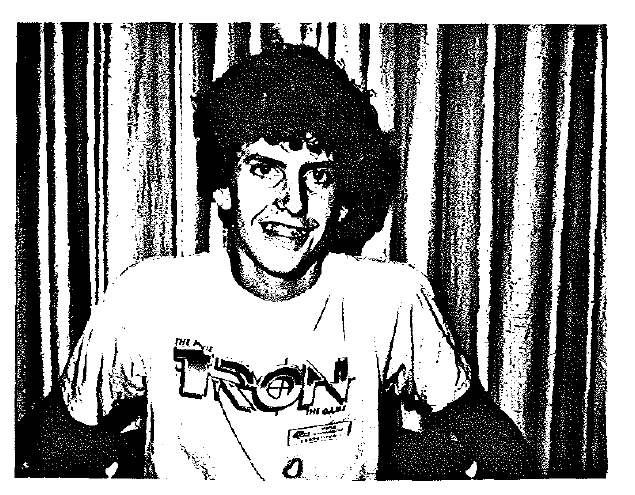
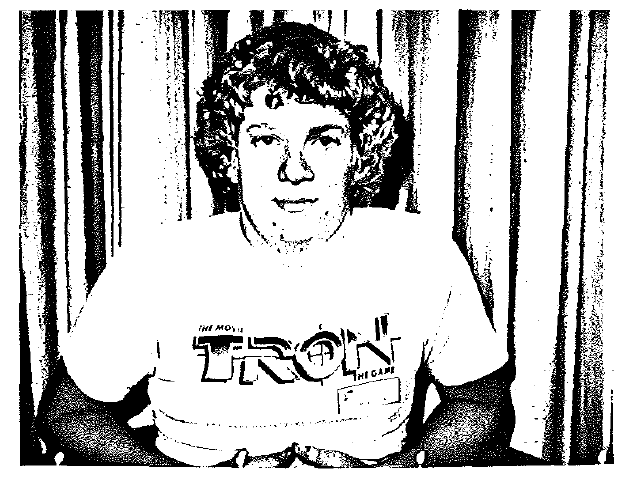
Back to the Tron tourney. The press kit had info sheets on each of the 16 finalists. I'm not going to post scans of the whole sheet, since it contained birthdates, but here are the photos:

Richard Ross:

Sterling Ouchi:


Scott Katkin:

Al Cooper:


Allan Watts: 

James E. Hatley:


Matthew John Collins:

Matt Gordon:

Mike Simmons:

Rick Storer:


Robert Withers-Morgan:

Scott McDonald:


Scott W. Starkey:


Steve Baker:


Tim Collum:


Walt Marchand:


And here is the cover of the press kit and some of the included press releases:


Finally, here are a few other interesting photos I've come across:

Here's one of Dave Nutting in 1973 (he's the one in the middle):


Here's one of director Steven Spielberg with a PSE Maneater game:


And here's one of Wilt Chamberlain looking at a Westlake Systems Grand Slam cocktail Pong game, which he was considering buying for his home.