Tuesday, October 15, 2013

What Was the First Cocktail Video Game (Redux)

Last November, I posted a preliminary report on the first cocktail video game: (http://allincolorforaquarter.blogspot.com/2012/11/preliminary-report-what-was-first.html)
 
Since then, I have gathered some more information and thought it was time for a follow-up.
 
So what was the first cocktail video game? I'm still looking into the matter, but here are the prime candidates I've identified so far:
 
Elimination/Quadrapong


Atari's Quadrapong is probably the game I've most-often seen identified as the first cocktail video game (at least among those with some knowledge of the subject - I'm not counting articles like the one that said Space Invaders was the first video cocktail).
 
Here's one example:
http://www.glasshotel.net/teleblivion/history.htm
 
But when, exactly, was it released.
 
According to the well-known Atari internal document available on the web, Quadrapong was released in March, 1974. The game, however, may have actually been on the market a bit earlier than that. A flyer appeared in Vending Times in January, 1974. But flyers often appeared in trade magazines a month or two before a game's release. The trademark registration for the game lists a "first use in commerce" of March 4, 1974 and a "first use anywhere" of January 1, 1974.
Of course, none of this really matters because Quadrapong was really just Atari's version of Kee's Elimination.


The Atari internal document lists Elimination as an October, 1973 release. I didn't find a trademark registration for Elimination under Atari or Kee, but I did find one for WCI Games, Inc. of Sunnvale filed 7/12/76. I'm guessing that "WCI" is Warner Communications, but am not sure. The registration gives a first use in commerce of 10/31/73 and a first use anywhere of 10/31/73. The October 6, 1973 issue of Cash Box announced that the game was (or would be, I don't have the actual issue, just my notes) sample shipping.
 
So, was Elimination the first cocktail video game?
Maybe not.
 
As I mentioned in my earlier post, I think there is some question as to whether it counts as a cocktail game at all given that it lacked the flat top where player's could put a drink and that seems to have been marketed at a game that you stood, rather than sat, to play and I think that the flat top and ability to sit while playing were almost defining characteristics of cocktail games.
 
Even if you do count it as a cocktail game, it may not have been the first.
Here are some other candidates:
 
Fascination, Ltd.
 
According to an article in the April, 1975 issue of Play Meter (a key source of information on this whole question), Fascination Ltd. of Des Plaines, Illinois claimed it was the first to market a video cocktail table.


Is there any merit to this claim?  
Fascination was founded in August, 1973 as National Computer Systems, Inc. by Bob Runte and Bob Anderson (in the latter's living room). 
Runte actually did file a patent for a cocktail video cabinet. Two of them, in fact.
  
The first was filed on July 17, 1974 for an "Amusement Device":http://www.google.com/patents/US3940136?dq=ininventor:%22Robert+Ralph+Runte%22&hl=en&sa=X&ei=UXucUOThBOuD0QGx6IDwAg&ved=0CEAQ6AEwAw

The second was filed on July 29, 1974 for an "Amusement Game Table":http://www.google.com/patents/USD237727?dq=ininventor:%22Robert+Ralph+Runte%22&hl=en&sa=X&ei=UXucUOThBOuD0QGx6IDwAg&ved=0CDcQ6AEwAA


The patent was filed in June, 1974, long after Quadrapong debuted (though he could have filed another patent earlier). Of course, patents - especially in these early years of the video game industry - sometimes weren't filed until months after the game was released.
So was this the case here?
 
Yes, it appears it was. That same April, 1975 article includes the following:


According to this article, then, Fascination Ltd. sold its first cocktail video game in October, 1973, the same month as Kee's Elimination. Which one came first? I don't know for sure (though if Elimination was sample shipping by the 6th, then it seems that it would have the better claim).
 
Of course, there are at least two other candidates.
 
National Entertainment
  
One intriguing possibility is a cocktail video game made by Atari for National Entertainment.
Once again, we look at the April, 1975 article:
 
 
This story is backed up by Nolan Bushnell himself in an interview in the June-July 1975 issue of Play Meter.
 

[Nolan Bushnell] We tried to sell cocktail tables clear back when and we were singularly unsuccessful through our regular distributorship organization. It was just a thing no one was ready for. We ended up building and selling some in Tokyo as early as mid-1973. The operators over there were a bit more aggressive and did rather well with it. But we could get no interest whatsoever in the states. So, we were approached by National Entertainment and we said, "Sure, we’ll build you a cocktail table."

Exactly when did all this happen? The April article says it was in "late 1973" but is no more specific. The Bushnell interview indicates only that it was some time after "mid-1973".
 
Several months back, I interviewed Doug Hughes, who says he actually worked on the game.
 
He doesn't remember exactly when the project started, but thinks it might have been as early as early/mid-1973 or even late 1972. In any event, his memory is that it was clearly before Elimination/Quadrapong.
 
The 1972 date is clearly far too early, and the mid-1973 date seems too early as well so Hughes' memory of the dates appears to be off. OTOH, from his memory of the details and people involved, he clearly knew of the game and was involved with it (at the time of the interview, I didn't even ask about cocktail games, much less about the National Entertainment game. In fact after he told me about it, I didn't even make the connection with the game from my earlier post until I went back and reread the April article in more detail).
Interestingly, Hughes also worked with Dick Januzzi later, after National Entertainment became Innovate Coin Corporation (Hughes worked on their game Spitfire).
 
There is one other piece of info I found that might support a mid-1973 date.
The following appeared in the March 22, 1975 issue of Cash Box.
 
 
This article says that National Entertainment was founded "almost two years" before March 22, 1975. Again, this is a bit vague, but would seem to indicate a date in summer, 1973, or possibly in very late spring. The article also indicates that National Entertainment put some games in the field very soon after Atari delivered them (assuming that Atari is the "leading video manufacturer" referred to) and even sold some before turning to Meadows.  
 
A search of the California Secretary of State's office reveals that National Entertainment incorporated in San Jose on 3/15/74, but this is of little help since the Pong game was created earlier.
 
So the evidence I have points to a date no later than "late 1973" but I can't pin it down more precisely than that. Given the evidence, it seems to me that there is a decent chance that the National Entertainment game was started before October and they may even have sold some before that date, but the data is just too inconclusive to draw a firm conclusion.
 
Atari's Japanese Game
 
But what about that cocktail game that Atari built and sold in Japan "as early as mid-1973", before National approached them? If Bushnell's dates are correct, that would seem to be a clear candidate for the first cocktail video game.
Doug Hughes actually remembers working on that game as well, but didn't recall the details.
 
And did Atari release the game under its own name, or did they license it to a Japanese company?
 
One very intriguing possibility is that they licensed it to Namco.
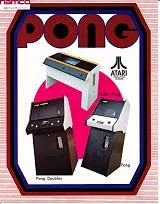
I came across the following flyer on a Japanese site devoted to Namco history.
Unfortunately, all I could find there was a tiny thumbnail and I've yet to find a better copy.


This appears to show a cocktail Pong game.
The flyer is not dated, but Pong Doubles came out in September, 1973.
Could this be the game Bushnell (and Hughes) was referring to?
Given Atari's relationship with Namco at the time, I can't imagine that they'd have licensed a game to another Japanese company.
 
I don't know if the game is the game Bushnell was talking about or not, but right now Atari's mid-1973 Japanese cocktail Pong (whenever it was released and by whom) is my leading candidate for first cocktail video game.

Pong-In-A-Barrel

Another leading candidate for first cocktail game is Atari's Pong-in-a-Barrel (not to be confused with the Australian-released Barrel Pong). This was a standard Pong game with the monitor placed face-up in an actual barrel.


Supposedly, only about 20 were produced and it doesn't appear to have been widely advertised (if at all) so some might see it more as a prototype than an actual release. It was apparently designed to be played sitting down, but given the height of the barrel and position of the monitor (which, in existing photos, appears to be at the bottom of the barrel), there is some question about this. There is also some question as to exactly when it was released. Nolan Bushnell reports that it was made early in Pong's production run, but exactly when is unclear. It was likely made in the first half of 1973.
 
 
Finally, I should mention a few games that I consider non-contenders.
TAFA lists Nutting's Table Tennis cocktail as a 1973 game, but this is almost surely incorrect (they similarly list Computer Space Ball as a 1972 game, while trade magazines don't mention it until mid-1973). The release of Table Tennis was announced in the June 1, 1974 issue of Cash Box and the game was not listed in their 1973 catalog issue, which listed the games released in the previous year (it WAS listed in the 1974 catalog).
 
I interviewed Andre Dubel, founder of Elcon Industries and he said that as far as he knew, Elcon was the first company to release a cocktail video game (he said he came up with the idea and had never seen it in a video game before). Unfortunately, I am unable to confirm this story and the evidence I have indicates that Elcon didn't start making video games until well after 1973 (the first reference I've found to Elcon is an announcement for their cocktail conversion kit in the June-July, 1975 issue of Play Meter.

Saturday, October 12, 2013

Photo Odds and Ends and Undocumented Games

Not much narrative this time, just some interesting photos I've found in various trade magazines:
 
May, 1978
 
 
Jews For Jesus was sued by Bally/Midway for infringement over this Pac-Man-themed religious tract.


From the 1978 JAA show. I like the Nintendo Shooting Trainer in the bottom row.
Courtesy Cash Box magazine.


A few scenes from "The Video Game" gameshow (short-lived follow-up to StarCade)


Some rare shots of a P.J. Pizzazz (Sega's answer to Pizza Time Theatre)


A few unlisted (or rarely listed) games:
 
 
UEP's Beam Shock


Here's another Kamikaze (I'm not sure who made this one - love that 'fro, though)


From Play Meter, January, 1976


Rare cabinet shot of Rock-Ola's Rocket Racer


Elcon's Diversions cabinet (1981)

From the 1975 MOA - Meadows Star Shooter video pinball game in a pinball cabinet. Never made it into production.
 

Another rare cabinet photo - Alstate's Battle Back


A couple of non-video games I found interesting:

From Play Meter, 6/15/80

From 1984


From April, 1976 - I don't think PSE ever released this one.


Tuesday, October 8, 2013

The Ultimate (So Far) History of Allied Leisure/Centuri - Part 4


1977 - Bankruptcy and Skateboard Parks
Financially, 1975 and 76 had not been good years for Allied. The company lost almost $700 thousand in 1975 and a whopping $3 million in 1976. Total revenues had declined to under $4 million per year. On March 4, 1977 (after a spate of lawsuits from angry creditors) the company filed for chapter 11. Only an almost $1 million loan from David Braun saved them from disappearing completely[1]. Allied attributed its bankruptcy to three issues: the production delay for Daytona 500, unanticipated service problems with their solid state pins, and their disastrous attempt to enter the consumer market.


            With Allied mired in financial difficulties, only a handful of games trickled off the assembly line in 1977, perhaps as few as three. Their most ambitious effort was Super Picker. Noting the success that Bally had seen with licensed celebrity-themed pins like Tommy and Capt. Fantastic, Allied marketing director Arnold Fisher decided to give the concept a try and inked Roy Clark of Hee Haw fame to a deal in 1976. Unfortunately, Roy Clark was no Elton John and Super Picker failed to take off. According to Allied's annual report they released just two "specialty arcade pieces" in fiscal year 1977 and they barely qualified as "released". Chase sold just 200 units and X-11 sold 120. The former was a first-person air combat video game in a sit-down cabinet that seemed quite advanced for its time. The debuted a third game at the AMOA in October, another huge (electromechanical) air combat game called Battle Station. They also released the gangster-themed pinball game Getaway Scott Cohen's Zap reports that Allied was designing a home backgammon game in 1977, but never marketed it (the company's annual reports don't mention it at all). Perhaps the most bizarre move in 1977, and a sign of their dire financial straits, was a subcontract to manufacture fiberglass skateboard parks (they got $13.5-20,000 per park and by early 1978 they had orders for about 25).


Aside (possibly) from Chase, Allied had not released a video game since early 1976. This may have been due to a lack of talent. On October 31, 1976 Allied had a staff of 20 engineers. By the time their 1976 annual report appeared, only 10 were left. One reason may have their video game designers began to slowly disappear. Upset with Dave Braun’s financial arrangements, Jack Pearson and Ron Halliburton left to form a design company of their own called Arcade Engineering[2]. When they needed employees, Haliburton and Pearson called Allied Leisure, who soon found themselves without a design staff.

Allied's bottom line didn't get any better during the year, but it didn't really get any worse either. For the fiscal year ending October 31, they lost $3.1 million on sales of $3.7 million. The news wasn't all bad however. On November 3, Allied was discharged from bankruptcy. They only way they were able to keep their head above water by striking an exclusive distribution deal with Fascination, Ltd. of Elk Grove Village, IL. . They also found themselves without one of their founders when Bobby Braun (who had been replaced as president by Morton Mendes in August, 1976) died suddenly on December 28th.

1978 - A comeback? - Allied's Cocktail Table Pins


Allied rebounded in 1978, thanks largely to another pinball innovation- the cocktail table pin. Like cocktail table video games, these games featured smaller playfields and allowed the player to sit down while playing. Cocktail pins had appeared as early as the 1930s but never really taken off. Allied had actually started making the games much earlier, but exactly when is uncertain. Their 1976 annual report claims that they made 800 cocktail pins (plus 300 microprocessor pins) to date (this figure included the first few months of 1977). In June, 1976 Play Meter reported that they'd shown a game called Spirit of '76 at a recent distributor meeting, describing it as a "tennis/pin cocktail". RePlay (2/77) reported that they had shown a "prototype of a video pingame in a cocktail cabinet" at the ATE in London in January. On August 12, 1977 David Braun and Ian Richter filed for a patent on a cocktail pinball cabinet. According to their 1977 annual report Allied had introduced a cocktail pin in April, 1977[3] and had sold 1,150 cocktail pins that year (compared to just 375 standard pins) and 3,500 to date. No trace of these machines, however, has turned up. The annual reports mentioned that they had an exclusive distribution deal with Fascination,Ltd. (the same company that had a 1974 patent for a cocktail video game cabinet) for the games and they may have been released under the Fascination name. That was the case with The Entertainer released in early fall. The Entertainer was another Roy Clark-themed pin, this time in a cocktail cabinet. When Arnold Fisher signed Clark to a licensing deal in 1976, he announced plans to introduce more games featuring the country star's likeness, including "coffee table" and cocktail models. He even planned on showing games at the Consumer Electronics Show. It appears that Allied wanted out of their deal with Fascination and wanted to produce The Entertainer themselves but they were mired I bankruptcy at the time and had to make the deal to stay afloat[4] (though they entered into another exclusive arrangement with Fascination in July, 1978). Allied's first pin of 1978 was actually a standard pin - March's Hoe Down (a non-licensed version of Super Picker). They followed in April with Take Five, their most successful cocktail pin, and according to most sources, their first.  Later in the year they debuted two more: Flame of Athens and Hearts Spades. Allied sold 4,290 cocktail pins in 1978. As for other games, there weren't many. In May they were appointed exclusive distributors for a pool table made by Champion Billiards. They showed two games later in the year - a water-pumping electromechanical game called Space Chip and a video game called Battlestar - but don't appear to have released them. They also licensed the projection screen rifle game Clay Champ from Namco but it wouldn't be released until 1979.  Thanks almost entirely to its pinball games, Allied actually turned a profit (of $3.2 million) in 1978 for the first time in five years.
1979: Back in the Red

            Allied's turnaround was short-lived. For those who looked beyond the numbers, this probably wasn't surprising. In 1978, for the first time, the company hadn't introduced an electromechanical game or a video game. They didn't do much better in 1979, releasing just two more cocktail pins: Disco '79 and Star Shooter as well as Clay Champ. While sales increased to $6.2 million in 1979, the highest total in since the Paddle Battle days of 1974,  Allied (once again) lost almost a million dollars ($154,000 of the total came from the settlement they paid to Magnavox).
Late in the year, Allied seemed ready to mount another comeback when they announced that they showed not one, but four new video games at the AMOA show: Battle Star, Clay Shoot, Lunar Invasion, and Space Bug. Of the four, the only one that was ever actually released was Clay Shoot, a video version of Clay Champ. By the time of the show, Allied was in trouble. While they had sold 10,000 cocktail table pins since introducing the concept in 1977, they had posted losses in five of the previous six years. Allied had released a number of innovative games over the years, including shakerball and cocktail pins, the video game Ski, and arcade hits like Wild Cycle, F-114 and Super Shifter. But while their products may have been long on innovation, they were short on reliability. In 11 1/2 years of existence. Allied had turned a profit just 3 times. Not for nothing did some refer to them as "Allied Loser".
The biggest news of 1979, however, was that the company had new owners. In a June 1 agreement, Brighton Products of Binghamton, New York acquired a controlling interest in Allied. Brighton was part of the KoffmanGroup of Industries, a conglomerate headed by Milton Koffman and his nephew Burton with a reputation for taking struggling companies and turning them around. As part of the agreement, Allied's officers and directors, including Dave Braun, resigned (though Braun would stay on in an advisory role). In 1980, the company would get new leadership, a new focus, and a new name. Only time would tell if they would get a new lease on life.


[1] Allied's annual report reports that Braun loaned Allied $215,000 plus an additional $85,000 for 1.6 million shares of stock.
[2] I'm not sure then the exodus bega. The 1976 annual report came out some time after March 2 (the SEC received it in September). Arcade Engineering may not have been formed until 1978.
[3] The seeming discrepancy with the 1976 report may be due to the fact that the 1976 report included the first months of 1977. While Allied's fiscal year ended on 10/31, their annual reports were generally prepared in spring of the following year, and often included information on the first quarter of the next year. The 1976 report, for instance, indicates that Allied resumed pinball production in November and that the cocktail pin wasn't introduced until that time or later.
[4] Fascination did release a number of Allied-designed pin uner their own banner in 1979, including Circa 1933. According to Allied's 1978 annual report , the Fascination agreement had accounted for 1/3 of total sales.

Tuesday, October 1, 2013

The Ultimate (So Far) History of Allied Leisure/Centuri - Part 3


1974 - Disaster Strikes
With the success of Paddle Battle and Tennis Tourney, Allied seemed poised to become a major player in the video game jungle. They had built more Pong games than perhaps anyone else and had streamlined their production process to eliminate waste. Then disaster struck. In January of 1974, Ron Haliburton traveled to London to attend the Amusement Trades Expo. When he stepped off the plane back in Florida, he was hit with a bombshell. On January 31, Allied’s manufacturing plant had been struck by a devastating fire. While the fabrication plant was virtually undamaged and the woodworking shop completely untouched, half of their headquarters and manufacturing facility was destroyed and production ground to a complete halt.
[Troy Livingston] It was arson. [They had] 5-gallon glass containers of gasoline. We had two compressor rooms…One of those was thrown in each compressor room on opposite sides of the building at Four O’clock in the morning and it burned to the ground… The fire burned down three square blocks of buildings. We literally then went from a burned-down building [and] 90 days later we were back in full production building the same quantity of TV games.

Other sources cite an electrical malfunction as the cause of the fire. Whatever its cause, the fire was a financial catastrophe. Due to insufficient insurance coverage (and some industrial doors that failed to release), Allied suffered half-a-million dollars in losses (and over $1.5 million in total damages) from the fire, not counting the downtime.


Thankfully, they weren't down for long. On March 1 they moved into a new 40,000-square-foot headquarters and manufacturing plant and in April, just 90 days after the fire, Allied was back in full production. The only problem was that URL now had an over-supply of boards . In an effort to use up them up, Allied quickly churned out a pair of new ball-and-paddle games. Hesitation (April) was another soccer game and Zap (October) was a Ping-Pong game that allowed players to move their paddles horizontally as well as vertically. Neither game, however, matched the success of Paddle Battle. By 1974, the video game market had softened considerably in the wake of the Pong glut and Allied soon began looking for greener pastures.

They announced plants to reenter the pinball market they'd abandoned in 1973 and to enter a brand new market - gambling. The Gambling Devices Act of 1962 amended the Johnson Act to permit states to allow the manufacture of gambling devices for sale outside the state. Until the early 1970s, the only state to have taken advantage of the act was Illinois and for nine years the only coin-op company to enter the market was Bally. Then Seeburg dipped their toes in the water. Allied had wanted to enter the market for years, especially when research revealed that 2/3 of states were considering legalizing gambling. They could do nothing, however, until Florida amended their laws. When they finally did, Allied quickly announced plans to produce their first slot machine.

Despite all the new plans, it was good old fashioned electromechanical arcade games that remained Allied's bread and butter in 1974 as they released three new pieces during the year. Knock Out (August) was a twin-rifle game Chopper (October), was another motorcycle game. The player sat on a simulated motorcycle while steering a plastic toy model along a track. Unlike Wild Cycle and other driving games, however, this one didn't use a projection screen. Instead the player "drove" along a non-moving track while flashing strobe lights simulated the effect of speed.
 
 
Their biggest hit of the year, however, was May's Super Shifter. The gameplay was basically the same as Chopper, but there were two key differences. First, instead of a motorcycle, Super Shifter featured a glowing plastic corvette. Second, the game shipped in a sit-down cabinet complete with racing seat. Chopper and Super Shifter seemed to be more exhibitions than games, but they were surprisingly fun. The emphasis was on realism, with a tachometers, a digital speed readout, Christmas-tree starting lights, revving engines, and flashing lights. The game was so popular that it was put into production a second time after the initial run of 3,000 sold out. In the April, 1977 issue of RePlay, a panel of experts voted on the best arcade pieces of all time. Three of the five put Super Shifter among the top ten. Troy Livingston tells of a humorous incident about a bomb threat Allied got while the game was in production. When Livingston called the Hialeah police department and told them to send their bomb squad, they hung up. They didn't have one. Bravely, Livingston made his way to the Super Shifter cabinet containing the alleged bomb As he began to open the cabinet Ron Haliburton, who had staged the whole thing, tossed a cherry bomb behind him and watched with glee as the "bomb" (and Livingston) went off.
While Allied made a respectable $7 million in revenue in fiscal 1974, they lost $266,000 due to the fire and the market downturn. On the other hand, they had survived a disaster that could easily have spelled the end of the still-relatively-young company. Only time would tell in 1975 would be any better.

1975-76: Video and Arcade Games
            Despite plans to curtail video game production, Allied produced (at least) five new titles in 1975 and early 1976. Robot (February, 1975) and Fotsball (March) were ball-and-paddle games, though the latter (a video version of foosball) came in an innovative stand-around cabinet. Allied finally got around to producing video versions of the two arcade game genres that had been putting bread on their table for years.


Street Burners (May, 1975) was a driving game while Ace (March, 1976) was a two-player aerial combat game in which each player controlled a biplane and tried to shoot down his opponent. When a player’s plane was hit, he bailed out and unscrupulous (or morbid) players could shoot helpless opponents as they slowly descended in their parachutes.  Fire Power (January, 1976) was a tank vs. airplane game that some say was one of the earliest video games to feature scrolling. Ski was one of the more inventive of the video games released in the late 1970s (though there is some question as to whether it actually was a video game). The player stood on a pair of footpads while gripping a pair of ski poles. By twisting her body she could move the footpads and control the direction in which the on-screen skier was travelling while the ski poles could be used to control speed. As the player shooshed down the slopes, they were serenaded by alpine music. RePlay reported that the game did especially well in ski resorts in New York.


Allied produced only one electromechancial arcade game in 1975, but it was a doozie. The "fabled" (as RePlay later described it) F-114 (June) was an absolutely gargantuan projecting screen air combat game that put the player in a swiveling seat, facing an ginormous screen while blasting away at enemy jets. Allied's sole arcade effort of 1976 was Daytona 500, another outstanding sit-down projection screen driving game. Manufacturing problems, however, pushed its planned May release to June and affected sales projections
An Unusual Departure (or two)


In January, 1975 Allied entered into an agreement with another company (probably Advanced Patent Technology[1] of Nevada, who sued them in 1978) to begin development on a solid-state slot machine. In 1976, Allied introduced one of their oddest and most expensive products - the AstroPrint photo booth. In development since 1975, the machine printed computer-generated portraits of patrons. While paying money for a low-res, pixilated, "photo" from a dot matrix printer might seem downright loopy today, at the time the units were all the rage. When Allied debuted the unit at the Circus Circus casino in Las Vegas, the line extended all the way around the mezzanine. Almost no one lined up to buy it however. By the end of 1976, they'd sold only 20. Maybe it was the $12,500 asking price. Hoping to do better, the company hired two salesmen just to market the unit but by 1977 it, along with their ill-fated slot machine venture, appear to have gone by the boards.
1975/76 - Solid State Pinball


Allied's most significant move in 1976 was its reentry into the pinball market. The move had actually started in late 1975 with the introduction of Dyn-O-Mite, the company’s first traditional pin. One thing about the machine, however, was anything but traditional. Dyn-O-Mite was the first successful solid-state, microprocessor-based pinball game. Unlike shakerball, Allied’s earlier pinball “innovation”, solid-state pins would catch on. Indeed they would completely transform the industry. Companies like Atari and Bally had produced experimental pins with microprocessors as early as 1973 but none ever made it past the prototype stage. At the 1975 MOA show in October, a small company from Phoenix called Mirco Games, best known for its foosball tables, introduced a pinball game called Spirit of ’76 which is generally considered the first microprocessor pin to have been commercially released.  Mirco’s game may have been innovative, but it sold less than 200 units (partly due to its uninspired playfield and backglass art). Dyn-O-Mite proved much more popular. The playfield featured the stylized likeness of Jimmie Walker, the rubber-faced young star of the sitcom Good Times uttering his catch phrase “dyn-o-mite!”
While Dyn-O-Mite made its debut around the same time as Spirit of ’76, however, the Mirco game has generally been given precedence. There is evidence however that Allied may have beaten them to the punch. In addition to the two-player Dyn-O-Mite, Alled released a four-player version called Rock On, which may have been released as early as September, 1975, a month before Spirit of ’76 debuted at the MOA show[1]. At the time, Allied had actually been working on solid-state pins for months, perhaps even years and may have been the first company to fully commit to the concept. Development of Dyn-O-Mite was underway by April of 1975, when a prototype version was shown to distributors[2], and even that may not have been the company’s first stab at solid-state pins. In Brian Bagnall’s Commodore: A Company on the Edge Chuck Peddle, reveals that he had visited Allied while trying to drum up customers for his 6502 microprocessor. Created by Peddle at MOS Technology, the 6502 would be used in a number of early personal computers, including the Apple II, Atari 800, and Commodore PET. At the time of Peddle’s visit, Allied was talking with a number of microprocessor companies with an eye toward investing in the new technology. To convince them that the 6502 could be used in coin-op games, Peddle volunteered to build them a microprocessor-based pinball game. Working through the night and sleeping on a mat at Allied during the day, Peddle created a prototype and showed it at the National Computer Conference. Bagnall does not name the machine, mention anyone else working on it, or give a date (though it seems to have occurred sometime in 1975, the year the 6502 was introduced). While this could have been Dyn-O-Mite or Rock On, it seems unlikely. Troy Livingston described another early Allied attempt at a microprocessor pin.


[Troy Livingston] Allied Leisure actually was the first company to build a solid-state pinball machine. Bally patented it first but Allied Leisure actually built the first totally solid-state electronic pinball machine. We built 13 units and it took about 18 months to build. They were solid PC boards. It was the first totally electronic pinball machine ever. It was a disaster.

[It used] 7400-series TTL chips. I don’t know how many chips it had in it but it probably had 10 square feet of PC boards – literally. The entire inside of the cabinet was lined with PC boards. It was so expensive; we could have never made it on a production basis. Also, you just couldn’t keep it working. There was very little in the way of signal-level connectors available in those days...or they were for the fledgling space industry and were like $1000 each. So we were literally having to make our own connectors. Now you go to AMP and you buy a nice connector but in those days it didn’t exist.

Then the microprocessor… came out.  Luis Sanchez and a couple of the other guys learned how to use it and designed the first processor-controlled pinball machine and manufactured it. We didn’t file patents on it, but I had machines sitting on the floor before Bally’s patent.

The prototype was designed by Ian Richter, another former NASA engineer. So should Allied be considered the father of the microprocessor pin? Probably not. Peddle’s game likely came well after Atari’s Delta Queen or Bally’s Flicker prototypes and there isn’t enough information to date Richter’s game (assuming, that is, it isn’t the same game mentioned by Peddle).

Chuck Peddle at Allied


Chuck Peddle at Allied
       The most innovative thing that came out of Peddle’s prototype project, however, had nothing to do with pinball. While working on the game, he had befriended Allied engineer Bill Seiler. Personal computers were just appearing on the market and Seiler ordered a kit computer from a Denver company called The Digital Group. In 1975, The Digital Group began selling what they called the “Cadillac of Computers” - a kit system that offered users a choice of four CPUs and included cassette, video, and keyboard interfaces. While it was much easier to use than the Altair 8800, there was no real software available for it and after Seiler got his unit up and running he was hard pressed to find something to actually do with it. Seeing Seiler’s enthusiasm for the product, despite its obvious shortcomings, Peddle realized there was a market for personal computers and after completing his pinball game, he returned to MOS Technology and began working on the Kim 1, an inexpensive, user-friendly PC based on the 6502 that was released in 1976. Before leaving, Peddle promised Seiler that the two of them would one day design a personal computer together. When he later moved to Commodore and began working on the PET, he made good on his promise and brought Seiler in to work on the design.

Pinball Problems

          Despite their promising start, Allied’s reentry into the pinball market ultimately proved unsuccessful. They sold just 1600 pins in the 1976 fiscal year. State-of-the-art technology or no, Allied had little experience designing pinball games. When they put their first game on test, for instance, they were surprised when they arrived at the test location to find the playfield covered in black streaks. They had used a chrome plated ball - something pinball designers didn't do because, well - it left black streaks on the playfield. The real issue, though, was reliability. The games were plagued with technical glitches (the most serious of which was a balky digital scoring unit). Cancelled orders poured in, damaging Allied's relationship with its distributors. In June, they cut back substantially on the pinball production (they resumed production in November), leading to an even more fateful decision.


Entering the Consumer Market


In June, after the pinball sales fell off, Allied decided to enter the home video game market. Projecting sales in excess $1.5 million for the upcoming Christmas season, Allied produced two home units (though it appears that both were actually produced by URL under contract). Name of the Game I was a $67 four-player game that offered the choice of four ball-and-paddle games and two target games (via a gun controller). Name of the Game II was cheaper ($45) two-player version. They quickly lined up order for 60,000 units - over $3 million worth. Once again, however, most of the orders were cancelled - this time because of shipping delays for a key component and because FCC approval of the game, which was scheduled for September, was delayed until December. Allied also had commitments to buy parts for 25,000 units. In the end, Allied built only 17,000 units and Christmas sales totaled only $350,000. They sold another $320,000 worth in fiscal year 1977 but still had 4,000 units in inventory, which they ended up dumping for as little as $15 apiece. And they probably didn't even get to keep all of theat. To rub salt in their wounds, Magnavox brought suit against Allied for patent infringement. Allied signed a deal promising Magnavox a 1.25% royalty on future arcade product sales (except pins) up to $225,000, plus a maximum base royalty of 4.75% on sales of products covered by the Magnavox patents, and a maximum base royalty of 6% on sales of home products covered by the patents - including, of course, Name of the Game.


[1] Advanced Patent Technology later, after name changes, became Alliance Gaming, who bought Bally Gaming International in 1996 and changed its name to Bally Technologies in 2006.
[1] The Internet Pinball Database lists this release date, but gives no source and I have been unable to confirm it. The release date for Spirit of ’76 is also uncertain (Internet Pinball Database simply lists “1975”
[2] Play Meter, November, 1976.
[3] Some claim that Sega Japan may have produced solid state pins (such as Millionaire, Big Kick, and Adventure) even earlier.


BONUS SECTION
 
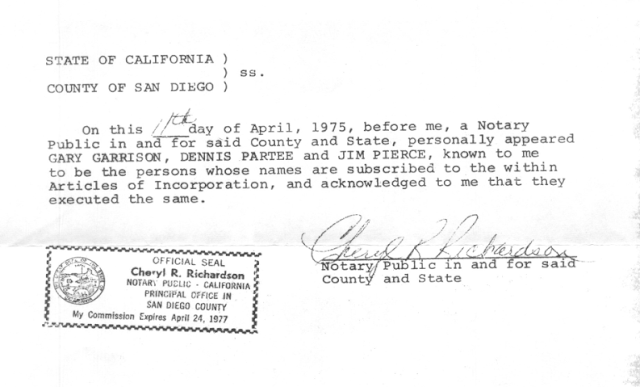
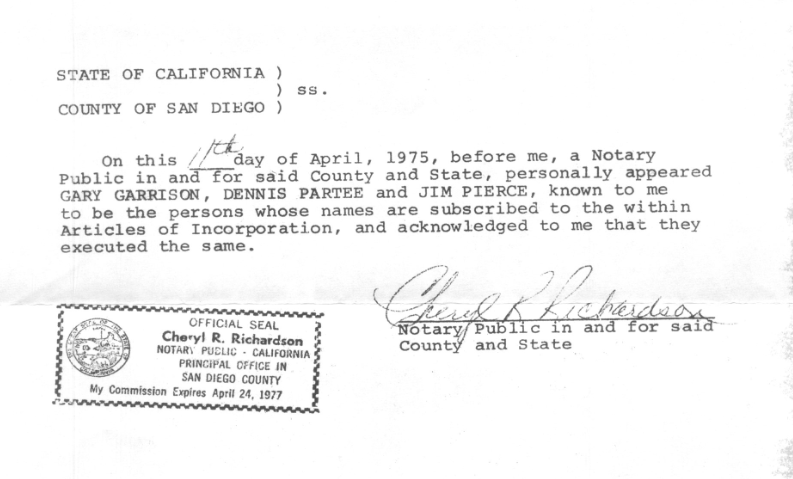
Recently, I ordered a copy of the articles of incorporation for Cinematronics and Exidy.
 
Here is the one for Cinematronics. Not much of interest. The main thing that struck me was the date. Earlier, I had speculated that Jim Pierce may not have joined the company until May, 1975 or after, based on a help-wanted ad the Partee and Garrison ran in various papers. This document, however, was notarized on April 11, 1975 and Pierce was already onboard at that time (though it may have taken them awhile to discontinue the ads).