Tuesday, September 15, 2015

1982 Tron Tournament Press Kit and Other Tourney Photos


After my recent post on the 1982 TRON Tournament, someone  (who goes by the name Joe Zydeco) was kind enough to send me a scan of the press kit that Bally created for the tournament. I thought I'd share it with you in case anyone else had use for it. Thanks to the original sender.

But before we get to that, I wanted to post a few interesting photos I've come across recently.
I recently had a chance to look at about 30 issues of a fairly obscure (or at least hard-to-come-by) arcade operators newsletter called Games People Pay (later renamed Games People).
Some of the issues had photos from two of the early major video game tournaments I posed about earlier: the $10,000 California State Championships of late 1981.

There were two of them, held within three months of one another. Both were billed as state championships and both had a $10,000 prize fund.

The first was run by Silco-West and held in 350 of their locations (including 300 7-11s) over several weeks with the finals held on August 29. It was won by John Conley. Here are two photos from the tournament and a picture of the entry poster that was posted in each participating location:


The second tournament was run by Recreation Station (an Anaheim distribution and service company) and sponsored by Stop N Go with the finals .on December 18 and 19, 1981. Here are some photos of the winner: Jeff Davis (by the way, if you didn't know, Matthew Labyourteaux was a dedicated gamer and was ubiquitous at California video game tourneys back in the day). 


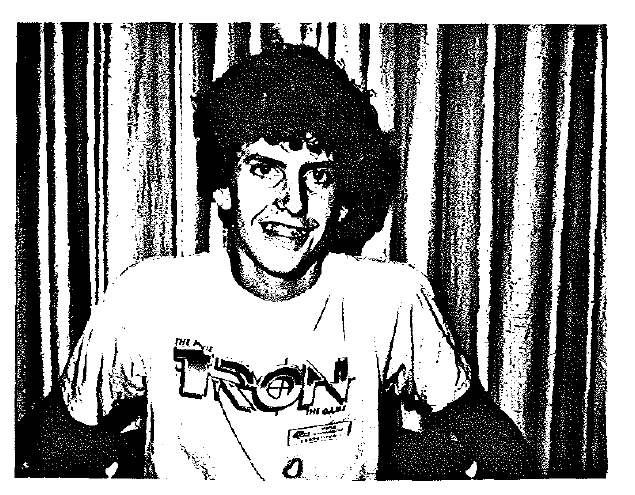
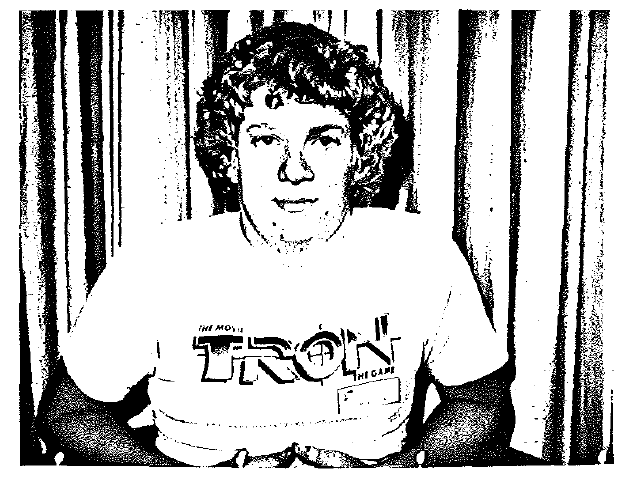
Back to the Tron tourney. The press kit had info sheets on each of the 16 finalists. I'm not going to post scans of the whole sheet, since it contained birthdates, but here are the photos:

Richard Ross:

Sterling Ouchi:


Scott Katkin:

Al Cooper:


Allan Watts: 

James E. Hatley:


Matthew John Collins:

Matt Gordon:

Mike Simmons:

Rick Storer:


Robert Withers-Morgan:

Scott McDonald:


Scott W. Starkey:


Steve Baker:


Tim Collum:


Walt Marchand:


And here is the cover of the press kit and some of the included press releases:


Finally, here are a few other interesting photos I've come across:

Here's one of Dave Nutting in 1973 (he's the one in the middle):


Here's one of director Steven Spielberg with a PSE Maneater game:


And here's one of Wilt Chamberlain looking at a Westlake Systems Grand Slam cocktail Pong game, which he was considering buying for his home.


Sunday, September 6, 2015

The 1982 Wizard vs. Wizards Tournament - eSport's forgotten competition

Today’s post completes my recent trio of computer game posts (don’t worry. I’ll get back to coin-op games soon enough) with a look at one of the most interesting and little-known “video game” competitions of the 1980s – the 1982 “Wizard vs. Wizards” computer game tournament. I’ve actually briefly covered this one before but thought it merited a full post. Despite the fact that the competition was covered in Steven Levy’s 1984 classic Hackers, however (it even provided the title for chapter 20), there is almost no information on the web about the contest, its organizer, or its participant. Luckily, however, it was covered in some detail by both Softline and Softalk.


So what was Wizard vs. Wizards? It was a competition between twelve different computer game programmers that was held at the Comdex show in Las Vegas in December 1982. And get this – it was supposed to be televised as the first event in what the organizer would sure would become the spectator sport of the 1980s. While it was filmed, however, I don’t know if it was actually televised. If it was, it likely would have appeared several months before Starcade broadcast its first episode (though well after the first Starcade pilot was filmed). It was also yet another episode in the sadly-neglected early history of eSports.


Wizard vs. Wizards was the brainchild of Tom Tatum. According to Levy, Tatum was a former “lawyer, lobbyist, and Carter campaign aide, [who was] now a leading purveyor of video “docusports” programming.” His earlier efforts in this new arena (according to Levy), included the 1981 Maui Windsurfing Grand Prix and the Telluride Aerobatics Invitational. Unfortunately, a brief web search turned up little information on either event. Levy also indicates that Tatum may have been involved in BMX competitions, which makes me wonder if he is the same Tom Tatum who wrote and produced the 1987 BMX film Winners Take All. In any event, back in 1982 Tatum got the idea that video games had the makings of the next great spectator sport (as we have seen in other posts, he wasn’t alone). Noting the popularity of video game tournaments, Tatum wondered how many people would want to see the real “pros” compete. By “pros,” Tatum meant the actual game programmers (that Tatum thought the game programmers were the real gaming “pros” was only the first of many problems with his concept). Tatum’s idea was to get top computer game programmers together for a televised computer game tournament. The tournament, called the “Wizard vs. Wizards” personal computer game world championships, was held on December 3, 1982 at the Comdex computer industry trade show in the Las Vegas Sands. Ever the optimist (or at least promoter), Tatum referred to the event as “the event where Hollywood meets the computer age” and “the ultra-contest of the eighties.” He referred to the programmers as the “new stars” and opined that “the sizzle in this show is the double-whammy” of the programmers competing against one another on their own games.


Unfortunately, the tournament does not appear to have gone well. It was originally supposed to be sponsored by Atari, but the company pulled its sponsorship just two days before the event, forcing the organizers to buy twelve Atari 800 computers from a local store on their own dime. Fortunately, Apple stepped in and agreed to take over as sponsor, providing a dozen Apple II’s The night before the event started, the team from Datamost had to break the copy protection on their game so that they could provide the requisite copies (“Nobody told me I was going to need 11 disks” wailed VP Sandy Wivott). Jim Nitchals wanted to enter his latest game, but it was rejected as unfinished, forcing him to enter a different game instead. The tournament was hosted by Catherine Mary Stewart. Yes, the same Catherine Mary Stewart that would go on to co-star in The Last Starfighter (at the time, she was mostly known for her role on Days of Our Lives). Stewart started off the tournament proper by flubbing her opening line and required fifteen takes and some hastily-prepared cue cards to get it right. After that, the tournament got underway.


The twelve programmers (with their best known games) who entered the tournament were (note that I include games created after the tournament):

Jim Nitchals: Microwave, Bug Attack, Asteroid Field, Star Thief, Teleport, Ring Raiders (Cavalier)
Dan Thompson: Repton, Twerps (Sirius)
Mark Turmell: Turmoil, Sneakers, Beer Run, Free Fall. Fast Freddie (Sirius/Fox)
Bob Flanagan: Spectre, Thief, Speedway etc. (Datamost)
Jay Zipnick: Pig Pen (Datamost)
Peter Filberti: Night Raiders (Datamost)
Steve Bjork: Canyon Climber (Datamost)
Gerry Humphrey: Clowns and Balloons (Datasoft)
Russ Wetmore: Preppie, Preppie II, Sea Dragon, Savage Island Pt 2  (Adventure International)
Chuck “Chuckles” Bueche: Jawbreaker II, Pacific Coast Freeway,  Lunar Leeper, Laff Pak, Caverns of Calisto, Autoduel, 24000 AD (California Pacific, Sierra On-Line, Origin)
Ken Williams: Various (Sierra On-Line)
Joe Hellesen: Wizard of Wor (Roklan)

Broderbund was too busy working on the Atari ports of Choplifter and Serpentine to send any representatives.  The twelve programmers would square off on twelve different games, one from each programmer, with the first six played on Atari computers and the last six on Apples. The twelves games were the first games listed after each programmer above (Ken Williams’ game was Threshold). After playing each game for five minutes, points were awarded based on their ranking in each game. The top four then moved on to three semifinal games on an Apple with the top two switching back to Atari games (chosen at random by a DEC Rainbow computer) for the finals.


Sirius – who had sent a team of five programmers and executives, clad in personalized red sweat suits - dominated the preliminaries, with Dan Thompson and Mark Turmell holding down first and second place most of the way. In a (very) minor controversy, the Atari joysticks were replace with Wico Command Controllers partway through the prelims.


Thompson and Turmell were joined by Russ Wetmore and Jim Nitchals for the semi-finals. Once again, Sirius appeared dominant at first with Thompson and Turmell getting out to an early lead. Nitchals, however, finished second in all three games and edged out Turmell for the second spot in the finals. The finals pitted Nitchals against Thompson. In an effort to maintain the suspense for the planned April airing of the program, the organizers tried to obscure the scores with duct tape but it didn’t work. The actual finals were a bit of an anti-climax. Nitchals knew he was cooked when the computer picked three games at which he had fared poorly in earlier rounds (Clowns & Balloons, Canyon Climber, Wizard of Wor) and Thompson’s victory was cinched when Nitchals lost his game before time expired in the second round while Thompson played for the full five minutes. In the end, Thompson prevailed. For his efforts, Thompson received a DEC Rainbow and an Atari 800 while both he and Nitchals received an Amdek monitor, three joysticks, and $500 in cash.


As I mentioned earlier, I’m not sure that the event was ever televised – though the fact that Levy quoted from interviews with Thompson makes me think it was. Unsurprisingly, it did not launch the revolution that Tatum thought it would. The problem, which you think would have been obvious, was that watching computer programmers playing computer games just wasn’t all that exciting. Shocking I know, but the real wonder to me is that anyone ever thought it would have been. I can see (sort of) how someone would  have thought coin-op arcade games would make for interesting viewing (though even Starcade had to do more than just have people playing games) but computer games in 1982? I played plenty of computer games in the 1980s, but even I have to admit that they didn’t make for scintillating TV. Even loopier, to me, was the idea of having programmers playing the games. To the extent that Starcade worked, I think it did so because they mostly had kids playing the games. If they’d had designers and programmers playing, I don’t think it would have gotten past the pilot (though Eugene Jarvis would probably have been entertaining). If you’re going to have programmers playing, at least make it a pro-am in which they’re teamed with gamers. Personally, of course, I would have loved Wizard vs. Wizards but I’m not exactly representative of the general public. In any event, however, if this event was televised, I would sorely LOVE to see the video so if anyone knows where I can find it, please let us know.


Friday, August 28, 2015

Nasir Gebelli and the early days of Sirius Software


In my last post, I made mention of Apple II game programmer Nasir Gebelli. Today, I will take a closer look at Nasir, his work at Sirius Software and Gebelli Software, and the founding of Sirius. Unfortunately, information on Nasir is pretty sparse and he appears to be a bit of a recluse (though he seemed quite willing to talk when John Romero tracked him down in 1998). I do not have much to add to the little that is already out there, but thought I'd report on what I did find. Nasir has become something of a minor legend among Apple II gaming fans, primarily because he wrote a number of early action games for the Apple II featuring animation that was a cut above the competition. Part of his legend may also be due to the fact that id Software co-founder John Romero was a huge fan of his - a fact he has mentioned on multiple occasions. In the book Honoring the Code: Conversations with Great Game Designers, for instance, Romero gushed, "Nasir Gebelli is my favorite. He's my number one programming god, my idol. He's awesome." So what was Nasir’s story and how did he get his start?


Nasir was born Seyed Nasir Gebelli in Iran. While a number of sources claim that he was born in 1957, public records indicate that he was born in February 1954. At some point, he moved to the US to study computer science at Cal State[1] (Kohler 2005). According to a profile that appeared in April 1981 issue of Softalk, Nasir began programming on an Apple II "out of desperation" when he found that other computers didn't allow him to do what he wanted to - to input code in machine language and see the results immediately. Nasir bought his first Apple about a year before the profile appeared and it seems that he quickly became proficient with it and began programming games. Around spring of 1980, perhaps because he was doing poorly in classes (Levy 1984), Nasir took some graphics utilities he'd written to a Computerland store in Sacramento and demoed it to the owner(s) (Levy 1984; Carlston 1985). It was the start to an auspicious and prolific, if short-lived, career.

The Founding of Sirius Software


The Computerland store had been opened in late 1979 by a retired Air Force colonel named Terry Bradley. Bradley, who had a master's degree in management from Golden Gate University, had honed his management skills while working as an airlift director for the Air Force. Unsure if he could hold onto a civilian job and unwilling to risk losing his retirement benefits, Bradley spent 21 years in the Air Force until he retired in 1979. After leaving the Air Force, he began looking for a new career. He briefly considered becoming a real estate broker and even got a license, but quickly decided that it was not the job for him. What he really wanted to do was to own his own business. Toward that end, he visited the library and began researching franchise opportunities. He decided to open a small print shop, reasoning that the risk and required investment would be low. He changed his plans again, however, after he saw an ad for Computerland - a chain of personal computer retail stores that had been founded in 1976. Intrigued, Bradley visited a local Byte Shop to see what running a computer store was all about. Liking what he saw, he approached Computerland with a proposal to open a new store in Sacramento. Computerland agreed and in late 1979, Bradley opened his store. (Softalk July 1982)


In the spring of 1980, Bradley hired a Vietnam veteran and insurance executive named Jerry Jewell as sales manager. Like Bradley, Jewell had served in the military and worked as an executive, but according to Bradley, the similarities ended there.

[Terry Bradley] "Jerry and I come from completely different backgrounds and are ten years apart in age. There’s only three things we have in common. We’ve both been in military service, we both like our meat raw, and we have sympathetic views on the way to run Sirius." (Softalk July 1982)

Before coming to Computerland, Bradley had worked as a special agent and an account executive in the insurance industry. In 1979, hoping to switch to a more lucrative career, Jewell bought an Apple II and decided to learn some rudimentary programming skills. About two weeks after buying his computer, Jewell enrolled in a class in assembly language programming at the Lawrence Hall of Science - a public science center/museum established by the University of California at Berkeley. The class was taught by Apple's Andy Hertzfeld, who would later design the Macintosh system software. Assisting Hertzfeld was hacking legend John Draper, a.k.a. "Captain Crunch." With no disk drive, Jewell was unable to run the sample programs that Hertzfeld distributed to the class and for eight weeks, he was lost, not understanding a thing Hertzfeld was saying. Eventually, however, he got a disk drive and was able to catch up by listening to tapes he had made of the classroom lectures. In the spring of 1980, Jewell went to work for Bradley in his Computerland store. While the store sold some home and business software (like Easy Writer, an early word processor written by John Draper), most of the people who came in were writing tools or games of their own, which they were only too eager to demonstrate. (Levy 1984)

One of them was a struggling college student named Nasir Gebelli, who walked in one day with a disk containing a set of graphic utilities program he had written that made it easier to draw shapes on the screen. Gebelli, who had purchased his Apple just a month and a half before, demonstrated his program not long after Jewell began working at the store. Initially, Terry Bradley thought that the program was merely "OK" and asked to keep the disks for a day or two. A few days later, Nasir returned, certain that they'd be impressed once they actual saw his work, and demanded, "What do you think of it now" (Softalk July 1982).  Bradley, Jewell, and Nair decided to go into business together and in May 1980 they formed a company called Sirius Software with Bradley as president, Jewell as secretary-treasurer, and Gebelli as the sole fulltime programmer. 


Nasir, Jerry Jewell (seated), and Eric Knopp

For their initial offering, Jewell and Nasir worked together to develop Gebelli's demo into a graphics program called E-Z Draw (billed as "the poor man’s graphics tablet"), which Jewell began to peddle to computer stores in Los Angeles and the Bay Area (it is unclear if this happened before or after Sirius was formed). Before long, however, they turned to games. Nasir may have been Sirius’ only programmer, but he was a prodigious one. While he may not have produced 12 games for Sirius in his first year, as Steven Levy reported, he did create at least eight (Levy may have been referring to the number of games he made with Sirius and Gebelli Software, or Sirius may not have released all his games - or Levy may have been mistaken). In any event, it was am impressive feat. At a time when most programmers took months to write a program, Nasir was cranking them out in mere weeks. And these were not text adventures or simple BASIC games, but arcade games - always a challenge with the Apple II.

Levy reports that Both Barrels was Nasir's first effort (though some list it as a 1981 game). If so, it was an inauspicious debut. Things improved with Nasir's other 1980 creations: Star Cruiser, Cyber Strike, and Phantoms Five. All three were similar to games Nasir played in the Sacramento arcades he haunted. While produced by Sirius, it seems that at least one of the games (Star Cruiser) was initially distributed by Synergistic Software. If so, this may have been because Jewel and Bradley (who thought the money was in hardware rather than software) were still working at Computerland during the day while running Sirius in their spare time.

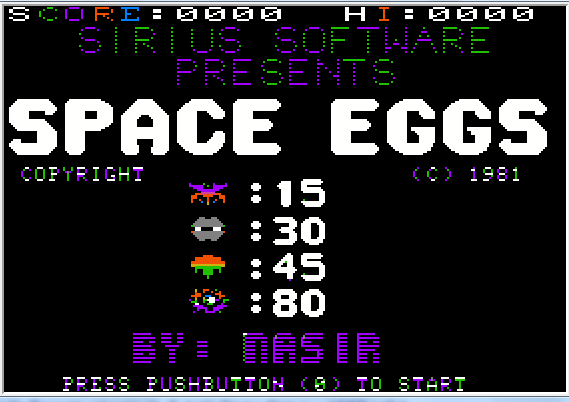
That would soon change, however. In November 1980, Sirius Software was incorporated in Sacramento and in December, the company made its first appearance on Softalk's bestseller list when Star Cruiser debuted at #3, behind VisiCalc and On-Line System's Wizard and the Princess graphics adventure. The next month, Star Cruiser (which was still at #3) was joined by Cyber Strike (at #6) and in March, they were joined by Phantoms Five. By then, to Jewell and Bradley's surprise, Sirius was doing well enough to be a fulltime business and in May 1981, the two sold their Compterland store. That same month, Sirius had its biggest hit yet when Space Eggs supplanted VisiCalc at the #1 position on Softalk's bestseller list. A takeoff on Moon Cresta, Space Eggs had started as a cosmic shell game until Jewell suggested that Nasir replace the shells with eggs.

[Nasir Gebelli] "It had gone from weird, to weirder, to weirdest. Yet it is the only game I’ve written that I continue to play because it’s so unpredictable. That is probably one reason why people are so compulsive with it. I was both pleased and a bit scared when I witnessed the sight of my old roommate shooting at those shells – I mean eggs – for six hours straight." (Softalk April 1981)

In August 1981, Sirius placed an astonishing six titles among Softalk's 30 bestsellers: Gorgon at #3 (which sold at least 23,000 copies in a year), Space Eggs (#7), Pulsar II (#14), Autobahn (#14), Orbitron (#18), and Gamma Goblins (#26). All but the last two were written by Nasir Gebelli. So what was the secret to Gebelli's success? One was his talent for creating faster, smoother animations than anyone else was capable of on the Apple II (which was probably not really a great platform for arcade/action games). Nasir achieved this via a technique called "page flipping" in which two pages of animation were switched back and forth several times per second to reduce the flicker that plagued other games. It does not appear, however, that he started using the technique until his later games. In his April 1981 Softalk profile, Nasir mentions the technique as something he planned to use in the future. Nasir was also famous for not taking notes while programming or writing out his code.

[Nasir Gebelli] " "Ninety percent of the work involved in realizing the game on the screen is in my head. Virtually all my ideas are worked out before I commit the work to disk." (Softalk April 1981)

John Romero was also impressed by Nasir's prodigious memory.

[John Romero] "Early on, seeing Nasir’s games, I really liked the speed of his games – great speed…He was chain smoking, drinking coffee, and turning out games. He never had a program that would save his code; he typed them directly into memory on the Apple II. There was no source code or comments. He’d type in one line, it’d be converted to machine code, then he’d type in the next line. There were no symbols, nothing. No source code for anything. He had to keep the whole game in his head." (Barton 2013)

Nasir spent as much time drawing pictures as he did writing code - though he made a number of changes after seeing his work on screen.

[Nasir Gebelli] "Only when I see the images on screen can I be sure that my ideas are workable. I might have been sure that this creature of that ship was exactly as I desired – but they were on paper, not on screen. That’s the real testing ground. And as I fiddle with them, they might change into something that I wouldn’t have thought of in the rough draft stages." (Softalk April 1981)

Sirius rode Gebelli's talents to the top of the burgeoning software scene. Thanks in part to a $1.5 million order from Apple, Sirius had made $3.5 million during Gebelli's time with the company. So successful were they that at one point they were able to purchase eight pages of advertising in Soltalk at a time when many publishers could barely afford one (Carlston 1985). Gebelli also reaped the benefits of Sirius' success, earning a reported $250,000 in royalties in his first year - money he used to buy a sports can and a new home (he also married a beautiful blonde - though whether or not that was because of his newfound success, I cannot say).


Despite his talents and the success of his games, however, all was not well between Sirius and its programming wunderkind. By the time the August issue of Softalk hit the stands, Gebelli had already left to form his own company. Speaking of Gebelli’s departure in July 1982, Jerry Jewell remarked, "Nasir is an excellent programming talent. He just wasn’t a team player" (Softalk July 1982). While Nasir had earned a fortune in royalties, what he wanted was equity. He had been a major part of Sirius' success and felt that he deserved a share in the company's ownership. when he didn't get it, he and general manager Phil Knopp left and formed Gebelli Software, which was incorporated on August 7, 1981


The subsequent history of Sirius is beyond the scope of this post (hopefully, the Digital Antiquarian will tackle the subject soon), but suffice it to say that Sirius, at least initially, survived the departure of Gebelli none the worse for the wear. By the time he left, they had already begun contracting with other programmers, many of them teens. Orbitron, for instance, had been written by Eric Knopp while Gamma Goblins was created by brothers Tony and Benny Ngo. Other programmers included Larry Miller, Dan Thompson, and Mark Turmell. Sirius had also hired a number of other employees, such as ex-sheriff Jim Ackerman, who joined the company as production assistant in spring 1981, and product manager Eric Bock (author of Pascal Graphics Editor), who often worked with programmers to clean up their games. Overall between 1980 and 1983, Sirius produced at least 40 games for the Apple II and other systems, including such classics as Snake Byte, Lemmings, Beer Run, Bandits, T.W.E.R.P.S, Wavy Navy, Repton, Kabul Spy, Sneakers, Escape from Rungistan, Critical Mass, and Gruds in Space.

Nasir Gebelli, meanwhile, continued to produce games at his Gebelli Software. The first, Horizon Vdid not fare so well, however. Softline called it "a good follow-up to Gorgon but not a great one," complaining that the player’s ship "handles at best like a garbage truck on an icy road" and dismissing the aliens as "listless and dimwitted." On the other hand, it noted that the game’s first-person graphics were "one of the best three dimensional effects for an Apple game seen in recent times." (Softline March 1982) Despite this, Softline named Horizon V its "dog of the year" in March 1983. Nasir followed up with Zenith, Firebird, and Neptune - none of which matched the success of his earlier efforts.

So why did Gebelli fail to match the success he'd had at Sirius? Perhaps Gebelli's meteoric rise had made him complacent or perhaps life as an executive was not his strong suit. Gebelli reportedly spent lavishly on his new company, installing luxurious furniture and a state of the art photocopier. Doug Carltson tells of an investor who scheduled a meeting at Gebelli Software for 8:30 only to find the doors locked when she arrived. The first employee didn't show up until 9:30 and the principals didn't arrive until 10. Another problem may have been that Gebelli's games no longer stood out from the crowd as they had before. In 1981, a number of arcade games had arrived from Japan, such as Alien Rain, a slick Galaxian clone licensed from StarCraft and programmed by Tony Suzuki. In addition, the demands of running his new company reportedly left Gebelli with little time for programming, forcing him to turn to others, some of whom appear to have been poached from Siris. Alan Merrell and Eric Knopp, both former Sirius employees, produced High Orbit (Merrell), Lasersilk, Candy Factory (both Knopp), and Russki Duck (Merrell and Knopp).

Neither Gebelli Software nor Sirius would survive the video game crash of 1983. In the case of Sirius, the end was hastened by a seeming lucrative deal with 20th Century Fox to develop VCS games that proved disastrous when Fox was unable (or unwilling) to pay. Meanwhile, Nasir Gebelli had experienced one of the fastest rags to riches to rags stories in gaming history. Less than two months after buying his first Apple, he had gone from being a complete unknown to perhaps the hottest game programmer in the industry and back to obscurity, all within the space of two years. It must have been quite a ride - and perhaps an appropriate one for a man whose ability to turn out software at breakneck pace was legendary.

After his company folded, Nasir Gebelli reportedly traveled the world and disappeared from the public eye. He resurfaced in 1986 when he met with Doug Carlston of Broderbund, who told him about the NES. Carlston took Gebelli to Japan, where he met with Shigeru Miyamoto and others at Nintendo, who were not interested in working with Gebelli. Luckily, Square’s Hironobu Sakaguchi was a fan and the two went on to work on the Final Fantasy games. Gebelli also worked on a number of other NES titles, including Rad Racer, 3-D WorldRunner, and Secret of Mana only to disappear to travel the world once again. Other than an appearance at John Romeo’s 1998 Apple II reunion, he has remained largely out of the public eye. 

Now that we have taken a look at Nasir’s career, let’s take a brief look at his Apple II output.


Both Barrels (1980??) 


As I mentioned above, the date on this one is a bit unclear. Given that it is not one of Nasir’s better efforts, however, I suspect that it may be his earliest game. Both Barrels combines two shooting games: High Noon and Duck Hunt and neither are very exciting. 


Star Cruiser (1980) 


The influence of arcade games is obvious in Gebelli’s Apple II oeuvre. Star Cruiser is a fairly straightforward take on Galaxian. As with most, if not all, of Nasir’s games, the shapes were created with E-Z Draw. 

Phantoms Five (1980) 


Phantoms Five is a vertically-scrolling overhead shooter in which the player drops bombs on ground targets. Some targets, like hospitals and prison camps, have to be avoided. When the player is aiming, the ship is replaced by targeting crosshairs. Periodically, the player encountered enemy fighters, whereupon the action switched to a first-person sequence. 
For many, the first game to spring to mind will probably be Xevious but that game did appear until much later. The most likely influence here, if there is one, may be Atari’s Sky Raider. 

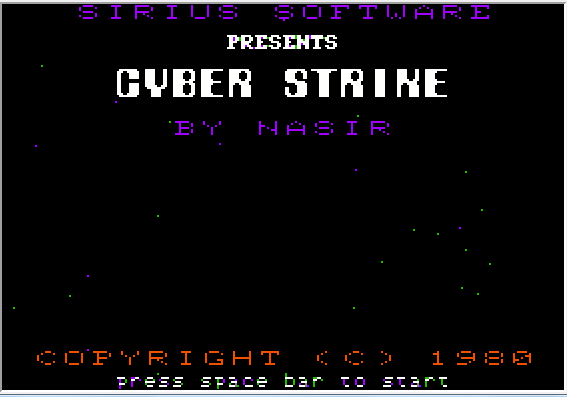
Cyber Strike (1980)


From the game’s description: “The date is 320.45. You have been briefed by Major General Nasir about a clone attack on bases Keppler, Galileo, Copernicus, and Newton. The attack was masterminded by the notorious leader, Gar, and executed by his fleet of robot fighter drones. Your job is to command the Gamma Glider IV drone into the trouble areas and eradicate the enemies. You send the drone through hyperspace and remotely control the drone's actions. You have antimatter torpedoes and meteor shields for offense and defense. Destroy up to 4 enemies at each base then resupply before continuing on.” 
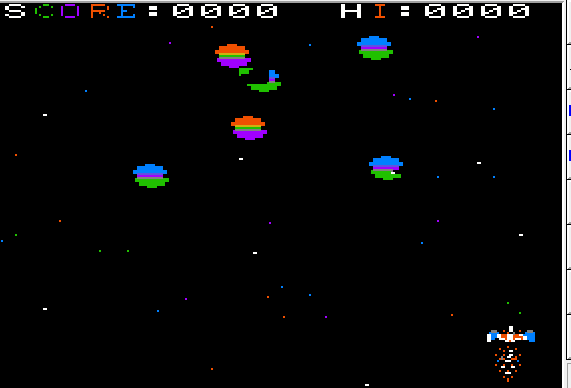
Cyber Strike was another first-person outer space shooter. While it was still an action game, it was a bit more sophisticated than Nasir’s other 1980 efforts, with separate screens to display local and galactic sensors. While there were similarities to some arcade games, it could probably best be described as a more action-oriented version of the mainframe classic Star Trek. As such, the most likely influence was probably Star Raiders for the Atari 800. The most well-known arcade version of the mainframe original was Sega’s Star Trek and the most well-known Apple II version may have been Cygnus’ Star Fleet I: The War Begins. 

In the Sirius version, the player piloted their “Gamma Gllider IV,” using the IJKM keys to steer and the 1-3 keys to change speeds. H engaged the “hyperdrive control” while F fired the “antimatter torpedo” and S toggled the “meteor sheild” on and off. The B key allowed the player to dock with a nearby base. 

Autobahn (1981)


This time, the arcade influence is all too clear. This one is a fairly straightforward version of Sega/Gremlin’s Monaco GP.  The game was an overhead, vertically-scrolling driving game in which the player drove a “Formula 7” racer, sponsored by Sirius Software. The player could switch among three gears that increased his maximum speed from 120 to 160 to 200 kph. 

Pulsar II (1981)


Pulsar II combined two different games, each with eight levels: Pulsar (a takeoff on Cinematronics’ Star Castle) and Wormwall (a maze game).
Gorgon (1981)


One of Nasir’s biggest hits, this was a straight up clone of Defender, with a few additions, like a fuel supply, Sirius, in fact, ended up paying licensing money to Williams for the game (though I don’t think they did so until after they shipped the game and Williams contacted them).

Space Eggs (1981)


This was probably Nasir’s biggest hit overall and one of the finest vertical shooters for the Apple II. Some have noted the game’s similarities to Phoenix. As mentioned, above, however, I think the real influence was Moon Cresta. Aside from the three stage ship in the opening (I don’t know if you could get it during the game), the first level of the two games is nearly identical. The player faced four different screens of enemies: spiders, lips, wolves, and bouncing killer fuzz balls. 

Horizon V (1981)


We discussed this one already, but here’s the official description:

“While on a routine patrol of one of the five planetoid outposts of the Galactic Federation, you are set upon by angry G-bellians who believe you have kidnapped one of their most prized performers, Paulette the G-belly dancer. Before you are able to explain your innocence, the G-bellians attack and you are forced to defend your planetoid. Using radar and plasma weapons you destroy first the ships and then the G-bellians themselves before you run out of fuel. As you make a run for fuel, some of the G-bellians follow you into the time warp. But before you can get to your fuel you have to destroy the oncoming G-bellians. Finally you reach the fuel dump and lock into the center of the fuel target. . . then onto the next planetoid...”

Firebird (1981)


While this one looks something like Crazy Climber, the gameplay is entirely different. The player plays a firefighter named Piggo, who tries to extinguish fires caused by fireballs (or maybe it’s flaming poo) dropped by a giant bird.  

Zenith (1982)


This one was another first-person shooter in the mold of Horizon V with the addition of allowing the player to turn their ship. It seems to have fared better than its predecessor (The Arcade Express newsletter, for instance, gave it a 9 out of 10). As described in the game’s manual: 

“You are a Skyfighter patrolling the airspace above the city Zenith as it's being built. Aliens are invading and your job is to shoot every single object above the city to prevent it from harm.”

Neptune (1982)


If  Gorgon was Nasir’s version of Defender, this was his tribute to Scramble. A somewhat underrated game.

Notes
[1] Carlston 1985 says that Gebelli was attending UC Davis at the time he visited Computerland. It may be that he attended both schools, or one the claims may be in error.


Sources

Steven Levy. Hackers. 1984
Doug Carlston. Software People. 1985.
Softalk. April 1981. Nasir Gebelli>>>
“Exec Sirius”. Softalk. July 1982.
Matt Barton. Honoring the Code: Conversations WDuck Huntith Great Game Designers  2013.
http://wikipcpedia.com/wiki/content-software-for-games-consoles/you-can-be-sirius-%E2%80%93-sirius-software/


Thursday, August 20, 2015

Classic Apple II Games - an Analyis of Softalk's Bestseller Lists

As much as I enjoyed playing arcade games back in the day, I probably enjoyed playing games on my Apple II even more. In part this was because computer games were much more involved and told more of a story and in part it’s because I played them in my home, making for a more intimate gaming experience. A few months back, scans of all 48 issues of SoftTalk were posted on Internet Archive. Published from September 1980 to August 1984, Softalk was perhaps my favorite Apple II magazine. More importantly for our purposes, it also printed several bestseller lists starting with the second issue. Now that I have the data, I thought I’d do a little analysis of the various lists, especially in regards to games.

The lists started with the October 1980 issue and included a list of the 30 bestselling software titles overall and several top five and top ten lists of the bestselling games in various categories (home, hobby, business, adventure games etc.) According to that issue, 15% of Apple-franchised retail stores volunteered to participate in the poll. They were contacted by phone in the first week of September to get data on their bestselling games for the month of August. The rankings were based strictly on number of sales made and nothing else (not quality, not profitability etc.) The top 30 list include an "Index" – "an arbitrary measure of relative market strength." While they do not say how they calculated the index, it is quite helpful since the index often dropped off precipitously after the top 2 or 3 titles (and sometimes it dropped after #1). Anyway, on to the numbers.


The first thing I looked at was how popular games were in relation to other types of software. While some have claimed that microcomputers of the late 1970s and 1980s were primarily used for business or home use rather than gaming, I have often wondered if that was the case and suspected that more people bought computers for gaming in these years that is generally realized (or admitted to). The data give some support to this idea, but only in the early months. From October 1980 to August 1981, 70.6% of the thirty bestselling programs (21.2 titles out of 30) were games. From September 1981 to April 1983, 49.6% were games, and from May 1983 to August 1984, just 35.4% were games. If we just look at the top ten, the difference is slightly greater: 75% of the top ten programs from October 1980 to August 1981, 49% from September 1981 to April 1983, and 29% from May 1983 to August 1984. Of course, there are other ways to look at the data. Business programs, for instance, were generally much more expensive than games so if we looked at dollar volume, a different picture would emerge. We could also look at home much time people spent using various software or how important it was to them. Many games were ephemeral. Once  you finished them, it was on to the next. Business and home software, on the other hand, probably had a much longer shelf life and may have gotten used more often and for more crucial purposes. .Once you found a good word processor or spreadsheet, for instance, it may have served its purpose for years.

In terms of peak index, top ten titles over all 47 poos were:
Choplifter (Broderbund) 214.57
VisiCalc (Personal Software/VisiCorp) 213.62
Apple Writer II/IIe (Apple Computer) 199.87
AppleWorks (Apple Computer) 145.99
Screen Writer II (Sierra On-Line) 99.73
Wizardry II: Knight of Diamonds (Sir-Tech) 99.7
Space Eggs (Sirius) 99.56
Personal Filing System/PFS: File (Software Publishing Corp) 99.38
Wizardry (Sir-Tech) 99.32
Home Accountant (Continental Software) 99.17

If we look at the top 42 individual monthly indexes, the top four titles above account for all of them.
Here are the top ten games, in terms of peak index:
Choplifter – 214.57
Wizardry II: Knight of Diamonds – 99.7
Space Eggs – 99.56
Wizardry – 99.32
Miner 2049er (Micro Fun) 99.11
Apple Galaxian (Broderbund) 99.06
Flight Simulator II (SubLogic) 99.88
Olympic Decathlon (Microsoft) 98.48
Lode Runner (Broderbund ) 97.73
Raster Blaster (BudgeCo) 97.53

The #1 titles were
VisiCalc – 17 times
Apple Writer IIe – 12 times
Choplifter – 5 times
Raster Blaster, Apple Galaxian – 3 times each
Apple Writer II, AppleWorks, Space Eggs – 2 times each
Flight Simulator II - once

Here are the top five titles in terms of total # of appearances on the charts
VisiCalc – 44
PFS: File – 37
Wizardry – 33
Typing Tutor (Microsoft) 33
Home Accountant - 28

For games, here are the top titles
Wizardry – 33
Choplifter – 24
Castle Wolfenstein (Muse) 24
Zork I (Infocom) 24
Flight Simulator - 22

Which publishers had the most titles appearing on the charts?
Sierra On-Line - 24
Broderbund - 23
Apple Computer - 18
Sirius – 16
Beagle Bros - 10
Personal Software/VisiCorp – 8
Muse – 8
Infocom – 8

If we just look at games, here are the publishers with five or more:
Sierra On-Line - 23
Broderbund - 20
Sirius – 16
Infocom – 8
Epyx/Automated Simulations – 7
California Pacific – 6
SSI – 5

Note that Muse falls off the list because its eight titles included four versions of Super Text.
Finally, I created a formula to rank the games based on overall chart performance.
The formula adds together:
1) Peak Index (max 214) – This is the only component that can exceed 100, but since that makes sense since it is the only one that is directly tied to sales (as I mentioned, the difference
2) Peak Position Points (max 100) -a game that peaked at #1 gets 30 points, #2 gets 29 points etc. then the total is multiplied by 3.33 to convert it to a 100-point scale)
3) Longevity (max 100) - # of appearances x 2.13 (the maximum # of appearances if 47, so I multiplied by 2.13 to convert to a 100-point scale)
4) Bonus Points - # of times at #1 x 2.13. The "max" here is 100, but to get it you’d have to have finished first in every list, which no game came close to doing.

Using this formula, the top titles were:
VisiCalc – 444
Choplifter – 376
Apple Writer IIe – 350
Apple Writer II – 330
PFS: File – 275
Wizardry – 266
Home Accountant – 260
AppleWorks – 257
MasterType – Lightning Software – 255
Typing Tutor - 233

Note that VisiCalc moves ahead of Choplifter, which is appropriate. This supports VisiCalc’s reputation as the program that made the Apple II. That may not seem to need confirmation, since the fact is so well known, but when dealing with Apple history, everything need to be confirmed since a number of the "facts" that everyone knows are little more than PR and corporate hero worship. PFS: File was database that was part of a Microsoft-Office-like suite of business applications for the Apple II (the others were PFS: Write, PFS: Graph, and PFS: Report).
And for games:
Choplifter – 376
Wizardry – 266
Flight Simulator - 231
Wizardry II: Knight of Diamonds – 230
Raster Blaster – 229
Miner 2049er – 222
Snack Attack – Datamost – 220.4
Lode Runner – 219.5
Space Eggs – 218.7
Flight Simulator II – 216
Zaxxon – 215
Olympic Decathlon – 214
Wizardry III: Legacy of Llylgamyn – 212.2
Apple Galaxian – 211.8
Gorgon – Sirius - 209

That’s it for the overall bestseller list. Now let’s look at the individual games lists.
Over the years, Softalk had four different lists:
Top 5 Adventure Games
Top 5 Fantasy Games
Top 5 Strategy Games
Top 10 Arcade Games

The first three ran from October 1981 to August 1984. The arcade games list didn’t start until January 1983 and ran to August 1984.
First, let’s look at adventure games.
#1 games
Zork I (Infocom) - 15 times
Cranston Manor (Sierra On-Line) - 5 times
Deadline (Infocom), Ulysses and the Golden Fleece (Sierra On-Line), Mask of the Sun (Ultrasoft/Broderbund), Escape From Rungistan (Sirius) – twice each
Zork II (Infocom), Time Zone (Sierra On-Line), The Quest (Penguin), Suspended (Infocom), Starcross (Infocom) – once each

The surprise for many here is probably Mask of the Sun – an excellent game that is little remembered today (there was also a sequel called The Serpent’s Star). Escape From Rungistan and The Quest are also rarely discussed today. Time Zone was considered something of an ambitious flop.
Most appearances
Zork I – 28
Zork II – 26
Deadline – 19
Zork III – 12
Wizard and the Princess (Sierra On-Line) – 9

I also created my own index for this list, which is similar to the one I used for top 30. It consists of
Peak ranking; (6-peak)*20 (i.e. peak rating of #1 = 100 pts, #2 = 80 pts, #3 = 60 pts etc.)
Longevity = # of appearances x 2.86 (max 100) – there were 35 total charts, 100/35 = 2.86
Bonus – times at #1 x 2.85

Here are the leaders
Zork I – 223
Zork II = 177
Deadline – 160
Cranston Manor – 137
Mask of the Sun – 129
Ulysses and the Golden Fleece – 123
The Quest, Time Zone, Escape From Rungistan, Kabul Spy (Sirius) – 117

Top adventure game publishers (by # of games charted)
Infocom – 10
Sierra On-Line – 5
Phoenix Software - 3

No surprise at #1. Infocom easily dominates, despite the fact that their games had no graphics. I played tons of their games and enjoyed them far more than those of the competition, graphics or not (I think the lack of graphics actually helped). #3 probably is a surprise to many, most of whom probably don't remember Phoenix Software and their adventures (for the record, the three here were Adventure in Time, Masequearde, and Sherwood Forest).

Now let’s look at fantasy games
#1 fantasy games:
Wizardry – 27 times
Utlima, Wizardry III – 3 times each
Wizardry II – twice

Most appearances
Wizardry (Sir-Tech) – 34
Wizardry II: Knight of Diamonds (Sir-Tech) – 26
Ultima (California Pacific) – 22
Ultima II (Sierra On-Line) – 18
Exodus: Ultima III (Origin Systems) – 11
Apventure to Atlantis (Synergistic) – 11
Wizardry III: Legacy of Llylgamyn (Sir-Tech) – 10

Top Index (same formula as above)
Wizardry – 274
Wizardry II – 180
Ultima – 172
Wizardry III - 137
Ultima II – 131
Exodus: Ultima III – 111
Apventure to Atlantis – 111
Caves of Kharkan (Level-10, Daiken-5) – 89
Snooper Troops I (Spinnaker) – 83
Crush, Crumble, and Chomp (Epyx/Automated Simulations) – 80

As expected, the fantasy competition comes down to Wizardry vs Ultima and Wizardry emerges as the clear winner. This might seem surprising to some, since Ultima is much better known today (though its reputation is fading). In the early years, however, at least judging by Softalk’s lists, Wizardry was more popular. This actually accords with my own memories. I played both series extensively and while I loved them both, I preferred Wizardry (Wizardry I was the main reason I bought an Apple II). Despite the fact that they’re both fantasy role-playing games, it’s kind of an apples-and-oranges comparison. At first glance, the most obvious differences were in the graphics and perspective (first-person vs. overhead) but IMO, these differences were relatively trivial. The real difference was in the gameplay. Ultima was all about finishing the quest and solving problems while Wizardry was about character development and fighting monsters. Ultima had a richer story and more quests, while Wizardry had more items, abilities, and monsters. Given that, you’d think I’d prefer Ultima but for some reason I like Wizardry better (though I did love Ultima II). So what is Ultima better remembered today? I think one of the main reasons is that the Ultima series went on to much better things. Ultima IV and Ultima VI were two of the best RPGs of the time and Ultima Online was, for a time, popular (though it faded fast). The rest of the Wizardry games didn’t fare nearly as well . Richard Garriott’s media-friendly image and Lord British persona may also have been a factor (you didn’t see Andrew Greenberg and Robert Woodhead on television).

Top fantasy publishers in terms of # of games was Epyx/Automated Simulations with five games. Edu-Ware, Level-10, and Sir-Tech had three each.

Again, Epyx is probably surprising to most. The games were Crush, Crumble, and Chomp; Curse of Ra, Dragons Eye, Temple of Apshai, and Upper Reaches of Apshai. And that doesn't even count Morloc's Tower, Datestones of Ryn, Rescue at Rigel, and Hellfire Warrior, all of which made the top 30 list but didn't make the fantasy top five. Most of these were part of the Dunjon series, one of the first RPG series for the Apple II. The first was Temple of Apshai in August 1979 (though it was originally developed for the TRS-80) and a total of ten games were released for the series.

How about Strategy games?

#1 games
Castle Wolfenstein (Muse) – 23 times
Flight Simulator II (SubLogic) – 7 times
Flight Simulator (SubLogic), Robot War (Muse), Sargon III (Hayden) – once each

# of appearances
Castle Wolfenstein– 34
Flight Simulator – 28
Sargon II –(Hayden) 25
Robot War – 10
Sargon III - 8

Castle Wolfenstein is another game that I think is kind of unjustly ignored today. It is known, of course, due to Wolfenstein 3D but it seems to me that most people think it was some obscure game that served as inspiration for its successful follow-up. In truth, however, the original was a major hit in its own right. Until I made this list, even I didn’t realize how popular it had been.

Index
Castle Wolfenstein - 263
Flight Simulator - 183
Sargon II - 152
Flight Simulator II - 140
Robot War - 131
Sargon III - 126
Rendezvous - 100
Spitfire Simulator - 91
Beyond Castle Wolfenstein (Muse) – 86
Broadsides (SSI) – 86
Beyond Castle Wolfenstein debuted the month before Softalk ceased publication or it would have ranked higher.

Top strategy publishers (# of games)
SSI (Strategic Simulations Inc) – 16
Muse, SubLogic – 3 each
No other category witnesses such dominance by a single publisher. Again, however, for those who were around in the early 80s, this is no surprise. SSI was the sine qua non of computer strategy games - the Avalon Hill of the genre. Avalon Hill, despite the fact that it made several computer games, was not the Avalon Hill of the genre and some of their computer games were pretty terrible (B-1 Nuclear Bomber, anyone?) Avalon Hill was actually the dominant (or at least most prolific) war game publisher for the Apple II in the earliest years, until SSI pushed them out of the limelight.
SSI plumbed the same basic genres Avalon Hill did in its tabletop board games - war games and sports games. They also produced a number of role-playing games, some of which were pretty good (even if the graphics trailed far behind the competition). I still remember the ending to Questron 2 almost three decades after playing it.

Finally, arcade games
#1 games:
Lode Runner (Broderbund) – 8 times
Choplifter (Broderbund) – 5
Julius Erving and Larry Bird Go One-on-One (Electronic Arts) – 3
Zaxxon (Datasoft), Miner 2049er (Micro Fun) – twice each

# of Appeaances
Choplifter – 20
Miner 2049er – 18
Pinball Construction Set (BudgeCo/Electronic Arts) – 17
Frogger (Sierra On-Line) – 16
Zaxxon – 14
Lode Runner, Hard Hat Mack (Electronic Arts) – 13

Index
Peak ranking; (11-peak)*10 (i.e. peak rating of #1 = 100 pts, #2 = 90 pts, #3 = 80 pts etc.)
Longevity = # of appearances x 5 (max 100) – there were 20 total charts
Bonus – times at #1 x 5
Choplifter – 225
Lode Runner – 205
Miner 2049er – 200
Zaxxon – 180
Frogger – 170
Pinball Construction Set – 165
Julius Erving and Larry Bird Go One-on-One – 150
Hard Hat Mack – 135
Aztec (Datamost) – 115
Beagle Bag (Beagle Bros) - 110

Top arcade publishers (# of games)
Broderbund 8
AtariSoft – 6
Electronic Arts – 5
Datamost, Penguin, Sierra On-Line – 3 each

Finally, let’s look at the top game designers, by the number of different games that appeared on any of the above lists:
8 - Nasir Gebelli (Sirius/Gebelli Software), Ken Williams (Sierra On-Line)
7 - Jon Freeman (Epyx)
6 - Bill Budge (California Pacific/Sirius/BudgeCo/Stoneware/Electronic Arts)
5 - Roberta Williams (Sierra On-Line), Olaf Lubeck (Sierra On-Line), Mark Blank (Infocom)
4 - Tony Suzuki (Broderbund), Silas Warner (Muse), Richard Garriott (California Pacific/Sierra On-Line/Origin), Jim Nitchals (Cavalier), Doug Carlston (Broderbund), Dan and Kathe Spracklen (Hayden)
3 – Andrew Greenberg & Robert Woodhead (Sir-Tech), Robert Clardy (Synergistic), Bruce Artwick (SubLogic), Chris Jocumson (Broderbund), David Mullich (Edu-Ware), Eric Hammond (Electronic Arts), Jun Wada (Broderbund),Dave Lebling (Infocom), Michael Berlyn (Sentient Software/Infocom), Paul Murray (SSI), Rod Nelson (Level-10), Scott Adams (Adventure International), Warren Schwader (Sierra On-Line)

Sadly, many of these names are not as well-known as they should be and some are all but forgotten. Nasir Gebelli was a major force in the Apple II arcade gaming world until around 1982/83. His games here were Autobahn, Cyber Strike, Gorgon, Horizon V, Phantoms 5, PulsarII, Space Eggs, and Star Cruiser.

Jon Freeman is even less well-known (though I’m not sure what role he had in the games he worked on). Olaf Lubeck and Tony Suzuki are two others who are little-known.
Ken and Roberta Williams are quite well-known, though again I don’t know how significant Ken’s role was in some of the games he’s credited for. Richard Garriott (Lord British) is also quite well-known. Bill Budge was very well known back in the day. His six titles do not include his Graphics Package/System, which also made the lists.