Friday, November 16, 2012

The First Coin-Op Laserdisc Game and Book Information

THE FIRST COIN-OP LASERDISC GAME


What was the first coin-op laserdisc game?

Most would probably say Astron Belt (actually, if you're talking the general population rather than retro gaming enthusiasts most would probably say Dragon's Lair or, incorrectly, Dragonslayer or maybe even "that game with the dragon guy and the princess" if they said anything at all).

Astron Belt "debuted" at the AMOA show in November, 1982 (at least in the US. It had reportedly been shown at the JAA show in Japan on September 30th and may have been shown elsehwere in the U.S. prior to the AMOA show).
Astron Belt wasn't the first coin-op laserdisc game, however.It didn't begin shipping until months after the show, allowing other games to beat the makers to the puch but that's not what I'm talking about.

And I'm not talking about products like The First National Kidisc (that wasn't coin-op) or Show-Time International's Show-Time Jukebox, a laserdisc juke that appeared at the 1979 AMOA (that wasn't a game).

I'm talking about Quarter Horse by Electro-Sport. While Quarter Horse was also at the 1982 AMOA, its designer claims that it had been shown at the previous year's show as well.
I haven't confirmed that but the May, 1982 issue of Vending Times had a section on currently available video games and it listed Quarter Horse so the game was available to the public long beore November.


Here is a brief excerpt from the rough draft of my book dealing with Quarter Horse:

Quarter Horse

Astron Belt wasn't the only laser disc "game" at the 1982 AMOA show, nor was it the first coin-op laser disc game created. Electro-Sport of Costa Mesa, California was also showing its Quarter Horse, an "amusement only" horse racing game designed by Rodesch Associates. Quarter Horse, not Astron Belt, was actually the first coin-op laser disc game. Designer Dale Rodesch recalls that the game was first shown at the 1981 AMOA at the Blackstone Hotel across the street from the main showroom at the Hilton. Rodesch's involvement with games had its origins during his days working for Northrop Aircraft where he struck up friendships with co-workers Dale Frey and Bob Burr. When Frey later developed what was likely the first video poker game as part of his master's thesis, he asked Rodesch to join him. Frey designed some of the earliest video blackjack and poker machines for Si Redd and A-1 Supply. Rodesch, who served as A-1's general manager, was responsible for marketing the games outside of Nevada. In the late 1970s, Rodesch left A-1 Supply to develop a teaching machine used by doctors in the American Academy of Family Practice. Rodesch and Frey also formed a company called Dale Associates where Frey set to work designing a next-generation video poker machine while, in late 1980, Rodesch went to work on a horse racing game that would use laser disc footage. Development on the poker game screeched to a halt when Si Redd slapped a lawsuit on Dale Associates but the work on the horse racing game continued. Rodesch soon approached Los Alamitos Race Course and was given permission to use footage from their library in his game. Back in 1976, Bob Burr had founded a company called Electro-Sport in  Costa Mesa, California, which supplied "amusement only" video poker games to gray-market regions of the U.S. where gambling was prohibited. Rodesch struck a deal with Burr to produce a prototype "amusement only" version of his game.  Nevada gaming veteran Mickey Wichinsky signed on to produce a gambling version (Si Redd actually took a look at Quarter Horse but balked at the terms Rodesch was asking for).

Quarter Horse was a horse racing game. The player examined a tote board and bet on a winner then watched laserdisc footage of the race. Because of the short playing time of the Pioneer laserdisc player, only a limited amount of footage could be included.

[Dale Rodesch] The Pioneer laserdisc player was limited to thirty minutes of play if "freeze frames" of the finishes were to be utilized. The original Quarter Horse (and by far the most popular version over the last thirty years) had six blocks of ten races each (60 races total) where each block contained each post position winning once. Also, because the laserdisc was capable of presenting two monaural sound tracks, each block cycled between two sets of names and the player thus heard 120 "different races".


The original version had two separate monitors, one where the player made their bets and other to display the video footage.

[Dale Rodesch] My concern was for the Nevada market, where I felt the Nevada gaming authorities would not allow the player's bets to not be visible throughout the play. We did go to a single (switched) monitor later in the production of the amusement version

Not only was Quarter Horse the first coin-op laserdisc game, but it was also the most enduring by far. It remained in production for over 30 years. The last laserdisc for the U.S. market was shipped in January of 2012 while a solid-state version remains in production in Canada under license for the world market as of this writing.

BOOK INFORMATION


This blog was recently mentioned on the RetrogamingRadio podcast. While I certainly appreciate the mention ,there was a bit of confusion about my book (whether it had been published, what it was about etc.).

If you didn't read the first blog entry, you probably don't know what book I'm talking about so I thought I post an update.

First of all, the book has not been published yet, nor do I have a publisher.  It is a forthcoming book that I will probably end up publishing as an e-book or Kindle book.
I started writing it around 1998 and put it on hold in 2002. I picked it back up around September of this year to finish.
Right now, it is in rough draft state (as you can no doubt tell from the excerpts I've posted). I'm still in the process of collecting information and interviewing people. I have put it together into a rough narrative (currently about 700 pages in Word) but haven't gotten around to actually making it, you know, interesting (I'll do that once I've gathered enough info).
It will be several months before I'm ready to publish anything.
So what' s in it?
It covers the history of arcade video games and the arcade video games industry up to the end of 1984 (the crash).
It will be different from other books in a few ways.
First, it's all coin-op/arcade. I cover home video games and computers only tangentially (if they were made by coin-op companies I go into a bit more detail).
Second, I focus a LOT on the games and the people who created them - lots of game design stories etc. (maybe too much).
Third, while other books seem to focus  almost exclusively on Atari, Nintendo, Sega, and (maybe) Bally/Midway) I want to tell the story of Exidy and Cinematronics and even Meadows Games and Mirco. I will certain cover the biggies, but I also want to talk about the little guys.
Here is the current table of contents (subject to change):
IN THE BEGINNING
·  Spacewar (MIT: 1961)

PART I - THE BRONZE AGE: 1971-1978
·  Bringing Spacewar to the Masses: Nolan Bushnell and Bill Pitts (Nutting Associates and Stanford University: 1971)
·  Pong (DuMont Labs, Brookhaven Labs,  Sanders Associates, Syzygy/Atari: 1947-1972)
·  Penny Arcades to Pinball Wizards: The Coin-Operated Amusement Industry, Circa 1972
·  The Clone Wars (1973-1975)
·  A Trip to the Sunshine State (Allied Leisure: 1968-1977)
·  Gun Fight in Silicon Valley: The First Microprocessor Game (Bally/Midway 1931-1975)
·   Meanwhile, Back at Headquarters (Atari: 1973-1975)
·   Causing a CoMotion (Sega/Gremlin: 1951-1978)
·   California Dreamin' (Meadows Games, Digital Games, PSE, Fun Games: 1966-1978)
·   Death Race (Ramtek, Exidy 1973-1978)
·   The Good Times Begin (Atari: 1976-1978)
·   The Independents
·   Spacewar Returns - The Rise of the Vector Game (Cinematronics : 1975-1978)
·   Back East (URL/Electra Games, PMC, Mirco Games: 1973-1977)
·   Bally's Little Helpers (Bally/Midway: 1976-1978)
·   Invaders From the East (Taito: 1955-1978)
·   Summing Up (The Industry: 1972-1978)

PART II - THE GOLDEN AGE (1979-1984)
·  On the Grow (Bally/Midway: 1979-1981)
·  Coin-Op Classics (Atari: 1979-1981)
·  The Vector Team (Cineatronics/Vectorbeam:  1979-1984)
·  Who Plays a Maze Game? (Pac-Man: 1980 and Beyond)
·  Spellbound in the Darkness (The American Video Arcade)
·  Goin' Berzerk (Chicago Coin/Stern: 1931-1984)
·  The Pinball Wizards (Gottlieb/Mylstar, Game Plan, Rock-Ola: 1927-1984)
·  What Sort of Company Invents Defender? (Williams Electronics: 1929-1984)
·  Copycats [pirate games, knocks, and copyright issues]
·  Winky's Revenge (Exidy:  1979-1984)
·  Not In My Backyard (The Video Game Banning Controversy)
·  Toyland, Bally's Little Helpers Part 2 (Bally/Midway: 1981-1984)\
·  Froggy's Lament (Sega/Gremlin: 1979-1983)
·  The Little Guys (Pacific Novelty, Entertainment Sciences, Elcon Industries: 1973-1984)
·  A Match Made in Heaven (Centuri/Konami: 1979-1984)
·  Super Mario (Nintendo: 1889-1984)
·  Rising Sun (Namco, Taito, Taito America: 1955-1984)
·  Other Japanese Companies (Universal, Nichibutsu, SNK, Tehkan, Irem, Capcom 1966-1984)
·  Here Come the Kits, Here Come the Kits - Conversion Kits and System Games (Venture Line, CVS , Data East: 1975-1983)
·   Joystick Heroes - Players, Records, and Tournaments
·  Before the Storm (Atari: 1982-1984)
·  From Tron to Starcade (Video Games in Popular Media)
·  The Next Big Thing (The Rise of the Laserdisc Game: 1981-1985)
·  Gambling, Trivia, and Golf Games
·  The Return of Nolan Bushnell (Bally/Sente: 1983-1984)
·   Summing Up - The Industry 1979-83
·  Crash! (1984)
·  Shakeout (1985)

·   Aftermath (1986-???)
·   Revival - Retrogaming


There will also be extensive appendixes:
·         A brief history of other types of coin-op amusement machines (pinball, jukeboxes, gun games, ball bowlers, skee ball, pitch-and-bats, wallgames, vending machines, exhibition machines, fortune tellers, strength testers, driving games, novelty games, foosball, air hockey, and more)
·         A list of all known arcade video games released before 1985, organized by company and year with a lot of information including date of company's founding and incorporation, company location, company founder, approximate month of release for games, licensee, developer and a lot more info.
·         A list of prototypes and unreleased games
·         Video game production numbers
·         Operator survey results (yearly figures for average weekly earnings by machine type [pinball, video etc.], market share by company etc. , number of video games)
·         (maybe) A list of the AMOA show dates and attendance figures for each year
·         Company financial information (yearly revenue and income)
·         A summary of popularity charts from Replay, Play Meter, Electronic Games etc. (for each game it lists when it entered the charts, how many times it appeared, peak position. and average weekly earnings)
·         A summary of the Arkies and other video game awards
·         Video game design credits: A list of all people I know of who worked on arcade video games prior to 1986 and the games they worked on

·         Significant Tournaments (pre-1986)


Finally, here is a list of the people I've interviewed so far (by company):
Allied Leisure/Centuri:
Jack Pearson (engineer), Joel Hochberg (executive), Ken Beuck (VP of materials), Ron Haliburton (cofounder), Troy Livingston (engineer), Larry Leppert (engineer), Bill Olliges (executive)


Atari:
Al Alcorn (engineer), Bob Brown (engineer), Dan Pliskin (engineer), Dave Shepperd (designer/programmer), Dave Stubben (engineer), Ed Logg (designer/programmer), Ed Rotberg (engineer), Franz Lanzinger (designer/programmer), Howard Delman (engineer), Jack Ritter (designer/programmer), Jim Morris (engineer), Joe Alig (test technician), Ken Beuck (materials manager), Larry Leppert (engineer), Lyle Rains (designer/programmer), Michael Cooper-Hart (artist), Mike Albaugh (designer/programmer), Noah Anglin (engineer), Owen Rubin (designer/programmer), Rich Moore (engineer), Rusty Dawe (designer/programmer), Ted Michon (designer/programmer)


Bally/Midway:
Internal Team:
Brian Colin (artist), Dave Marofske Sr. (executive), Dave Needle (designer/programmer), George Gomez (designer/programmer), Gershon Weltman (executive), John Pasierb (engineer), Stan Jarocki (executive), Stanley Levin (executive), Steve Ulstad (artist)
Dave Nutting Associates: Bob Ogdon (designer/programmer), Dave Nutting (founder), Jay/Jamie Fenton (designer/programmer), Pat Lawlor (designer/programmer), Tony Miller (engineer)
Arcade Engineering: Jack Pearson, Ron Haliburton
Marvin Glass Associates: Richard Ditton (designer/programmer), Scott Morrison (artist), Steve Meyer (designer/programmer), Rick Hicaro (artist)
Chicago Coin:
Ken Anderson (executive), Paul Jacobs (executive)


Cinematronics/Vectorbeam:
Dana Christianson (artist), David Dentt (designer/programmer), Jack Ritter (designer/programmer), Ken Anderson (executive), Ken Beuck (VP of manufacturing), Larry Leppert (engineer), Larry Rosenthal (designer/programmer), Rick Dyer (designer/programmer), Robert Shaver (designer/programmer), Scott Boden (designer/programmer), Tim Skelly (designer/programmer), Tom Stroud Sr. (executive), Bill Cravens (executive), Ed Anderson (plant manager, sound designer), Bob Skinner (programmer), Phil Sorger (programmer), Jerry Huber (artist), Rob Patton (programmer), Tom Carroll (artist), Earl Stratton (programmer), Dennis Halverson (engineer), Brooke Jarret (engineer)


Data East USA
Paul Jacobs (executive)


Digital Games/Micronetics:
Ted Michon (engineer)

Elcon Industries
Andre Dubel (founder)

Electra Games/URL:
Bill Olliges (executive), Stan Jarocki (executive)


Exidy:
Dan Pliskin (engineer), David Rolfe (designer/programmer), Ed Anderson (plant manager, sound designer), Ed Valleau (designer/programmer), Howell Ivy (designer/programmer), Ken Nicholson (sound designer), Larry W. Hutcherson (designer/programmer), Mark Von Striver (hardware engineer), Michael Cooper-Hart (artist), Noah Anglin (engineer), Paul Jacobs (executive). Pete Kauffman (founder), Ted Michon (designer/programmer), Vic Tolomei (designer/programmer), David Rolfe (designer/programmer), Richard Spitalny (founder, First Star Software), Peter Liepa (designer/programmer)


Fun Games:
Ken Anderson (executive), Larry Leppert (engineer)


Game Plan:
Ken Anderson (executive), Stanley Levin (executive), Troy Livingston (engineer)


Gottlieb/Mylstar:
Chris Brewer (designer/programmer), Dave Pfeiffer (designer/programmer), Dave Thiel (engineer), Jeff Lee (artist), Jim Weisz (engineer), Neil Burstein (designer/programmer), Tim Skelly (designer/programmer), Warren Davis (designer/programmer), John Buras (pinball designer)


Gremlin/Sega:
Gene Candelore (cofounder), Lane Hauck (designer), Lonnie Pogue (cabinet designer), Medo Moreno (designer/programmer), Alex McKay (designer/programmer), Dan Viescas (artist), Howell Ivy (executive), Ken Anderson (executive), Tim Skelly (designer/programmer)


LDCS:
Michael Harris (designer/programmer)
Meadows Games:
David Main (designer/programmer), Ken Beuck (VP of materials), Larry Leppert (engineer), Paul Jacobs (executive), Harry Kurek (founder)


Namco America:
Ed Anderson (plant manager, sound designer)

Nintendo of America:
Al Stone (executive), Bill Cravens (executive)


Pacific Novelty:
Bill Cravens (executive), Francisco Pflaum (sound designer), Phillip Lieberman (designer/programmer), Bernie Stolar (executive)

Ramtek:
Howell Ivy (designer/programmer), Peter Kauffman (executive)
Rock-Ola:
Joe Bak (designer/programmer), John Jaugilas (designer/programmer), Larry Gleason (engineer), Lonnie Ropp (designer/programmer), Mike Perkins (engineer)


Sente
Howard Delman (engineer), Owen Rubin (designer/programmer), Ed Rotberg (designer, programmer), Gary Levenberg (sound designer), Tian Harter (programmer), Jon Kinsting (designer/programmer)

Simutrek:
Noah Anglin (executive), Dan Pliskin (engineer)


Stern/URL:
Allan Woodman (executive), Brian Poklacki (designer/programmer), Gary Stern (executive), Bill Olliges (engineer), Chris Oberth (designer/programmer), Ed March (designer/programmer), Jon Hogan (designer/programmer), Tony Miller (engineer), William Philmlee (designer/programmer)
Taito America:
Bill Olliges (executive), Dave Needle (designer/programmer), Dave Poole (engineer), Keith Egging (executive), Mark Blaszcyk (designer/programmer), Scott Boden (designer/programmer), Rex Battenberg (designer/programmer)

Universal USA:
Paul Jacobs (executive), Bill Cravens (executive)
Williams:
Bill Pfutzenreuter (designer/programmer), Dave Poole (engineer),  Ken Fedesna (executive), Ken Graham (designer/programmer), Kristina Donofrio (designer/programmer), Larry Demar (designer/programmer), Noah Falstein (designer/programmer), RJ Mical (artist), Sam Dicker (designer/programmer), Chuck Bleich (hardware designer), Gary Berge (hardware designer), Paul Dussault (programmer), Richard Witt (programmer)

Others:Ed Adlum (publisher, Replay magazine) Bill Pitts (designer/programmer) Steve Epstein (owner, Broadway Arcade), Scott Ellison (Perceptronics), John Gatens (distributor), Al Kress (operator), Tom Asaki (gamer), Steve Sanders (gamer), Billy Mitchell (gamer)


Monday, November 12, 2012

The Atari $50,000 Centipede Fiasco

Todays post is an excerpt from a section of my book covering Atari's Centipede.
One of the promotions for the game (and one of the most infamous promotions of the golden age of video games) was the disastrous $50,000 World Championship held in Chicago in October, 1981.
Disastrous may actually be an understatement.
While the tournament is remembered today, the details are not.

 ---

Bailey’s instincts proved correct as Centipede became one of the first coin-operated video games to be played in large numbers by women. One of these players was Julie Winecoff, an unemployed North Carolina truck driver who spent her savings on a ticket to Chicago to play in a three-minute Centipede tournament sponsored by Atari in October, 1981. Winecoff made it to the finals of the women’s division only to be trounced by Ok-Soo Han, a Korean immigrant who’d flown in from L.A. After the match, Winecoff said “I’m never going to play another game of Centipede as long as I live. I’ve been whipped bad. I’ve been sure enough tore down[1]


 Sidebar - The Atari $50,000 World Championships
 
            Despite the tough competition the tournament, dubbed the $50,000 Atari World Championships was an unmitigated disaster. Atari spent over $100, 00 promoting the tournament, sending out 1,500 promotional packages to operators around the country and launching a month-long ad campaign in Chicago. The tournament was part of the Tournament Games Spectacular $400,000 Weekend, which also featured foosball, Mark Darts, eight ball, and air hockey competitions. The tournament was organized by Seattle's Tournament Games Inc., an experienced promoter of pool and darts tournaments headed by Lee Peppard. Peppard was in many ways the driving force behind the explosion of foosball in the early 1970s. Peppard got his start in the amusement industry when he saw his first miniature golf course as a traveling dental tools salesman. He soon built four courses in his hometown of Missoula, Montana. In 1972 he was managing a bar in Missoula when he staged  a $1,500 foosball tournament.  He formed a company called Tournament Soccer to administer the tournaments. About a year after its founding the company produced a table also called Tournament Soccer - a cheap model manufactured in Taiwan. The 1974 Tournament Soccer tournament, held in Denver was a nationwide contest with $50,000 in prize money. The following year it increased to $250,000 and foosball was a full-fledged national craze. It was featured in a Sports Illustrated article in September and Peppard's tournaments had much to do with that. The tournaments were well run - held in high class hotels with excellent prize money. A handful of top players were reportedly able to make a living on the tournament circuit. A number of them even went to work for Peppard's company (which eventually became Tournament Games, Inc.).
     When the video game boom hit foosball's fortunes headed south quickly. In a four month period from April to July of 1980, TGI ran three foosball tournaments and ended up issuing rubber checks in all three. In addition, Peppard was sued for $10,000 in unpaid bills by the Hyatt Regency O'Hare Hotel after the May tournament. Peppard was able to pay off most of the winners within a few months, but the bounced checks were only a symptom of a larger issue. Tourament Soccer went from building 1,500 tables a month to 150 in two months. In May of 1981 Jim Wiswell, one of the game's top players, committed suicide and to many it seemed that the game had died with him.  
      The situation looked grim until Atari president Joe Robbins approached Peppard in early 1981 with an idea for a video game tournament. Robbins gave Peppard a $40,000 advance and, according to Peppard, a verbal agreement to finance the venture. Peppard saw it as a golden opportunity to bring foosball back to respectability. In addition to the money from Atari, Peppard had secured $20,000 guarantees from Sutra, U.S. Billiards, and Arachnid.  Even two months before the tournament, however, he realized that he was in trouble but was confident that he could fall back on the entry fees for the Centipede tournament to bail him out. Then Atari backed out  of their commitment, concerned that Peppard wanted to make the tournament HIS tournament. Peppard, on the other hand, felt that Atari had placed him in a compromising position by announcing their association with TGI in industry journals. A contract was quickly renegotiated (for, Peppard claimed, $100,000 instead of the $240,000 originally agreed upon), with acrimony on both sides. More financing problems followed in the weeks leading up to the event, but Peppard was still hopeful that he could recoup his losses - until he saw the turnout.
   Some expected upwards of 3,000 - perhaps as many as 10,000 to 15,000 contestants to show up and were shocked when only 174 did so (and only 138 for the Centipede tournament).. Panicked might be a better word since TGI  was relying on the contestant entry fees to provide funding for the prize pool. Part of the problem may have that contestants had to pay for their own transportation and lodgings, as well as a $60 entry fee (unless they could find a sponsor). Then again, the poor turnout may have been an early sign of things to come in the video game industry. The Centipede tournament itself was poorly run, to put it kindly. Players had to pay an additional $1 officiating fee to enter the Chicago Expocenter, where 280 Centipede machines awaited. Many of the contestants had no idea that Centipede would be the only game in the tournament (some had come to compete in Asteroids or other Atari games and rarely, if ever, played Centipede). Atari, however, had earlier announced (to operators at least) that Centipede would be the game used in the finals. While they initially claimed that the game used in the finals would be selected from a group of games used in qualifying tournaments (including Asteroids, Asteroids Deluxe, Battlezone, Warlords, and Red Baron), the summer 1981 issue of Atari Coin Connection included an update that Centipede had been chosen for the final round.  
    The confusion in Chicago didn't end thereTo qualify for the next day's double-elimination round players had to post a high score on any of the machines (which were set to a three-minute time limit - a fact that wasn't specified when the tournament was advertised), entering the initials they had been given. They could play as many games as they wanted within the "allotted time" but no one specified how much time was allotted. On top of that, players had to pony up their own quarters to play. Two hours after starting the players were told that they all qualified for the double-elimination round - their scores were irrelevant.  When Peppard was collared by some angry players and their parents, he explained that some players were entering initials other than their own (the "officials" hired by the tournament had failed to police the tournament - or do much of anything else). Peppard promised to meet with players the next morning then excused himself to go to a cocktail party. Somehow, the tournament managed to finish with Eric Ginner the overall winner and Ok-Soo Han the female champion.
    
Centipede championships Ok-Soo Han and Eric Ginner 

Things went from bad to worse when Ginner’s $12,000 check and Han’s $4,000 check both bounced as did foosball champion Johnny Lott's (whose first-prize car also failed to materialize). Peppard was also unable to pay the $20,000 he owed to the site hotel. He was able to stave off some of his other creditors. Before the tournament had started, he was already deeply in debt to Sutra, U.S. Billiards and Arachnid, but they had extended him generous terms of credit and were "willing" to wait for their money (though "forced' might be a better word since Peppard would likely have gone bankrupt had they pressed him for payment). Peppard ended up not having to pay Video Concepts, a retail chain that had agreed to provide many of the prizes because they heard about the tournament's collapse before delivering any goods.
       In the wake of the disaster, accusations flew back and forth between the principals. At one point, Peppard claimed that he expected to lose money on the tournament (as he had in earlier tournaments) since the purpose was to promote the games. Peppard also claimed that he was expecting the three $20,000 guarantees from the various manufacturers. When Play Meter talked to two of them, however, they said that they'd never promised Peppard anything. Peppard put much of the blame on Atari. He said that they had given him a $40,000 purchase order to cover decorating costs (one of the few bills Peppard actually paid on time). Atari's Frank Ballouz, on the other hand, said that Peppard had refused the order and had been told to "rip it up". Another bone of contention was that Peppard believed that Atari still owned him the final $20,000 on the $100,000 called for in the contract. Atari had actually sent him the final $20,000 payment three weeks before the tournament but Peppard was apparently convinced himself that this was confidence money, since he was expecting Atari's final payment to come in the form of 184 blank checks to cover the prize money. Finally, Peppard claimed that Atari had agreed to help him sell a projected 5,000 tournament kits at $5 each. Peppard only sold 600 due, he said, to the fact that Atari failed to help market them (Ballouz said that marketing the kits was entirely Peppard's responsibility).

The Atari-approved ad for the tournament (this version appeared in the Summer, 1981 edition of Atari Coin Connection)


      Whether they were at fault or not, many disgruntled contestants blamed Atari for the fiasco (posters for the event gave the impression that Atari was the cosponsor. Atari claims it never approved them) Lott even threatened a class-action lawsuit. In the end, Atari ended up footing the bill themselves while suing TGI for breach of contract. The Illinois Attorney General launched an investigation, TGI went bankrupt, and Peppard lost his home. Perhaps the biggest casualty of the tournament, however, was foosball, which quickly faded back into obscurity.

An unapproved (by Atari) ad for the tournament


Note -
Major sources for this post include the Febraury, 1975 issue of Replay (an issue dedicated to table soccer, including an interview with Lee Peppard), two long articles on the 1981 touranment in Play Meter (January and February 1982), and the documentary Foos.

[1] Microsoft Arcade, p.111            
[2] Posters for the event gave the impression that Atari would be co-sponsoring the event, but Atari claims it never approved the posters

SOME UPDATES:

First another un-TAFA'd game. Electrocoin's Minesweep, released around February of 1977.


Here's a picture of the Midway production line churning out Sea Wolf from the November 1976 issue of Play Meter (though the picture had appeared in an earlier issue).


 The same issue reports that Midway produced 8,600 units of Gun Fight and 7,000 of Winner. Given the scarcity of non-Atari production numbers, I thought I'd post the info.
.
The December issue also had an interesting piece of info. In a report on Night Driver/Night Racer/Midnite Racer at the 1976 AMOA show Play Meter mentioned that the games were copies of a German driving game that had appeared at the IMA show in spring. So it looks like Nurburgring wasn't as unkown as I thought it was.

Thursday, November 8, 2012

Preliminary Report - What Was the First Cocktail Table Video Game?

This post is actually a bit premature. I was planning on waiting to publish it until I had some more solid information. I am still accumulating data sources for 1973 (someone who has access to the 1973 Vending Times issues is working on getting me some information but that could be awhile).

I recently came across some interesting info on this question so I though I'd go ahead and do a preliminary post.

So, what was the first cocktail-table arcade video game?

The most commonly given answer is Kee Elimination / Atari Quadrapong (see KLOV, WikiPedia etc.)


Well, maybe but there are at least two issues with this claim.

1) In my opinion it's quite debatable that Elimination and Quadrapong were in fact cocktail table games.
If by "cocktail" game you just mean a game with a low cabinet and a horizontally mounted screen then yes, they would qualify.

If, however, you mean a game with a flat top that you could sit around and play and put your drinks on the table and which was marketed to high end cocktail lounges etc. (which seems to be the meaning of the term in the industry at the time) then I don't think they do.
In addition, the term "cocktail table" itself long predates video games (it was used for stereos etc.).
Free dictionary defines it as "a low table where magazines can be placed and coffee or cocktails are served"

Then there's the fact that Atari may not have even considered them cocktail table games (more on this later).

The top was actually arched and I doubt you could put any drinks on it. The flyers for the game all showed players standing around and not sitting - which, IMO, make it more of a "stand around" game in the vein of Atari Football. These may seem to be minor points, but as I will discuss the term "cocktail game" seems to have had a very specific meaning at the time.

Based on a quick and dirty poll, the games were also a tad taller than most cocktail games at the time, though this is a very minor point. Elimination was 37" high while Quadrapong was 32.25" (as per the flyers). I did a quick look at 10 other cocktail games from the time and they were all between 27" and 30"

2) There is some evidence that there were cocktail table games released before either of them (this is the part I need for which I need to gather data).

Before getting on to the major part of the article, a couple of things most people may not know about cocktail table video games.

1) Cocktail table games were ubiquitous in 1974 and 1975.

Cocktail Pong clones were coming out of the woodwork (no pun intended) in these years. I took a quick look at my list and counted over 40. A lot of people probably associate them with the 1980s but 1974 and 75 may have been the peak years. A number of companies made nothing but.

2) Cocktail table games were quite controversial at first.

Within the industry, cocktail table games were very controversial.
Play Meter ran a 10-page cover story on the games in its April, 1975 issue and the author at first had no use for them.  Early on he admits "I approached this entire subject with a negative attitude, intending to expose the 'frauds' taking  place..."
It should be noted that some saw cocktail games as the savior of an industry that had stagnated as the market flooded with Pong clones.


So what was the big deal with cocktail games?
First of all, the games were often sold by fly-by-night companies either through direct marketing (want ads) or to independent operators - thus bypassing the traditional distributors and operators. The games were also expensive (often far more so than games sold through "legitimate" distributors).

Why was this?
Part of the reason was that the sellers wanted to avoid the expenses associated with distributors and operators and possibly to avoid other barriers to entry in the marketplace.
Of, course, that doesn't explain why cocktail games were sold in this fashion so much more so than uprights or why the controversy was limited to cocktails.

And this brings up what was probably the real reason the fly-by-nighters sold the games the way they did and why they were so controversial.
Cocktail table games were sold and marketed to a completely different type of clientele than traditional video games.

At the time (early-mid 1970s) coin-op games had for years been traditionally sold to neighborhood bars and restaurants (called "street locations" in the industry). Games were also sold to arcades but arcades still weren't very common at the time, at least not outside the large cities (arcades really started to spread in the late 1970s and 80s with the mallification of America).

Cocktail table games were sold to upscale cocktail lounges, hotels, high end restaurants etc. - locations that coin-op operators of the time had no experience selling to. Sadly, many of them also seemed to have had no desire to sell to such locations.
Here is a very typical ad/flyer for a cocktail table game of the time (in this case PMC's Princess from 1974).


 The Play Meter article discusses this issue in detail, but I'll stop for now.

So on to the main question.
What was the first cocktail table video game?

First of all, when were Elimination and Quadrapong released?
From the Atari internal document, the former was released in October of 1973 while the latter was released in March of 1974. Wikiepedia notes that they were released simultaneously but that doesnt' seem to be the case. Interestingly enough, one flyer for Quadrapong says it is going to be released on December 7th (1973, one presumes). Of course, it would be nice if these dates could be corroborated.

WERE THESE GAMES CONSIDERED COCKTAIL GAMES AT THE TIME?

I don't mean at the time of their release (since the term likely hadn't been invented yet - see below, however). I mean that once the term came into use in the industry, were these games considered examples.

The flyers don't include the word "cocktail" anywhere and one refers to Quadrapong's "new exciting table cabinet" but that isn't much good since, as I said, the term may not have come into common parlance at the time.

The June-July 1975 issue of Play Meter contained an interview with Nolan Bushnell. The topic of cocktail table games came up. Here are a couple of relevant excerpts (especially relevant text in bold):

PLAY METER: That seems to be what happened with the booming video cocktail table market and the way the blue-suede-shoe men jumped into it. What are your feelings about the tables and about the marketing methods controversy?
BUSHNELL: I think it's been good for the industry because it's got a lot of operators off their ass.

PLAY METER: In what way?
BUSHNELL: Operators had somehow gotten the idea that their areas are fully saturated. You know, I've talked to guys so many times and their idea of going after a location is going to a place that's already got games and trying to buy it with a checkbook.
A lot of these guys, if you'd have told them to go into a nice cocktail lounge, they'd have told you no chance.
We tried to sell cocktail tables clear back when and we were singularly unsuccessful through our regular distributor organization. It was just a thing that nobody was ready for. We ended up building and selling some in Tokyo as early as mid-1973. The operators over there were a bit more aggressive and did rather well with it. But we could get no interest whatsoever in the states.
So, we were approached by National Entertainment and we said, "Sure, we’ll build you a cocktail table." They went out, beat the bushes and placed the tables on location and suddenly you had operators scrambling around trying to protect their locations,  trying to buy cocktail tables. Not because they wanted to, not because they thought it was a good idea, but to sort of protect their downside.


PLAY METER: Does Atari plan to do something in the cocktail table market?

BUSHNELL: Yes. We've got our first table -- I should say our second run of cocktail tables -- coming off the line June 25, called Goal Four. We modeled it after our successful World Cup game that we're marketing in Europe.
So, does this interview give us any insight into whether Quadrapong was considered a cocktail table game? Nothing definitive but some intriguing info.

First, note that the game is never mentioned in the article. Also, note that Play Meter asks if Atari is planning to do anything in the cocktail market - as if they never had before (though the interviewer may just not have known about Quadrapong).
Also note that Bushnell starts to say that Atari is coming out with its "first" cocktail table (Goal 4 - unquestionably a cocktail table game) in June then corrects himself and says its their second run.
So if it was the second, what did he consider the first?
Maybe he was talking about Quadrapong but it seems more likely to me that he was talking about the 1973 runs he mentioned earlier. Could that 1973 run have been Elimination? Again, it seems unlikely to me since that game came out late in the year, and came out in America, and was released by Kee (and I think Nolan was still trying to maintain the fiction that Kee was a separate company at the time).

On the other hand, Bushnell does say that Goal 4  was modeled after World Cup and World Cup  came in the same stand-around style cabinet at Elimination so maybe he did consider that a cocktail cabinet.

There is also the possibility that Bushnell had just forgotten how many cocktail games Atari had released (the cocktail version of Pong and Coup Franc had both been released by then).
 
 WAS A COCKTAIL TABLE GAME RELEASED BEFORE OCTOBER, 1973?

I need to do a lot more research here but here are some interesting questions/possibilities.

First of all, what was that run of cocktail games that Atari did in Tokyo in mid-1973?
I've seen no other reference to it. It's quite possible, of course, that Nolan's memory is simply off but this wasn't too long after the fact.

There are actually at least two other companies that claim to have released a cocktail table game in 1973.
First is National Entertainment - the company Bushnell mentioned in the interview. The author of the other article (the one on cocktail games) actually talked to National Entertainment president Dick Januzzi, who confirms that they did indeed approach Atari to build them a cocktail game in 1973. Initially, says Januzzi "They laughed at us" but the did build the game. Later, quality issues forced them to drop the Atari unit and go with a cocktail version of Meadows' Flim Flam instead.
But when did this all happen? Januzzi says only that it was in "late 1973".
BTW, National Entertainment later became Innovative Coin Corporation.

The other company that claimed to have marketed a cocktail game in late 1973 (and actually claimed to be the first to do so) was Fascination, Ltd. of Des Plaines IL. Fascination president Robert Runte, in fact, was granted two patents on the game and cabinet in 1974.

The first was filed on July 17th for an "Amusement Device":
http://www.google.com/patents/US3940136?dq=ininventor:%22Robert+Ralph+Runte%22&hl=en&sa=X&ei=UXucUOThBOuD0QGx6IDwAg&ved=0CEAQ6AEwAw

The second was filed on July 29th for an "Amusement Game Table":
http://www.google.com/patents/USD237727?dq=ininventor:%22Robert+Ralph+Runte%22&hl=en&sa=X&ei=UXucUOThBOuD0QGx6IDwAg&ved=0CDcQ6AEwAA


When were the games released?
The earliest I have record of is the Fascination 500, released around April of 1975.
Given that they also had a Fascination 600 and Fascination 700 it seems reasonable that there would have been a Fascination 100-400 but I've yet to find info on them or when they were released.

Of course, if they started as a fly-by-night operation there probably wouldn't be much info out there.
Which also raises the possibility that some other fly-by-night company released a cocktail game much earlier.

The author of the cocktail article mentions that he scanned the L.A. Times  want ads to find ads for such games so that is one place to look for more solid info.

A few other early cocktail games:
Atari's cocktail Pong was supposedly released in May of 1974 (though I don't have a lot of details on it).

KLOV says that Coup Franc was released by Atari Europe in 1974 but also indicates that it predated Quadrapong and was the first cocktail game (though this isn't entirely clear to me)

One of the earliest non-Atari cocktail games that I have been able to date (bear in mind that I have little data for pre-1974 dates and that dating games from this era is difficult in any event) is Electromotions Electromotion IV (released around May of 1974).

NUTTING TABLE TENNIS??

Finally, I mention one (likely) pretender to the throne. TAFA lists Nutting Associates' Table Tennis  as a 1973 game. The April 1975 issue of Play Meter had an ad for the game, which almost certainly means it wasn't a 1973 release (they didn't run ads for games two years after they were released - it would have gone out of production LONG before that).
One thing I should mention, however, is that TAFA has two flyers for the game. The cabinet that appears in the ad is the same one that appears in the second (alternate) flyer. The other flyer actually shows three other cabinet styles (one octagonal). While it's possible that they came out with a game by that name in 1973 and another in 1975, it seems highly unlikely to me.
My guess is that Table Tennis is an early 1975 game. BTW - I am also highly doubtful of many of the release years that appear on Nutting games (I.E. I don't think Computer Space Ball came out in 1972).

Cocktail Games in the 1930s???

One final note. You will notice that I asked what was the first cocktail table VIDEO game and not the first cocktail table game period. Were there cocktail table games other than video?

Dick Beuschel's Pinball 1 includes this intriguing comment in the entry for Game Plan's Foxy Lady (A cocktail table pinball game)
"The idea wasn't completely new as sit-down cocktail table games had been made and modestly sold in the mid-1930s up through the World War II years by Rotor Table Games of New York City, Scientific Machine Company of Brooklyn, and the National Novelty Company of Long Island among a few other producers of the unique game format."

I don't have the time to go into this, but here's a photo of one of them - Rotor's Confusciouis [sic] Say manufactured sometime between 1935 and 1937 (photo from the International Arcade Museum):


Another photo of the same game from Sands Mechanical Museum (www.sandsmuseum.com/). Taken from Dick Bueschel's Encyclopedia of Pinball, Vol. 2


BONUS PHOTO


Yes, that's right - a home cocktail unit. And United wasn't the only one to offer one at the time (Control Sales did one and there were also a few others).

Coming attractions:

More detail on my book.

The Ultimate (So Far) History of Cinematronics/Vectorbeam - this one should be a doozy. Probably 5-10 posts. I've talked to at least a dozen people from Cinematronics/Vectorbeam and found a LOT of infomation that hasn't been published anywhere before.

Monday, November 5, 2012

More Odds and Ends - Ikegami Tshshinki, Elcon, First Video Game Death

From the March 1976 Play Meter
 
I was looking through yet another court case today and once again it yielded some interesting info.

The case is Nintendo of America, Inc. v. Elcon Industries, Ind. (564 F Supp 937), available here:
http://scholar.google.com/scholar_case?case=14413211357527714092&q=564+F.+Supp.+937&hl=en&as_sdt=2,5

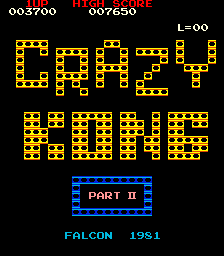
It is a lawsuit regarding the game Crazy Kong - a bootleg of Donkey Kong but it wasn't really a bootleg (at least not entirely  - read on)


The first bit of info involves a company called Ikegami Tshshinki.
If you haven't heard of them, they are a Japanese manufacturer of TV cameras formed in 1946. Supposedly they did most, if not all of the programming for Donkey Kong.

See the following for basic info:
http://en.wikipedia.org/wiki/Ikegami_Tsushinki
http://gdri.smspower.org/wiki/index.php/Company:Ikegami_Tsushinki
http://web.archive.org/web/20050212192733/http://www.video-fenky.com/archives/000036.html

Rumor has it that they also worked on the following games:

Nintendo: Block Fever, Computer Othello, Space Launcher, Sheriff, Space Demon, Helifire, Radar Scope, Space Firebird, Space Fever, Sky Skipper, and Popeye

Sega: Congo Bongo, Zaxxon

If the rumors are true, that would make them one of the great unknown video game design firms from the golden age.

They are supposed to have had a verbal contract with Nintendo to design 8 games.
Nintendo is supposed to have paid them 10 million yen.
Suppsedly, they sued Nintendo for copyright violation in 1983 after Donkey Kong Jr. came out seeking 580 million (settled out of court in 1990). Another trial allegedly found that Nintendo didn't own the right do Donkey Kong.


But are the rumors true?

I don't know if any documentation from those trials has ever turned up.
The main evidence for these claims seems to be:
1) A Japanese book called It Started With Pong (translated title) by Masumi Akagi published in 2005. (if I read Japanese I might try to get a copy, but I don't)
2) a message that appears in the Donkey Kong ROMs.
3) Images of the Ikegami logo in the tilesets for Congo Bongo and Zaxxon.

As I was perusing the case above, I found this little tidbit:

"Nintendo Co., Ltd. expended over $100,000.00 in direct development of the game, and Nintendo Co., Ltd. hired Ikegami Tsushinki Co., Ltd. to provide mechanical programming assistance to fix the software created by Nintendo Co., Ltd. in the storage component of the game. The name "Ikegami Co. Lim." appears in the computer program for the Donkey Kong game. Individuals within the research and development department of Nintendo Co., Ltd., however, created the Donkey Kong concept and game. The operation of the Donkey Kong game includes the use of the audio-visual material which was originally created for use in the game by Nintendo Co., Ltd."

So much for Ikegami but what about the rest of the case.

One thing that I found interesting is that Nintendo actually granted a license Falcon, Inc. to sell Crazy Kong in Japan (this fact has been disputed). Why would they license someone to produce a knockoff of their own game?

Elcon Industries was using Falcon boards (via Artic International, a company that had already gotten in legal hot water with Williams).

First of all, what about Elcon Industries.

From Play Meter, June-Jully 1975 - an early ad for Elcon
Back when they were still Electronic Concept Industries


Elcon was founded in Michigan in the 1970s by Andre Dubel. They were incorprated on September 2, 1977. At various times, they were located in Bloomfield Hills, Ferndale, and Royal Oak. The name was short for Electronic Concept Industries

Below is a list of games I've found by them:

1975
Double Play (Tennis/Hockey)
Triple Play (aka Tennis/Hockey/Soccer)
1977
Blockbuster
Brickyard
Casino
Circus [lic Exidy]
?Highjumpers
The Six Pack [cabinet, not a game]
TV Pinball
Videobowl
1979
(c6) Cosmic Attackers
(s10) Dodge 'Em
Collision
Royal Flush Draw Poker
Super Casino
Video Blackjack
1980
Astro Combat
1981
(11) Crazy Kong [BL]
Tank Battalion
Unknown
Devil Zone

I'm not sure about all of those titles.

So were they a legitimate company? I don't really know. Almost all of their games appear to be copies of other games. Maybe they actually licensed some of the games. Maybe they were just a distributor at first. The flyer for Cosmic Attackers (seemingly an exact copy of Space Invaders) claims that they manufactured games. Video Bowl was Exidy's Robot Bowl. I'm not sure if they actually had a game called Highjumpers (it was the same as Circus). Blockbuster is Breakout

On the other hand, if they were bootlegging the games, it seems odd that they would advertise them so heavily in the trade mags (the Blockbuster ad/flyer appeared in almost all of them).The Circus flyer mentions that the game was the hit of the 1977 AMOA show but I didn't see a note in there that they licensed it from Exidy.
Then again, Artic/ATW produced flyers too and they were taken to courty by Williams (though I don' know if they advertised their bootlegs).


The First Video Game Death?

What was the first coin-op video game-related death?
Most sources point to Peter Bukowski, who died of a heart attack at Friar Tuck's game room in Calumet City, IL on April 3, 1982 after playing Berzerk (though he apparently had an existing heart condition, was overweight, and had run up the stairs prior to playing).

Many sources, in fact, list this as the only known case of a coin-op video-game related death (Jeff Daily is also said to have died in 1981 after playing Berzerk but details are sketchy and the story is doubted).

Actually, there was a video-game related death long before Bukowski's. The March, 1975 issue of Play Meter reports that Charley Currie, an operator from Ontario was electrocuted on December 3rd, 1974 while playing a "TV game" he'd just installed. He put it next to another (non video) game and neither of them were grounded. He was touched instantly when he touched the other game.

There is yet another game related death (involving a child crushed to death by a game) but I won't go into that one. (I may put it in the book, but may not since it could dredge up bad memories for those involved).


Friday, November 2, 2012

Vectorbeam Scramble

I wanted to post a pair of photos from the December, 1978 issue of Vending Times.

First is a photo of Larry Rosenthal in front of his game Scramble at the 1978 AMOA show (held November 10-12 that year).
For those who don't know, Rosenthal created Space Wars, which put Cinematronics on the map. It was introduced at the 1977 AMOA show, sold at least 10,000 units (big numbers for those days), and was named the top money maker of 1978 by Replay. Rosenthal left Cinematronics in late 1978 and formed Vectorbeam, who produced their own version of Space Wars called Space War..Scramble was supposedly their first original game. About 10 years or so ago Scramble was one of the holiest of holy grails but a bit more information has since surfaced about it.


Here's another picture of Rosenthal and programmer Dan Sunday from the same issue:


Finally, here is the section of my book dealing with the game (I probably need to update it):

            Vectorbeam’s first original release was another game Rosenthal had created (along with Dan Sunday) called Scramble.


[Dan Sunday] [Scramble] was the very first game the new Vectorbeam company made. Remember, Vectorbeam only existed for 1 year: I recall Sept 1978 to Aug 1979, but may be off a month either way. So when it first started things were really hectic -- a scramble. We were trying to get everything off the ground, and get a game to a big annual trade show in Chicago. We managed to quickly put together a video pinball game, Scramble, and actually took it to the Chicago trade show[1].


The game was shown at the 1978 AMOA[2] and over the years, it has been become a much-storied collector’s item as no copy has ever turned up (though some boards were found in 2008 that may have been from the game). Some have speculated that the game was never actually released, but at least two units were on display at the AMOA show. Gameplay, was reportedly extremely crude. Tim Skelly, who played the game on a visit to Vectorbeam, describes it as a video version of pinball. Rosenthal, who barely remembers the game himself, vaguely recalls that they shipped 65 units to an overseas distributor and probably didn’t release it in the U.S. at all (a recollection supported by the fact that a German flyer exists for the game).

German flyer for Scramble, from TAFA


A US Flyer for the game that I contributed to TAFA a long time ago.


[1] Email from Dan Sunday to Chuck Zonn, October 1998. Posted at www.arlo.net/vectorlist/.
[2] The company was supposed to show a second new game at the show, but it is not known if they did

Thursday, November 1, 2012

1975 Atari Photos and UnTAFA'd Games Project

One of the things I've been doing for my book has been to go through old issues of the various video game industry magazines (Replay, Play Meter, Vending Times, and Cash Box).

TAFA, KLOV, and arcade-history.com are invaluable tools for documenting the existence of bronze and golden age video games (or at least their flyers) but TAFA only includes flyers and many games didn't have them.

This post will be the first in a series documenting games I fiind that aren't listed on these sites.. Unfortunately, my pictures are of VERY poor quality. Many of the old Replays I have are ones I scanned in black-and-white years ago.
The Vending Times issues I have are from the local university libary and are tabloid size and bound in yearly volumes, making scanning very difficult, even with my wand scanner (especially when they are on the inner edge of the page).

They're better than nothing, however, and I hope it's valuable to document them somewhere.

First, however, a few interesting Atari photos from the May, 1975 issue of Vending Times.
Here's one of Nolan Bushnell in the factory in Los Gatos amidst a bundh of Atari and Kee games.


 This one is for a game called "Indy 500". This must have been an early name for Indy 800. Oddly, ther was a mini-flyer for Indy 800 in this issue and the previous one.


From another 1975 issue, here's a photo of the production line at United States Marketing:


On to the games:

A miniflyer for Grand Slam by Westlake Systems (Replay, October 1975). Not listed on any of the three sites.


From the May, 1974 Vending Times, Electro-Fun 401 from Electromotion. This one is listed at arcade-history but there's no photo.:


 From 1974, Tele-Tennis by United States Marketing. This one is listed at arcade-history with a photo, but I thought I'd include the ad/mini flyer.


From August 1975 Vending Times, the Scandia cocktail table from Project Support Engineering. Not listed on any of the sites.


From Vending Times, 1975, an ad for Scoreboard Electronic Games. I don't know if they licensed their games, distributed games from other companies or what:


.
From the February, 1976 issue of Replay. Fascination, Ltd's Fascination 700 (this one is listed at arcade-history under Fascination but with no photo of this model).


From the August, 1976 Play Meter. Gametech's Olympic 9. On arcade-history with no photo.


Finally, an announcement from the July 1976 issue of Replay. No photo, but I include it because the company (Can-Am) isn't even listed on any of the sites.