Thursday, March 7, 2013

The US National Video Game Team and the North American Video Game Challenge/1983 Video Game Masters

Today's post is the final in my three-part series on events that occured in the wake of the Life photo shoot. Unfotunately, I didn't have as much information on this event (save Walter Day's book) and there are a number of unanswered questions and no doubt some inaccuracies (I'm still not sure about the 2nd and 3rd State Team Tournaments, for example).

If any of the principals are out there and can provide me with corrections or more information, I'd appreciate it.

-------------------------------


From the 1984 Guinness Book of World Records.
Scored from the 1983 Video Game Masters


            Perhaps the biggest victims, however, were the "superstar" players. Expecting a months-long tour, complete with salary, they now found themselves stranded in Boston and had to fly home at their own expense (though they had been paid for the five days the event lasted). Rather than returning home, a number of the players accompanied Walter Day back to Ottumwa. As they sat around trying to decide what to do they decided to stage an impromptu tournament. Walter Day contacted the Guinness Book of World Records, who agreed to sanction the event, which was dubbed the 1983 Video Game Masters. Walter also returned to his earlier idea. On July 25th he announced the re-formation of the U.S. National Video Game Team with five initial members:: Billy Mitchell, Steve Harris, Jay Kim, Ben Gold, and Tim McVey. It wasn't the first video game team. On October 10, 1982 the a group of students at North Missouri State University had formed a collegiate video game team (they even showed up at the famous Life magazine photo shoot).


            Day also organized the North American Video Game Challenge (now known as the 1983 Video Game Masters Tournament), the most ambitious video game tournament to date. Players from all 50 states and the Canadian provinces would be invited to a series of tournaments to fill 30 more slots on the National Video game Team. Three "State Teams Tournaments" would be held with the top ten finishers from each earning spots on the team. The results would be featured in the 1984 edition of the Guinness Book of World Records. The first of the tournaments would take place during the week of August 24-28th in eight different arcades across the Midwest and West representing eight different states/regions: Ohio, Illinois, Michigan, Nebraska, Idaho, Washington, Northern California/Northern Nevada, and Southern California. The tournament involved seven different games: Star Trek, Buck Rogers Planet of Zoom, Congo Bongo, Sinistar, Bubbles, Mario Bros., and the unreleased Atari 2600 game Spike's Peak (from K-tel/Xonox). Ten finalists from each of the 8 regions would compete in the finals on the 27th and 28th (at their home locations) with the top 10 overall finalists being invited to join the national team. Two more State Teams Tournaments were scheduled for October 28-30 and November 24-27.
 

Venues for the first State Teams Tournament:
  1. Video City, Dayton, OH
  2. Lake Odessa Fun Center, Lake Odessa, MI
  3. Video Wizard, Villa Park, IL
  4. Space City, Omah, NE
  5. Mr. Deli, Coeur D'Alene, ID
  6. Arnold's on the Avenue, Seattle, WA
  7. Starship Video, Upland, CA
  8. Video Paradise, San Jose, CA

            To kick off the tour, Day planned to take his five-member core team on the road to visit six of the eight locations where the first State Teams Tournament would take place taking on all challengers and raising money for the Cystic Fibrosis Foundation while collecting proclamations of support from Mayors and Governors to present to president Ronald Reagan. The trip would culminate with a visit to Washington D.C. where Day planned to top by the White House for a proclamation by Reagan before heading off to the Japanese embassy to challenge Japan to an international competition. Day also planned to open a Video Game Hall of Fame museum exhibit in Twin Galaxies.

            The last member of the team to arrive in Ottumwa was Ben Gold who showed up on August 11th to find the rest of the team camped out on the floor of Twin Galaxies out of money (Day had spent his last $60 on six red-and-white team t-shirts), desperate for food, and afraid to call home (lest their parents cut the trip short). That evening, their departure delayed by an interview with an AP reporter, the team set out in a rented 44-foot 1953 GMC city bus loaded with nine video games hooked up to a generator. It was a disaster from the start. The bus suffered the first of many breakdowns on the way to their first stop in Dayton, Ohio the next morning. After a delay, the bus finally started and they drove all night, arriving in Dayton at dawn where the owner of Video City arcade let them sleep in her living room. On other occasions, the team would sleep on the floor of the bus, wedged in between the video games.


After two days in Dayton, they broke down again in the arcade parking lot. A mechanic repaired the bus for free and the team headed to its next stop - tiny Lake Odessa, Michigan - then to the Video Wizard arcade in Villa Park, Illinois (a Chicago suburb). Once again the bus broke down. This time it was unable to switch gears. The bus was repaired late that evening but after three hours on the road, it broke down again in Portage, Wisconsin. When Day got out, he saw a trail of oil extending back along the road. The mechanic had failed to secure a gasket header properly and most of the oil had leaked out. A friendly cop arranged to have the bus towed into town where the players stayed for two days (missing an appointment at K-Tel offices in Minneapolis). This time the bus was beyond repair. The owner of the bus sent a car to bring the team back to Ottumwa where they packed into a hot, smelly school bus with a noisy engine and headed to Space City in Omaha where the bus was broken into and some of the players had their personal property stolen (including Ben Gold's prized log book of high scores that he'd kept since he started playing games seriously - Billy Mitchell found it in the woods). Steve Latch, the owner of Space City, offered them money to ditch the bus for a rental car. With Billy Mitchell taking the wheel, they headed for Mr. Deli in Couer D'Alene, Idaho 1,350 miles away with Mitchell driving 90 most of the way. From there it was on to Arnold's On the Avenue in Seattle. While in Seattle, the players paid a visit to Nintendo headquarters where they were treated to free handheld games and (more importantly) free food. The food was a godsend. With almost no money, the players had to scrounge free meals whenever and wherever they could. A few days later they traded the games for more food.


On their way to Starship Video in Upland, California, Mitchell as pulled over for speeding (he was going 94). Then, on Sunday, Ben Gold got violently sick. They found a clinic that was open on Sunday and Gold headed to the back while the rest of the team stayed in the waiting room. Before long Gold let out a bloodcurdling scream when the doctor game him a shot in the ass. For the rest of the day, Gold's teammates teased him mercilessly. After a quick stop at Starship Video they headed south to San Diego for a tour of Sega headquarters, During their visit, Sega learned that they'd been bought by Bally and were being shut down. While the employees wept, the team beat a hasty retreat. With that, the trip was over and the team members headed home. The tournament was won by Tim Collum (in January of 1984 he was crowned 1983 player of the year, along with Ben Gold, Billy Mitchell, Eric Ginner, and Steve Harris).
 
Local players from Video Paradise in San Jose.
The first two in the back row are Todd Walker and Eric Ginner


Information above taken from http://www.videoparadise-sanjose.com/1983vgmt.htm


      The team (with new members) made an appearance at the 1983 AMOA show where they rated games for Play Meter magazine. The proclamation from President Reagan never materialized. Nor did the competition with Japan . Day, Mitchell, and Tom Asaki did visit the White House in September, where they presented their Japan challenge to some aides they never heard from again. They then headed to the Italian Embassy to deliver another international challenge. This one was accepted. Finally they made their way to the Japanese Embassy only to be met by befuddled diplomats who told them they had no time to play foolish video games and sent them packing. The second and third State Teams Tournaments apparently never took place. For such a promising start, it was a sad ending and perhaps the best illustration that that the golden age of video games was over.
Walter Day returned to Ottumwa where, according to an article in the October 23 Omaha World Herald he had to sleep on the floor of Twin Galaxies and on three occasions forced to live off change from the coke machine as the arcade struggled to stay afloat. On March 6, Twin Galaxies closed its doors.  The U.S. National Video Game Team, however, lived on under the direction of Steve Harris. Despite its shaky start, the USNGVT was an important milestone in the history of e-sports. Sadly, it's one the few today remember.


Friday, March 1, 2013

The Electronic Circus

In an earlier post, I talked about the disastrous 1981 Atari $50,000 World Championships. Today's post is about an event that may have been even a greater disaster - the Electronic Circus. In terms of total attendance, the even wasn't nearly as bad as the Atari fiasco. In terms of unrealized potential and unfilfilled dreams, however, it may have been worse.

------

Jim Riley and Walter Day - note the dates on the poster


            Fresh on the heels of the national television success, Bostonian Jim Riley announced the Electronic Circus. As Walter Day recalls it, Riley (then with a company called Meeting Planners) contacted him in February of 1983 (Wikipedia says it was March). After having seen the That's Incredible segment, he'd stayed up all night thinking of a new idea - a travelling "circus" of video games with Day as the ringmaster and top players as the performers. According to an article in Video Games magazine, the circus would feature live music, amusement rides, "a Disney-World-type section featuring a Captain Kidd show and more. The centerpiece would consist of three main events. The first would be the "World's Largest Video Arcade" with 500 games set on free play. Second would be the Video Circus with three rings. One ring would feature the band Video Experience "…who will perform against the high-tech ambience of the arcade… a second ring will feature the antics of favorite video games characters such as Pac-Man and Donkey Kong. And the third ring would present the Chimpanzee/Pac-Man Challenge, where chimps specially trained in the game will take on human opponents[1]".  The highlight would be the third event, the "Superstar Pro Tour" in which 30 video game superstars (3 per game) would take on all comers on ten different arcade video games. In March, during Iowa Governor Terry Branstad's visit to Ottumwa, Jim Riley held court in a backroom at Twin Galaxies, filling players' heads with visions of video game grandeur. Riley even promised the players a salary, making them perhaps the first professional video game players in history
 

Riley(?), Governor Branstad(?), and Day at Twin Galaxies


[Jim Riley] What we're doing is taking you, the superstars in the video games business, and turning you into professionals, so that you're now playing for cash…We have a show that will generally do about $1 .5 to $2.5 million in gate receipts each weekend, and from this will come the prize money that you'll be playing for. On an average, the number one-ranked player, provided he continues to retain his number one ranking, will earn about $3,000 a week. The second-ranked player will make about $2,000 and the third-ranked player will average about S 1,000. If you stay with the show for the entire 40 weeks of its initial run, you're talking about an annual income for the  number one-ranked player of about $120,000. And, if you add to that the endorsement monies which may result from manufacturers trying to promote their product, as well as other fees, it's not difficult to imagine the potential of earning a rather substantial income

…

This doesn't mean that every week you are competing or have to reach your scores. You only have to do that when you're challenged by somebody. If this happens, they can then issue a challenge and try to knock you out of one of those three top places. If they succeed, then you're out of the show and the other player gets the opportunity to replace you.[2].

This early scheudle for the ElectronicCircus appeared in

Video Games magazine


Players who set high scores before August 1st would get their achievement recorded in the next edition of the Guinness Book of World Records. Initial plans called for circus to kick off in Boston on June 3rd - 5th before heading on the road for a 40-week, 200-city tour. Riley also hoped that the event would begin to change the negative image that many had of arcades and video games. To that end, the players would have to agree to a strict set of guidelines covering everything from curfew to how to deal with groupies.

[Jim Riley] Hopefully, this show is going to change that and create a total family entertainment image. This is what we want to accomplish. So, when I say that our video game superstars are going to have to be a squeaky clean Brady Bunch I mean it. This is a business and you're going to have people watching you. You may not be as famous as people such as John McEnroe, because it may take us five years to get video gaming as popular as tennis. But we're going to work toward that.

Riley offered Twin Galaxies a 1/4 share of the show's revenue. For Day, it must have seemed like his dreams were finally about to come true. Video gaming was about to hit the big time. Reality had something else in store.
 

Steve Sanders at the Electronic Circus

 
      Riley appointed Steve Sanders as captain of the "U.S. National Video Game Team" and tasked him with scouring the country searching for video game talent. Sanders was chosen not for his accomplishments, but because he fit the image Riley was looking for. Riley teamed up with friend Billy Mitchell to assemble a team of players but they quickly ran into a few problems. At one point,  Mitchell called a player who had reported an obviously phony high score of 11 million on Donkey Kong and offered him $6,000 a week to join the tour, noting that with endorsements, the figure might reach $50,000. The man told Mitchell he couldn't afford the pay cut. When Mitchell asked how much money it would take to convince him to play, the man made an excuse and quickly hung up.
    
     Alarming signs soon began to appear. Once the players had signed their contracts, Riley reneged on his agreement with Twin Galaxies. In June of 1983 Riley, along with Frank Benedetto and Steve Robb, formed Superstar Productions in Boston to produce the event, dubbed the Electronic Circus. Weeks before the event, the backers ran into management problems and brought in a team of business women called Women at Work to get things back on track.

Ad for the Electronic Circus, from the Boston Herald


     In the end the event date was pushed back and the scope was cut, but it still featured rock and gospel bands (according to Steve Sanders Air Supply among them), rides, talking robots, clowns, jugglers, knife throwers, and 515 new and classic video games set on free play arranged in 8 different themed areas (Outer Galaxies, Jungle Safari, Dragon Quest etc.). A slick (and expensive) television, radio and newspaper campaign was launched and Boston mayor  Kevin White kicked off an "Electronic Circus Week" promo. Instead of performing chimps there was Congo the Gorilla from Trading Places taking on, and beating, all comers in Congo Bongo (Congo was, of course, a guy in a monkey suit and the game was actually being controlled from offstage by master player Steve Harris). Center ring was reserved for the video game competition, in which the "Electronic Circus Superstars" (the name "United States National Video Game had been dropped), captained by Sanders would square off against teams of locals challengers assembled by arcade operators in each city for prizes and Guinness world records.


Part of the revised schedule for the Electronic Circus

taken from Chasing Ghosts


The superstar competition, however, had been pruned considerably. Instead of the 30 superstars originally planned,  Walter Day invited a team 8 top players (though some sources say there were more). One player who did not participate was That's Incredible champion Ben Gold. During the governor's visit to Ottumwa, Gold had been openly critical of the Electronic Circus. He was doubtful that the tour would last past three months and was concerned that the players would turn against one another in the heat of competition. Gold made his remarks within earshot of the a number of video game magazine writers. Jim Riley was furious. Here he was trying to promote his idea and raise money for the venture and some sixteen year old kid was mouthing off in front of the press. While Riley claimed he excluded Gold from the team because he didn't fit the image he wanted, the real reason was probably that Gold was too outspoken.


Riley had the players flown into Boston for the first stage of the event. When they arrived, he told them they would be making only $200 a week (after the players threatened to form a union, Riley gave in and paid them more and even agreed to pay Twin Galaxies $1,500 a week). The players would still launch a national tour after the opening week, but to 48 cities instead of 200. After what they'd witnessed so far, none of the players believed it would last that long.

The "superstars" endorsing the Wingo-O lottery

from the Boston Herald


Disappointed that they would not be making the thousands they'd been promised, the players nonetheless managed to enjoy themselves. They were thrown out of the Boston Colonnade hotel for chucking M-80s out the window. They managed to get stuck between floors of an elevator and had to wait as the doors were pried open by a giant spoon. One incident involved the game Joust. During lulls in the action the players would often head to a nearby coffee shop where the food was cheap. The coffee shop also had two video games, Joust and Centipede. At the time Steve Sanders was one of the best Joust players in the country. Sanders, however, had been ridden mercilessly by the players. By that point they all knew about his phony Donkey Kong scores and that his being named team captain had nothing to do with his video game accomplishments. If he could prove himself on Joust he would be vindicated, in his own eyes as well as those of his teammates. There were just two problems - Darren Olsen and Eric Ginner, the two best Joust players on the team. At the coffee shop, Sanders decided to take them on. First, he dispatched Olsen. Then he started playing Eric Ginner. That’s where Billy Mitchell stepped in. Sitting down beside Sanders as he played, Mitchell put his plan into action


[Billy Mitchell] You remember the movie A Few Good Men? if you recall Tom Cruise's job as an attorney was to get under Jack Nicholson's skin and get him to come apart and explode. Well Tom Cruise ain't got nothin' on me…[Steve was] the whipping post for us players. I have this truly unique thing I can do. I can talk to you and you can hear what I say but nobody else in the room can hear…He's playing Eric...and every time something goes wrong I say "What's the matter with you…Aw come on...jeez, you're really embarrassing yourself" I had him to the point where his eyes were shifting back and forth...his palms are all sweaty his tongue's kind of clammy…I've got him all worked up…We're closing in on 2 million points and Steve is catching up…and I've got him coming apart at the seams.

Joust only displays five of the free men you have in reserve. As Sanders lost man after man, Mitchell somehow convinced him that he was on the verge of running out of men. No one else heard a word of what he was saying. Suddenly Mitchell exclaimed  "That's right, I forgot, you get 50 points every time you die. No wonder Sanders is catching up."  Sanders couldn't take it anymore. He exploded, rose from his chair, and dropped the f-bomb on Mitchell[4],  who turned to the room and asked "What's this guy's problem?" Later, when they got ready to leave, Sanders began killing of his men. He had 52 left.
            Another incident involved the game Donkey Kong. At the time, Todd Walker was probably the best player on the team besides Mitchell and Sanders (he had scored 315,000). By far the hardest board on the game is the elevator board. Players normally have to make their way slowly to the top of the board dodging fireballs and bouncing springs. Once they get to the top level, the final move run up the ladder requires precision timing. The player has to keep a close eye out for the right type of spring. The way most players reach the ladder is to run to left going underneath the ladder and the spring then to run quickly back to the right and up the ladder. If things go just right, however, the player can run directly up the ladder. If things really go right, the player can even make a "super duper jump" to the top level and then run right up the ladder. If things really, really, really go right - like once-in-a-lifetime right - the player can sprint directly from the start of the level to the end in no more time than it would take if there were no enemies at all. At the circus, Mitchell was plying the game. Just as he started the elevator level , Walker walked up and started watching. Lo and behold the stars were aligned just right and Mitchell was able to sprint to the finish record time. Walker was amazed. "Damn!" he exclaimed, wide-eyed. "Do you always do it like that?" "No" Mitchell deadpanned, "sometimes I go the fast way instead." Walker shook his head and walked away.  
 
     The event itself was anything but fun. Held at the Bayside Expo Center, the circus was scheduled to remain in Boston from July 15th-24th before taking to the road. It didn't even last a week. Superstar Productions  expected 10,000 people per day to attend but nowhere near that many showed up. Riley even pressed the players into after-hours service cruising local beaches Boston with a megaphone in a last-ditch effort to drum up business. Walter Day realized how bad things were when he walked into a magic show and heard the magician repeatedly asking for two volunteers from the audience as he stared at Day intently. When he looked around, Day realized that he was one of only two people to attend the show. The press arrived on days four and five but it was too little too late. At the end of the fifth day, Billy Mitchell was on the verge of a new Ms. Pac-Man record when one of the organizers told him he had to go as the event was closing. After he refused, the woman told him that the event was closing for good - they had run out of money and were shutting everything down and cancelling the rest of the tour (the players had been promised that no matter how poorly the tour did in Boston, they would at least continue on to their next stop in Cleveland). After just five days in Boston, the Electronic Circus was no more. When they players returned to their hotel they found that they'd been locked out of their rooms. Their possessions, on the other hand, were still locked in and the hotel refused to release them until the bill had been paid (eventually, it was).

 A spokesman blamed the failure on "financial disputes with an electrical workers union and the management of the Bayside Expo Center[3]" but the real problem was the poor attendance. The organizers estimated that only about 2,000 per day actually attended the event but some Expo Center officials said that the real figure was probably only a fourth of that. Walter Day claims that less than 5,000 people in total paid the $9 to attend the event.  

 There were a number of suggested reasons for the low attendance: high admission cost (the event cost $9 a day - equivalent to about $21 in 2012 dollars), poor location, and a record breaking heat wave. Day said that the event was "under organized, under advertised, and under financed." Then again, the poor attendance could have just been another sign of the looming video game crash. In the end Superstar Productions lost $2 million (including $1 million paid to Bally Northeast distributing for the games, which were purchased outright) and declared bankruptcy. In terms of attendance, the event may not have been as big a bust as the Atari Centipede fiasco but in terms of promise unfulfilled, it was probably worse.


[1] Video Games, June, 1983
[2] Video Games, July, 1983
[3] Electronic Circus Folds Its Tent, Play Meter, September 15, 1983
[4] This moment, without the story that preceded it, is recounted in Chasing Ghosts.

Tuesday, February 26, 2013

That's Incredible - The North American Video Game Olympics

Today's post is the first of three on a trio of events that followed in the wake of the famous Life magazine photo shoot in November of 1982 (if you're reading this blog, I suspect you know about that one). One of the events is very well known.
The other two aren't but, in my opinion, make for far more interesting stories.

     The one you no doubt all remember is the 1983 North American Video Game Olympics  - considered by many the first national video game championship.Everybody remembers the finals on That's Incredible. The image of Ben Gold crossing the finish line isn't quite as iconic as the Life photo, but it isn't too far behind.

     Not nearly as many, however, remember the qualifying event and even fewer probably remember that the even was not the first video game tournament shown on That's Incredible. But anyway, on with the article...

That's Incredible Ms. Pac-Man Tournament

            That's Incredible was an ABC reality television show in the tradition of Ripley's Believe It or Not and NBC's Real People that aired from 1980 to 1984. Most video game fans remember the video game competition that aired on the show in February of 1983 (see below) but few remember the Ms. Pac-Man championship that aired the year before. Sponsored by Six Flags amusement parks, qualifying rounds were held at six Six Flags locations around the nation in the summer of 1982. Thousands competed in the tournament with finalists from each of the six regions (at the Southeast Regional in Georgia in June, there were 44 finalists) receiving $500 and a four-day trip for two to Los Angeles to compete in the televised finals, which aired on October 11th. Tim Collum of Boyd, Texas (who had won the Texas Video Game Championship in June) won the competition with a score of 123,000.


Tim Collum, winner of the That's Incredible Ms. Pac-Man tournament
Seen here winning the Texas Video Game Championship in June of 1982
One of the great unknown players from the 1980s, Collum was named video game player of the year for 1983


The North American Video Game Olympics/That's Incredible Invitational


Perhaps the most famous video game competition of the golden age came in the  January 1983 "North American Video Game Olympics" -  a contest that many consider the world's first national video game championship. Once again, That's Incredible was the driving force, though the main competition took place in Ottumwa. While they hadn't been credited, Walter Day and Twin Galaxies had been involved in the That's Incredible Ms. Pac-Man tournament, providing advice on how to run the competition. When the show proved to be a hit, producer Alan Landsburg decided to do another show related to video games and director Todd Simon made another call to Day looking for ideas. As he had with Life, Day suggested bringing top players to Twin Galaxies, this time for a five-game video game "pentathlon". Simon was skeptical but when he arrived in Ottumwa to scout the location, the just-released year-in-review issue of Life magazine and all doubt vanished (some sources claim that the competition was actually announced in the Life issue). The competition was scheduled for January 8-9, 1983 and Twin Galaxies was paid $1,100 for expenses. Excited by the prospect of their national television debut, the citizens of Ottumwa chipped in. The local Radio Shack supplied a Model III computer and a technician to help create a computerized scoring system (sadly, calls for a  marching band went unanswered). Volunteer referees came from as far away as South Carolina and Maryland.  The documentary crew from the Life shoot was on hand.


The opening parade


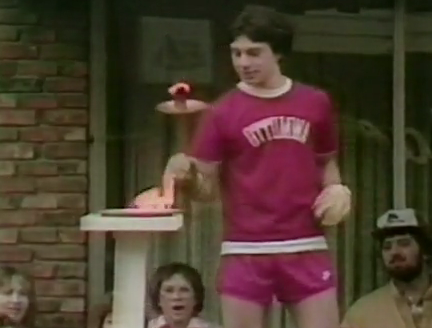
            Day invited 21 of the top players to compete in the event. Only two failed to participate, including Billy Mitchell.  Mitchell wanted to attend but after the expense of the Life magazine trip he decided that he didn't want to spend any more money or take any more days off from school. With the temperature dipping below freezing, the festivities kicked off in Ottumwa on Saturday, January 8th with a torch-lighting ceremony and a parade down Main Street. Heading the pack was a player dressed in a Pac-Man uniform that had been donated by Bally/Midway. In place of the band there were pickup trucks with boom boxes (plans to have a convoy of dump trucks fell through). After the festivities (including, some say, a call from Ronald Regan) and parade, the main event got underway (after, that is, Day chased a gaggle of groupies out of the arcade).  Players competed on five games: Super Pac-Man, Donkey Kong Jr., Millipede, Joust, and Frogger. Each player would play three games on each machine with their highest score being recorded.  The top scorer on each game was given a 100 percent rating with the others given a score based on the percent of the top score (i.e. if the top score was 50,000, a score of 10,000 would be given a score of 20%). The final score for each player was calculated by averaging the percentage scores achieved on each game. 19-year-old Todd Walker of Milpitas, CA was the odds-on favorite. Considered the best all-around player in the world, Walker took a unique approach to video games. He found that it was easy for him to get good enough to beat 99.9% of the players in any given game. Getting good enough to beat the handful that remains, however, would take longer than it did to beat the first 99.9%. Instead, Walker preferred to move on to another game at that point. In Ottumwa, Walker  didn't disappoint He crushed the competition with a winning score of 69.58% - almost 23% ahead of second place. The top three finishers - Walker, Darren Olsen of Calgary, and Ben Gold of Dallas would be compete in the finals on That's Incredible. Joe Malasarte of Anchorage finished fourth, less than one percentage point behind Gold. Eric Ginner, winner of the 1981 Centipede fiasco, finished fifth - largely due to a bug in Frogger. The game had a "kill screen" that appeared randomly, making it impossible to finish the game. Ginner got the kill screen after scoring just 15,000 points. Steve Sanders, author of The Video Masters Guide to Donkey Kong, finished 6th.  Ms. Pac-Man champion Tim Collum finished ninth.  Finishing dead last, with a paltry 12.9% was none other than Steve Juraszek, the original video game superstar (though his critics were not surprised).


The players arrive. I believe that's Steve Sanders in the jacket.


Drawing for position


Final Standings
 
1.    Todd Walker (Milpitas, CA) - 69.58%
2.    Daren Olsen (Calgary) - 46.85%
3.    Ben Gold (Dallas) - 46.17%
4.    Joe Malasarte (Anchorage) - 45.32%
5.    Eric Ginner (Mountain View, CA) - 42.12%
6.    Steve Sanders (Clinton, MO) - 36.97%
7.    Steve Harris (Gladstone, MO) - 36.91%
8.    Lee Whitney (Las Vegas) - 36.87%
9.    Tim Collum (Boyd, TX) - 35.58%
10. Jeff Stueve (Dayton, OH) - 30.66%
11. Matt Brass (Helena, MT) - 29.59%
12. Mike Lepkosky (Spring, TX) - 27.92%
13. Antonio Medina (Napa, CA) - 26.21%
14. Landon Rothstein (Happauge, NY) - 25.49%
15. Tim Foland (Spring, TX) - 21.16%
16. Joe Louks (Moncks Corner, SC) - 20.16%
17. Mark Sellers (Grand Rapids, MI) - 18.87%
18. James Marino (Happague, NY) - 13.15%
19. Steve Juraszek (Mt. Prospect, IL) - 12.95%

----------------------------------------------------------------------
            The finals, which aired on February 21st, were more of a sprint than a distance race. Players had to achieve certain scores on five different games in turn: Cosmos (50,000 points), Burgertime (8,000), Millipede (90,000), Donkey Kong Jr. (30,000), and Buck Rogers (20,000). After the whistle blew, the players ran to the first game. When they reached the target score, they could move on to the next. While Walker was considered the best player, Gold took the early lead - within minutes he was 20,000 points ahead of Walker on Cosmos. Walker lost more precious time when he peppered in the wrong direction on Burgertime. Olsen briefly pulled ahead on Millipede before Gold climbed back to the top. The commentary by hosts Cathy Lee Crosby, Fran Tarkenton, and John Davidson, was unintentionally hilarious: "He piles on the pepper and sends down a bun covered with hot dogs and an egg!" "Junior caught papa and papa kicks the evil Mario temporarily out of the picture!" "Ben, the leader, just lost a life to a millipede head!"


Olsen and Gold finished the penultimate game practically simultaneously and headed for Buck Rogers neck and neck. Olsen quickly took the lead but Gold quickly caught up and was first to the 20,000 mark. He then madly sprinted the 30 feet to the "finish line" pursued by - no one, since Walker and Olsen were still blasting away. Gold, arms raised in triumph, breasted the tape, followed by Walker (who had miraculously managed to catch up) and Olsen. The three collected medals, and kisses, from Crosby (who almost gave the gold to Olsen). The event was perhaps the high water mark of video game popularity in the U.S. The low point would come shortly thereafter.


Much of the information in this article came from Walter Day's outstanding Video Game and Pinball Book of World Records - 1st Edition. Many of you may have skipped this one thinking it's nothign but records, but pick up a copy if you can find one.
Note - That's the FIRST edition, not the 2nd of 3rd.
The first edition had a wonderful 200+ page section on "the golden age of video games" in which Day recounts many of the stories associated with Twin Galaxies. The 2nd edition did not include this section (can't speak as to the third).

OK, this article probably didn't tell you anything you didn't already know but I think the next one will - the fascinating and tragic story of the Electronic Circus.

Sunday, February 24, 2013

Odd Coin-ops From 1987 - Plus Odds and Ends

I recently looked through Replay's 1987 Machine Catalog - 66 pages of all manner of devices for sale to the coin-op amusement industry.
The variety of games was surprising - or maybe not so surprising since operators were looking for anything that might make money in the wake of the crash (cranes, for instance, took up 8 pages).

A few of the odder items:

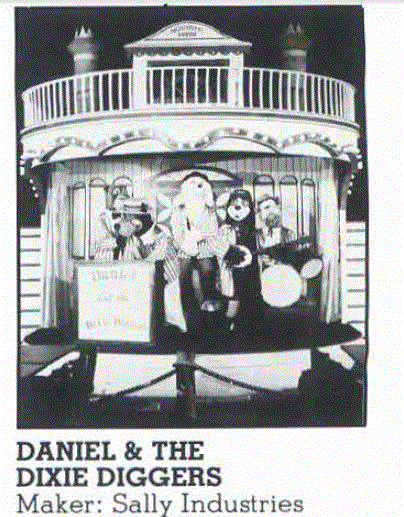
Pizza Time Theate wasn't the only place offering animated mannequins.

Here are a couple of others:


The next one might seem boring (OK, it IS boring) but it does illustrate a litte-known fact.
The breakup of AT&T went into effect on January 1, 1984. One of the results of the breakup was that other companies began making private pay phones. After the video game crash, many operators actually turned to pay phones as an alternatative.
Here is just one of a number of them offered in the 1987 Machine Catalog:


Along similar lines, but probably a bit more interesting were condom dispensers. Oddly, the trade mags seemed to have no compuctions about advertising them (in earlier years, for example, they refused to mention gambling machines).
This oddball combines a condom vender with a love tester.


I assure you that it's only coincindence that I put tis one right after the Sex Tester. Did UBI have a warped sense of humor or were they just unaware of the meaning of the term "bimbo"?


Arm wrestling machines were nothing new in the coin-op biz, but they uusually involved one player against either a video opponent (as in Nintendo's Arm Wrestling) or a mechanical one.
Here's one that pitted two human opponents against one another:


This one gets my vote for weirdest of the bunch. I'm not sure exactly how it works but I don't think it used video or laserdisc footage.
Has anyone out there ever seeen (or played) one in the wild.


A few un-TAFA'd games (Face to Face is on TAFA but they don't have a photo of an actual machine):

Face to Face from SMS Manufacturing


Finally a few photos that I found interesting.

This may have been one of the largest arcades of the 1980s- 270' x 180' with over 1,000 games.
It as located at Cedar Point, the amusement park near Sandusky, OH


As a preview of my upcoming series on tournaments, here is a photo from the the New York Regionals of Atari's 1980 Space Invaders Championship. This wasn't a coin-op tournament. It was on the Atar 2600 version of the game. Over 10,000 competed in the five regionals with one winner from each region competing in the finals in New York. The winner was Bill Heieman (who later had gender reassignment surgery, became Rebecca Heineman and co-founded Interplay).


And for those who missed it, I added some photos of designers to my Cinematronics series.

Here are Kevin Lydy, Phil Sorger, Bob Skinner, and John Rowe (at least I think so, Replay and Play Meter often mislabeled photos of designers):


And here's Medo Moreno: