Tuesday, February 25, 2014

The Tangled History of Omni/Glak/Eagle/Magic Electronics (Part 2)


In part 1, we looked that the somewhat colorful history of Omni Video games. As we left the story, Omni had all but disappeared after coming out on the short end of the Stern v. Kaufman case. Omni prexy Frank Gaglione, one the other hand, was still alive and kicking in the video game industry.

Glak Associates


Around 1982, Gaglione established a new company called Glak Associates, at 25 Eagle Street in Providence. Billing itself as “New England’s largest manufacturer of video games”, Glak had a 40,000-square-foot manufacturing facility, complete with its own cabinet shop and silk-screening department. As with Omni, a number of Glak’s video game seem to have been legitimate, including the same Artic games Omni had produced (some under the Omni brand). Other Glak games included Red Clash (licensed from Tehkan), and Portman (in which the player caught bales of goods off a conveyor belt to fill the hold of a waiting ship). At the 1982 AMOA show, Glak showed Crazy Mazey[1], Woodpecker, and D-Rail (though this doesn’t necessarily mean the games were legit). On the other hand, there were some troubling signs. Glak often sold directly to operators (a somewhat suspicious move in itself). They also dealt with “business opportunity” companies, a term often associated with shady, fly-by-night operators who sold customers shoddy goods at inflated prices. In late 1982, one of these companies (who claims they were actually legit) - Counter Top Amusements of Raleigh NC - terminated their relationship with Glak after a customer complained about a bootleg copy of Frogger they’d been sold.


Eagle Conversions

            In any event, by early 1983 Glak seems to have disappeared as well. By then, Frank Gaglione had already set up a third company called Eagle Conversions (for a brief period at the start of 1982 it seems that Omni, Glak, and Eagle existed simultaneously, though Eagle may have just been another name for Glak). Eagle was probably named for its address at 25 Eagle Street, Building 5, in Providence (not coincidentally the same address as Glak). As its name implies, Eagle specialized in conversion kits, in addition to producing most of the same games Glak did (including those ubiquitous Artic titles). Even with his new company, however, Gaglione couldn’t stay out of trouble. In March, 1983 Universal filed suit against Glak for its illegal version of Mr. Do! and on May 16, the U.S. District Court in Providence issued a temporary restraining order against the company ordering them to stop producing the game (in response, Eagle filed suit against Easter Micro Electronics, though they didn’t say why).


Games I’ve seen associated with Eagle Conversions: Ack-Ack, Crazy Mazey, Devil Fish, D-Rail, Espial, Lady Bug, Popper, Portman, War of the Bugs, Dragon Slayer (?? - suspect this one may have been a typo)

Magic Conversions/Magic Electronics

            By late 1983[2], yet another company had appeared on the scene called Magic Conversions. Located in Cranston, Rhode Island, Magic was headed by Kevin McIntyre. Born in Australia, McIntyre had come to Rhode Island from Sydney on a business trip in 1973. While there, he met a client’s niece named Valerie and the two fell in love. The following year they were married and McIntyre relocated to the Providence area. After serving as VP of Omni, Glak, and Eagle, McIntyre decided to form a video game company of his own, specializing in conversion kits. Magic Conversions’ first game was The Glob (September 1983), which the company released as part of its “Magic Conversion System”. The Glob was an extraordinarily cute platform game in which the player controlled a smiling, blue, quivering “glob” with big eyes name Toby. The goal was to guide Toby through multiple floors of a building, scarfing up fruit from the floors. To move between floors, Toby could summon an elevator by pushing the button (though with what is anyone’s guess since he didn’t have arms or legs). Opposing Toby (“the glob”) was “the mob”: gator, froggy, bunny, monkey, and porker. Toby could either avoid his deadly foes or destroy them by using a limited supply of energy to cling to the ceiling, then drop down on them as they passed, engulfing them in his gelatinous body. With excellent graphics and fun gameplay, The Glob reached #13 on Play Meter’s arcade conversion kits chart. While Magic may have been a new company, they still had ties to Eagle Conversions, whom they licensed to produce The Glob as a $325 conversion kit for Pac-Man. The game was actually designed by Epos Corporation, who would later design three more games for the firm. After The Glob came Eeekk (February 1984), a cute/horror-themed game in which the player guided Sidney the Ghost on a quest to rid his haunted, four-story house of the Fantum Gang. The game was licensed from Shinkai Industries (though some say it came from Epos). Next came a follow-up to The Glob called Super Glob (February 1984) that reached #15 on Play Meter’s arcade conversions chart. In June’s Revenger, the player piloted a ship through 48 sectors, searching for intruder bases, and blasting enemies with torpedoes. Intruders who contacted fallout debris were transformed into atomic mutants with enhanced powers. Epos’s final game for Magic was Igmo (August 1984) in which the player tried to rescue the princess Iggy from her island, where she was held captive by The Dragon Sintar. In 1984, Epos began releasing conversion kits of its own under its Cardinal Amusements subsidiary. Their first game was Beastie Feastie – essentially the same game as The Glob. When Epos had sold the marketing rights to The Glob to Magic, they kept the copyrights to themselves. Or at least they thought they did. Unbeknownst to Epos (and without its permission), Magic had registered a copyright on the game, prompting Epos to form its own game company so it could retain the copyrights to its creations)
NOTE – thanks to Supercade author Van Burnham for unearthing the above information about Beastie Feastie. Expect a detailed history of Epos/Cardinal on Van’s forthcoming revival of the Supercade website (supercade.com)

Other Magic offerings during this time included Popper (licensed from Alway Electronics) and H.B.’s Olympics (designed by Century Electronics/Seatongrove). Throughout the first half of 1984, Magic and Eagle continued to work together, with Magic manufacturing games and Eagle often distributing them. By the time of Revenger, Eagle seems to have vanished, along with Frank Gaglione (who, it seems, had never been directly involved with Magic). Around the same time, Kevin McIntyre renamed Magic Conversions to Magic Electronics. With Eagle out of the picture, McIntyre established another company in Providence called Montgomery Vending to distribute his games. With that, it seems that Magic had broken its ties with its shady past and the company seems to have been on the up-and-up for the remainder of its short life. In the fall and winter of 1984, Magic released a number of new games but none of them saw much success in the arcades. By the end of the year, they had produced almost a dozen titles but only three (The Glob, Super Glob, and H.B.’s Olympics had seen any kind of success).

In 1985, that would change as Magic became one of the industry’s most successful conversion kit specialists. Following are the known games Magic produced from late 1984 on (in roughly chronological order)


Atlantic City Action – a 6-games-in-1 poker game.
Taxi Driver – just what it sounds like. Drive around a cab around a city and pick up passengers.

Bomb Jack – licensed(?) from Tehkan
Curve Ball – licensed(?) from Mylstar

8-Ball Action – a pool game designed for the bar/tavern market. Conversion kit for Donkey Kong/Donkey Kong Junior. Reached #6 on RePlay software charts.

Driving Force – racing game released as a conversion kit for Pac-Man and marketed as an inexpensive substitute for Pole Position II. Reached #8 on RePlay software charts.
Bull’s Eye Darts – a darts game marketed to bars and taverns. Licensed from Shinkai. Conversion kit for Centipede.

Porky – licensed from Shinkai. This one sounds like one Magic’s more interesting efforts. A pig drove around a city landscape avoiding potholes while shooting wolves with smoked sausages and dodging falling bombs and barbecue forks. For bonus points he could jump into the air to catch flying piglets.

Samurai (aka Samurai Nichon-ichi) – Side-scrolling martial arts beat-em-up licensed from Taito. Reached #18 on RePlay software charts and #11 in Play Meter.

Special Forces Kung-Fu Commando – Designed by Senko Industries. The player controlled a gung-ho super commando named Captain Action in a quest to fight off kidnappers and rescue hostages using commando tactics in one phase and hand-to-hand kung-fu in another. Conversion kit for Donkey Kong/DK Jr./Crazy Kong. Reached #6 in Play Meter.

Field Combat – appears to have been a kind of combination of Xevious and Commando in which the player piloted a UFO over a battlefield fighting off enemy foot soldiers.

Grobda – Sci-fi tank game licensed from Namco. “the great alien invasion of 1985 has ended…the evil Xevious empire has retreated to their native solar system pacmanus…[and] left behind advanced nuclear war tanks known as grobdas”

Wiz (aka The Wiz) – Another interesting-sounding game. I’ve never seen it before, but pieced together some info from various reviews and game descriptions. The player controlled a staff-wield wizard, collecting treasure chests and fighting off enemies like gremlins, snails, and skeletons with his magic powers. The wizard was also “…ever searching for elusive dragons” and avoiding falling into craters. One phase began in an ice-encrusted cavern. At one point the wizard was whisked away in a balloon.
Poseidon (aka Poseidon Sea Fighter) – not much info on this one.

Special Forces II (???)

Son of Phoenix (???)
Hex Pool – listed as “coming soon” in flyers produced in late 1985 but may never have been released.

Nun Chackun – ditto

Magic’s most interesting venture may have come at the 1985 AMOA convention when they tried to revive the “Moppet” game concept with a line of games designed for 3-8 year olds called “Child’s Play”. Magic was convinced that the problem with the Moppet games was that they had been too difficult for their target audience. Magic's games (Sailor Sam, Jumbo Pilot, and Race Ace) were much easier. For further appeal, the cabinets also dispensed "badges" (stickers) to every player. The Child’s Play games don’t appear to have fared any better than their predecessors and, with the Moppets, they stand as an obscure footnote to video game history.

 
          By the end of 1985, things seemed to be going well for Magic. Around November, it consolidated all of its operations into a new 25,000 square-foot facility in Providence. In 1986, however, things went rapidly downhill (or maybe they hadn’t been going so well in the first place). On May 14, Magic petitioned the courts for debtor protection and filed suit against a number of companies for licensing games to Magic that they had no right to. On May 23, Kevin McIntyre (who had reportedly been forced to sell his home) went before the Rhode Island Superior Court to get permission to sell off its assets. The court granted permission and on June 12, Bob Henry of Hi Tech Coin Distributors bought them all (including a number of unsold machines, parts, and equipment) for a paltry $1,000.


[1] Rotheblog claims that Crazy Mazey was originally developed by Ron Meadows for the Apple II.
[2] The December, 1984 issue of RePlay says that the company was founded in “late 1982”. However, the December, 1983 issue of RePlay claimed it was a new company that had just entered the field. Given the timing of their games, the 1983 date seems more plausible.

BONUS PICTURES

Here a few undocumented games I found in the September, 1988 RePlay catalog issue


This one is documents, but I thought it was interesting nonetheless:


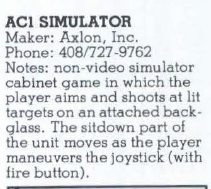
This one isn't a video game:


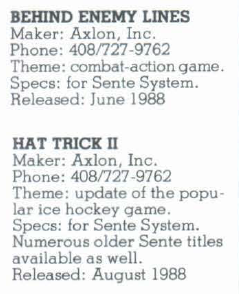
These are the games I found most interesting. They were developed by Axlon for the Sente SAC-I system. For those who don't know, Sente was a company founded by Nolan Bushnell that started producing video games in October, 1983 (after Bushnell's non-compete agreement with Atari expired). They planned to revolutionize the industry with a "system game" called SAC-I. They had plans for other systems, including SAC-II (a motion cabinet used for the barely released Shrike Avenger), SAC-III (originally a laserdisc system but it later went through a number of changed in concept - at one point it was a crane game with a robot arm), and others (IIRC there was a SAC-IV and SAC-V as well but I don't think they even got around to specifying what they were).

After Pizza Time Theatre got into trouble, Bushnell sold Sente to Bally. When WMS bought Bally in 1988, Sente (or at least its assets) was purchased by Bushnell's Axlon Inc. They announced plans to produce new games for the SAC-I system but I don't know if they ever did (I suspect they didn't).


Axlon produced some non-video games (and it looks like they actually made Frenzy, or at least a prototype)


Sunday, February 16, 2014

The Ultimate (So Far) History of Allied Leisure/Centuri - Part 8


Today’s post is part 8 of my ongoing history of Allied Leisure/Centuri. It mostly covers Tunnel Hunt and as such is basically a repeat of a post I did earlier. Sorry for that, but I couldn’t leave the game out of my history.

Tunnel Hunt


            While The Pit had a convoluted history, it was nothing compared to July’s Tunnel Hunt. The game, which was actually designed by Atari’s Owen Rubin, started life at Atari as Tube Chase and was Rubin’s first color vector project. Initially he started with an Asteroids vector system and used some Night Driver code to create a simple flying game.


[Owen Rubin] I started the game as a vector graphics project based on the opening landing sequence in the movie Aliens. It did not work in vector, but that took several months to discover. Dave Sherman had an ellipse generator that he thought would be good, so I spent nine months or so and did this great game of flying down tunnels. The tunnels split and merged and you occasionally exited into space where you could fly into one of several other tunnels (worm holes). . .The only way you could slow down was to hit the walls, but that raised the hull temperature. It was a good strategy to bump the wall to hold off a target so that you would not overtake it, especially if your lasers were out. . .  It had a great cabinet. It “wrapped” around you with speakers behind and in front. You stood, not sat, and it blocked out outside noise. The controller was a flight stick for flying with buttons for firing and shields.


The game was play-tested and was ranked a solid #2 or #3 for 10 weeks straight. Atari, however, would not feel comfortable releasing it unless it reached #1 and asked Rubin to make some changes. After Rubin spent another six months working on the game, management decided that it was too expensive.


[Owen Rubin] So we cheapened the hardware to do circles only. This made the split tubes ugly, and the warping of the tunnel effect was lost... It took another four months to make the changes. We field tested it again – #2, solid! They changed the hardware again to make it even cheaper, which allowed only one sorted list of circles and so I had to take out the splits. The game was MUCH simpler now, but still the same basic game play.  [It was] still too expensive, so Dave [Shepperd] did a rectangle generator and I rewrote the game for a square tube. After 3-4 months [we did] another field test – still #2 for another five weeks (at different arcades all the time as well). So after almost two years of screwing around with it, they decided to sell the game to a competitor – something Atari had NEVER done. So, I stated another turn to change the name to Vertigo for Exidy. This was harder than it sounds because I put some VERY elaborate security code in the game to prevent a clone company from being able to copy the game and remove the word Atari from the screen. After all this time, I forgot where it all was. Another three months and they had their game. They field tested it again, but now it was only earning a solid #3. After all, it was OVER two years old and starting to look out of date.
 
In Exidy’s version, the game was packed into a cockpit cabinet. After building a small test run, however, Exidy decided it didn’t want the game after all (though they did go on to develop another, unrelated, game. In a cockpit cabinet bearing the same name). 

[Owen Rubin] About three months later, they rolled the game back into my lab and asked if I could make “just one more change”. This line became a joke because they’d asked this maybe 70 times by now. I changed it AGAIN, this time for Centuri in Florida, and they did build the game. Unfortunately it was now almost three years out of date…The kicker to all this is that after I left Atari, I went immediately to Bally/Sente to work with some old teammates from Atari. When I walked into my new law, there was a Tunnel Hunt with a sign asking if I would make “just one more change”. Of course, they didn’t really want it, but I got a VERY good laugh out of it.                                                                             

While Centuri did release Tunnel Hunt, it was even less successful than The Pit and netted Centuri just $1.15 million in sales (probably less than 1,000 copies). Centuri’s final release of 1982, September’s The Swimmer (licensed from Tehkan), didn’t do much better, netting the company just $1.49 million (though it might have made more money in 1983).


 Centuri – 1982

            After their “annus mirabilis” of 1981, Centuri failed to reproduce its success in 1982. In fact, they didn’t even come close. Centuri’s revenues for fiscal year 1982 (which ended October 31) fell from $61.5 million to $37.6 million and the company lost $2.9 million. It was déjà vu all over again. Centuri sold just 8,682 video games during the year, resulting in $14.1 million in revenue, but losses from video games were $3.1 million, even greater than losses as a whole. Their biggest “hit”, The Pit, accounted for 21% of video game revenues. With arcade video games in decline, the company began to branch out into other areas. In February, they struck a licensing deal with Atari for home rights to Phoenix, Vanguard, and Challenger (the Phoenix license would be the basis for Atari’s November suit against Imagic over the Demon Attack cartridge). In May they sold $10 million of their convertible notes to a California life insurance company to raise some much-needed cash. The biggest move came In September, when Centuri acquired Outdoor Sports Headquarters Inc., a wholesale distributor of hunting, fishing, camping, marine, and archery equipment with four retail stores in Ohio and Indiana (though the stores accounted for less than 5% of Outdoor Sports’ revenue). In September and October alone, Outdoor Sports generated $20.9 million in revenue (more than video games had for the entire fiscal year) and turned a modest profit of $134,000. In the final two months of the calendar year, Centuri had revenues of $21.2 million and a profit of $72,000 with most of the total coming from Outdoor Sports.
            In response to the decline in their video game business, Centuri also made a number of personnel changes in 1982. In the spring, Ed Miller resigned as president and formed his own company called Telko Properties, which worked with Miami’s Techstar (founded by former Centuri VP Bill Olliges) to secure licenses for their games. A short time later, Centuri brought in another coin-op veteran – Arnold Kaminkow – to replace him. In addition, Centuri laid off a number of workers in their Hialeah plant and shut down their development lab in Bensenville, IL. With the industry crash already underway, things were not looking good for Centuri’s video games, but 1983 would be much different from 1982.
 
Bonus Pictures
First, a few more undocumented games:
 
 
Above photo is from the 1982 AMOA show
 
 
Photo above is from June, 1976

The next one is not a photo, but it does confirm the existence of Shadco's Mister Doodle and Naughty (for which I posted an ad earlier). This one's from August, 1982


Anybody ever seen the following? Wonder if you could put a Moppet game in there?


This one's not a video game, but it's interesting anyway:


Finally, a little peek behind the scenes. Here's a Gremlin IC inserter from 1982:


Monday, February 10, 2014

A Sampler of Coin-Op Football Games - Part 1 (non-video games)


I planned to post this on Superbowl Sunday, but obviously didn’t get around to it. In honor of the Superbowl I wanted to look at a few coin-op football games. While there have been dozens over the years (including one made in 1892, thought I don’t know if it featured American Football or Soccer), here are a few that illustrate the variety of coin-op games that existed (mostly) prior to the rise of video games

 1. Play Football – Chester-Pollard Amusement Company– ca 1926


OK, this was soccer, not American football, but it was a very cool, and very popular game. The Chester-Pollard Amusement Company was formed in New York by three Chester brothers (Pollard was their mother’s maiden name). Football was an English game that Chester-Pollard bought the rights to for production in the U.S.

You can see the machine in action at this link at this link.

If you are interested in antique coin-op machines, take a look at some of the guy’s other videos. A few of my favorites: Bally Alley,  1901 Rifle Game (love the mechanism), The Locomotive (created in 1885 by William T. Smith, this is considered by some the first American-made coin-op amusement device).

 2. Army- Navy – Rock-Ola – 1934


Rock-Ola made a trio of absolutely ingenious pinball games in 1933 and 1934. First was Jigsaw (aka World’s Fair), in which the player flipped over pieces in a miniature jigsaw puzzle. Next was World Series, which featured a rotating baseball diamond. Then there were Army-Navy, which simulated a football game and even kept score.

I would try to describe it but this video does a better job than words could. Jigsaw sold 50,000+ copies and World Series sold 75,000. Army Navy didn’t sell nearly as well (though maybe it should have). On, and if you didn’t know, these game were 100% mechanical. No electricity at all, just some brilliant engineering.

There were plenty of other pinball games over the years with a similar idea (Gottlieb’s 1973 Pro Football is a good example), but Rock-Ola was there first.


3. Football – Victor Vending – 1950
This one was a gum vending machine.


4. Air Football – Mike Munves – 1954


Munves also produced a game called Air Hockey at the same time. This took me aback at first. Air Hockey was supposedly invented by Brunswick around 1972. Could that be wrong? Probably not. It appears that Munve’s game just used air to push the ball/puck across the table. There doesn’t appear to have been a cushion of air that the ball floated on.

5. Quarterback – Genco – 1957


Photo courtesy of pinrepair.com (an outstanding source of info on electromechanical arcade games). Despite the fact that it was called Quarterback, it looks like a kicker to me.

6. Touchdown – Williams – 1965


Another photo from pinrepair.com

This was actually a “pitch-and-bat” game. Pitch-and-bats were baseball games that featured a miniature bat you used to hit a ball and score doubles, triples, homeruns etc. Some of them had a “running man” unit like the one seen here. Others used miniature figures of baseball players. Most of them depicted baseball, but here’s an example of a football variant. Williams produced two more football pitch-and-bat games, both named Gridiron, in 1969 and 1984 (the latter as a conversion kit).

7. All-Star Football – Chicago Coin – 1972


Wall games were a fascinating, short-lived, mutant variety of game that appeared in bars in taverns mostly from about 1970-1975 before video games basically put them out of business. They used light bulbs behind a plastic screen and usually had remote controls boxes with a single button for controls.

 8. Challenge Football – Unknown – 1975


I posted a picture of this one before. I have no other information about it but it sure looks cool.

9. Touchdown Football – Intermark – 1988


A football version of Pop-a-Shot.

10. Football Frenzy – Island Interactive – 1990s??


A football-themed redemption game.

 Next time - back to video games.


Wednesday, January 29, 2014

The Ultimate (So Far) History of Allied Leisure/Centuri - Part 7


            In 1981, Centuri had undergone one of the most remarkable transformations in coin-op history, going from perennial also-ran to major player in a single year. As 1982 dawned, they seemed ready to enter the upper echelons of the industry, but only time would tell if they would be able to do so.

1982 Games (Part 1)
Round-Up

 
            Licensed from Hiraoka[1] (probably the same company that created Phoenix), Round-Up was released in December of 1981. The game was a combination maze/puzzle game with emphasis on “puzzle”. The player controlled a character called “Cowboy” who, despite his name, was more of a ghostly-white version of Pac-Man with eyes, legs, and a pink hat. The action took place in a concentric maze at the center of which was a grid of 9 (later 16) white circles. The goal was replace all the white circles with red ones. To do this, “cowboy” had to “round up” red “knights” then “push” a new red circle into a row or column of the grid. Opposing Cowboy were five “gly boys”: Ugly, Beastly, Ghastly, Homely, and Deadly. Aiding his efforts was King Rompus, whom the player could touch to temporarily freeze all enemies and knights. The game also featured a bonus round in which the player had complete one side of a Rubik’s Cube (which they called an “electronics cube”) so that it matched a target pattern. While the game was certainly innovative, it wasn’t much of a hit and Centuri probably sold around 700-1,200 copies. The game was later released by Taito as Fitter.
D-Day
 
 
            One of Centuri’s sorriest releases was April’s D-Day, licensed from Italy’s Olympia, a company that had been founded by Livio Leante. While Olympia was headquartered in Milan, their games were developed and manufactured at their factory in Bari (supposedly home to the second university in Italy to offer a degree in information science). Olympia produced its first game, Master’s Game (a Breakout-like game) in 1979, possibly under the Leante Games brand. From 1979 to 1983, the company produced at least a dozen and a half titles, many of them knockoffs of existing hits. ­D-Day was their most successful game and the only one to be released in the U.S. Looking at the game’s crude graphics, it’s hard to see why. The game was a shooter in which the player used a single cannon to defend a beachhead from enemies including tanks, ships, planes, and trucks. It was a perhaps Centuri’s biggest flop of the decade and probably less than 100 units were sold.
 
Loco-Motion/Guttang Gottong

 
A bit more successful, but not much, was Loco-Motion (known as Guttang Gottong in Japan), licensed from Japan’s Konami (formerly known for their very profitable relationship with Stern). . The game was based on the ubiquitous 15-piece sliding block puzzle invented by Noyce Chapman in 1880 in which the player slid blocks horizontally or vertically within a frame to complete a picture or rearrange the blocks in numerical sequence. In Loco-Motion, the video “frame” contained 15 blocks, each with a section of a railroad track on it. As a train chugged around the track, the player had to slide the blocks to create a path for it and prevent it from crashing. The player also had to guide the train to pick up trackside passengers. If a passenger wasn’t picked up within a reasonable amount of time, they were replaced by a countdown timer and if the player didn’t reach the timer before the time reached zero, A “Crazy Train” appeared that the player had to avoid. While the game was not a hit, it was one of the earliest examples of an arcade puzzle game.
Centuri sold only $576,000 worth of Loco-Motion games in 1982, probably translating to about 300-500 units. In the long run, however, the game may have Centuri’s most important release of the year since Centuri’s relationship with Konami would prove perhaps even more lucrative than Stern’s had been.

 The Pit


1982 was an international year for Centuri. Loco-Motion had been licensed from a Japanese company, D-Day from an Italian one, and April’s The Pit came from jolly old England. The game was developed by the British company AW Electronics (aka Andy Walker Electronics, for its founder). In his youth, Andy Walker had served as a shipboard radio operator before spending ten years in the British Foreign Office. In 1977, while working at a government electronics center, he had his first brush with computers when he encountered a Honeywell 316 mini-computer. Instantly captivated, he purchased a kit computer consisting of single board with an 8080 microprocessor, a small amount of RAM, and a set of 8 red LEDs for output (as with the Altair and other early computers, it didn’t support a monitor). The only documentation consisted of a single photocopied page of instructions and a copy the 8080 instruction set. Programs had to be entered a byte at a time via 8 toggle switches. If the user made a mistake, they had to start over again from the beginning. In addition, the computer had no way to permanently store data, so even if a user did enter the data correctly, the program only lasted until they turned the computer off. This led to an amusing (at least in hindsight) incident. Walker entered program after program, only to find that they didn’t work. After spending days trying to sort things out, he finally discovered that to enter a 1 the user had to flip the toggle switch up and to enter a 0 he had to switch it down. This was obvious to American users but not to Walker, since in the U.K. (and most other countries), switches worked exactly the opposite way (to turn a light on, for instance, you pushed the switch down rather than up). Nonetheless, Walker eventually tamed the electronic beast and taught himself how to program in hex code. In 1981, fascinated by the new microcomputers that were appearing on the scene, Walker asked his bosses to send him to a small systems course to learn more about the machines. Convinced that the future was in mainframes and minicomputers rather than micros, they refused. Not long afterwards, Walker’s job changed and rather than relocate he quit and formed a company called Andy Walker Electronics (AWE - aka Slogan Court Ltd.) in the seaside town of Birdlington.
 
 
Deciding to build a computer of his own, Walker acquired a Tangerine Microtan 65 computer (a 6502-based kit computer). After putting it together, he ordered another and began writing programs in assembly language, displaying simple, interactive shapes on a black-and-white monitor. Realizing the system had potential, he hired another programmer named Tony “Gibbo” Gibson from Barnstable in Devon. Meanwhile, he purchased three graphics board (one each for red, green, and blue) and set about designing new hardware that expanded the MicroTan’s meager RAM, sound and graphics capabilities. After persuading a local company to turn his design into actual circuit boards, Walker programmed a crude Defender clone called Andromeda on his new system. Realizing that it was a bit too crude, he trashed the game and started again, eventually bringing in Gibson. Working together in a spare room in their house, Walker and Gibson would write code in assembly language then print it out and pin it to the wall so they could remember the memory addresses the next day. When they added joystick control to the game, they realized they could make a coin-op game. Young and full of confidence, they decided they could create their own from scratch and Walker began designing a cabinet. He ended up creating a multi-game system that allowed operators to swap ROM boards on the fly without turning the machine off (Walker described it as a “video jukebox”). Around this time, a third member joined the team - a graphic designer named Andy Rixon. Before long, the trio had created two additional games for the system: Hunter and The Pit. Oddly enough, it was a bug in Andromeda that led directly to the creation of The Pit.  
[Andy Walker] The spaceship had a fin on the back and it didn’t always rub itself out. It would paint the screen in pixels but then when it went through a second time it would tunnel through them. Ah, there’s a game there.
            <”The Making of The Pit”, Retro Gamer #85>

With three games completed, Walker and Gibson packed their system into a rented Nissan van and headed to the Cunard Hotel in Hammersmith for the London Previews (a prominent British trade show). They set up a small both next to a major manufacturer (where the near constant music from a Frogger machine nearly drove them mad) and got their system up-and-running, which required loading the operating system from cassette tape - a process that took fifteen minutes or more. Then, five minutes before the show started, an electrician told everyone they were going to turn off the power for a few minutes. Panic set in as Walker and Gibson had to hurriedly reboot their system and wait several painstaking minutes as the first visitors wandered into their booth only to be greeted by a screen with a “loading…” message.
In the end, however, things worked out just fine. They made the acquaintance of Norman Parker, who headed Zilec Electronics in Burton-on-Trent, one of the U.K.’s leading arcade game manufacturers. Parker took a look at their system and was duly impressed. After the show, Walker paid a visit to the Zilec factory and Parker suggested he show his system to Centuri sales exec Joel Hochberg, who was Zilec’s agent (it appears that he had also set up his own company called Coin-It by this time). Hochberg was interested in their system and had them ship it to him in Florida (Zilec actually handled the shipping). During testing in Miami, The Pit proved to be the most popular of the system’s three games and Hochberg quickly licensed it to Centuri, netting AW Electronics a royalty of $136 per machine at a time when the going rate was around $40. Hochberg took a large part of the royalty for himself, but Walker didn’t mind since Hochberg had given him the foot in the door he needed to establish himself in arcade industry. While Hochberg liked the game, the multi-game system proved impractical
 

[Andy Walker] Our (treasured) rack-mounted Tangerine custom hardware worked fine but was really unsuitable for mass-production and Joel suggested that we completely abandon it in favour of Centuri (capable, successful) boards - and he was right. The software guys at Centuri knew their board inside-out and got The Pit rewritten in fantastic time. It was quickly agreed that it should be released as a single game - and that was shown to be right decision too.

Meanwhile, Zilec/Zenitone produced a version of The Pit for English arcades based on the Galaxian board and assigned the task of porting the game to a pair of new Zi       lec engineers – brothers Chris and Tim Stamper (who went on to form their own company called Ashby Computers & Graphics, designed the game Blue Print for Bally/Midway, and later founded the software company Rare).
      The Pit was a digging game – a kind of crude predecessor to Dig Dug, Mr. Do, and Boulder Dash (whose creator, Peter Liepa, named The Pit as a major influence). The player guided a "space prospector" through an underground landscape strewn with boulders in an effort to collect a series of seven gems while avoiding enemy astronauts and falling rocks. Three of the gems were located in a large rectangular "pit" at the bottom of the screen whose ceiling was lined with falling enemies. Other obstacles included a pool of green acid(?) with a disappearing floor above it. While the player collected gems, the "zonker" (a name had chosen for the American version) slowly chipped its way through a mountain protecting the mother ship. If the player made their way back to the mother ship before the zonker "zonked" it, they received a bonus depending on how many gems they collected. As with most games, there were a few features that didn’t make it into the final version. The game was originally to feature additional levels, culminating with a fight against the "Grand Dragon". Despite the fact that the Grand Dragon never made it into the game, it may have influenced a much more popular digging game.
 

[Andy Walker]…when we were at the preview show, we all knew it was a work in progress. We described it as such to some Japanese people who were extremely interested. I think they were from Namco or Atari. We described how you would find the Dragon and blow it up. Not ‘you kill it’ but specifically ‘you blow it up’. The Japanese gave us an old-fashioned look then made expanding gestures, then “boom”. The point being that when we said “blow it up” they thought “inflate.”
          <”The Making of The Pit”, Retro Gamer #85>

The idea of a dragon that you “blew up” later turned up in Namco/Atari's Dig Dug. Walker claims that when he mentioned the uncanny similarity to Atari, they informed him that THEY were suing HIM for stealing their (or rather Namco’s) idea. Luckily, at Joel Hochberg's suggestion, AW had registered a U.S. copyright on their game in November of 1982, two months before Atari and Namco copyrighted Dig Dug and nothing came of the threat. While The Pit wasn’t a major hit for Centuri, they did sell $2.9 million worth, probably about 1,200-2,000 units[2].

The Pit ended up being AW Electronics sole arcade video game. They did develop a few games that never made it to production, including Stamper (a game in which the player tried to deliver items by foot, plane, or car while avoiding being stomped flat by wandering beasts) and Hunky DoorKey (a maze game in which the player collected keys to open doors). Meanwhile, with their royalties from The Pit, Andy Walker and Tony Gibson purchased some Intertec Superbrain computers and began working on another game called Pipeline. Eventually they formed a company called Tasket and released Pipeline for the Commodore 64, along with a number of other innovative titles such as Super Pipeline (probably their most popular game), Seaside Special (which involved throwing seaweed at leading U.K. politicians) and Bozo’s Night Out (in which the player guided a character named Bozo on a pub crawl, trying to get as drunk as possible before returning home safely)


[1] While the game’s flyer says it was licensed from Hiraoka & Co, the attract screen says it was copyrighted by Centuri and Amenip.
[2] According to Centuri’s annual report, their biggest production run of the year was 2,000 units. If there was only one game per run and The Pit only had one run, that would mean The Pit sold 2,000 units. If there was more than one game per run (the report said that Centuri never had more than two games in production at one time) then the figure would be lower.

BONUS PICTURE

This has nothing to do with Centuri but I was recently discussing Taito America's games and thought I'd post the following. It's a marquee for the ultrarare Taito America game Black Widow that was sent to me by the game's designer, Mark Blazczyk. Some report that the game was unreleased, but Mark recalls that a few copies made it out the door.