Thursday, November 1, 2012

1975 Atari Photos and UnTAFA'd Games Project

One of the things I've been doing for my book has been to go through old issues of the various video game industry magazines (Replay, Play Meter, Vending Times, and Cash Box).

TAFA, KLOV, and arcade-history.com are invaluable tools for documenting the existence of bronze and golden age video games (or at least their flyers) but TAFA only includes flyers and many games didn't have them.

This post will be the first in a series documenting games I fiind that aren't listed on these sites.. Unfortunately, my pictures are of VERY poor quality. Many of the old Replays I have are ones I scanned in black-and-white years ago.
The Vending Times issues I have are from the local university libary and are tabloid size and bound in yearly volumes, making scanning very difficult, even with my wand scanner (especially when they are on the inner edge of the page).

They're better than nothing, however, and I hope it's valuable to document them somewhere.

First, however, a few interesting Atari photos from the May, 1975 issue of Vending Times.
Here's one of Nolan Bushnell in the factory in Los Gatos amidst a bundh of Atari and Kee games.


 This one is for a game called "Indy 500". This must have been an early name for Indy 800. Oddly, ther was a mini-flyer for Indy 800 in this issue and the previous one.


From another 1975 issue, here's a photo of the production line at United States Marketing:


On to the games:

A miniflyer for Grand Slam by Westlake Systems (Replay, October 1975). Not listed on any of the three sites.


From the May, 1974 Vending Times, Electro-Fun 401 from Electromotion. This one is listed at arcade-history but there's no photo.:


 From 1974, Tele-Tennis by United States Marketing. This one is listed at arcade-history with a photo, but I thought I'd include the ad/mini flyer.


From August 1975 Vending Times, the Scandia cocktail table from Project Support Engineering. Not listed on any of the sites.


From Vending Times, 1975, an ad for Scoreboard Electronic Games. I don't know if they licensed their games, distributed games from other companies or what:


.
From the February, 1976 issue of Replay. Fascination, Ltd's Fascination 700 (this one is listed at arcade-history under Fascination but with no photo of this model).


From the August, 1976 Play Meter. Gametech's Olympic 9. On arcade-history with no photo.


Finally, an announcement from the July 1976 issue of Replay. No photo, but I include it because the company (Can-Am) isn't even listed on any of the sites.

Sunday, October 28, 2012

Atomic Castle and Pitchman


Screenshot from Pitchman from the January 1984 issue of Video Games


The LDCS Laser Jukebox at the 1983 AMOA show
Bob Walker and Elizabeth Falconer


Wednesday, October 24, 2012

A Trip to the Penny Arcade - Circa 1907


Today's post is a bit a departure. One of my favorite "video game" books is Dick Bueschel's Arcade 1.
 

In truth, it really isn't a video game book, though it does cover seven video games in its 300+ pages. It is the first of a planned five-volume series on the history of "arcade" machines (basically, any coin-operated amusement machines other than jukeboxes, pinball, slot machines, trade stimulators, or vending machines ). The volume was subtitled "Ancient Lands to Wonderlands: 3600 BP to 1905". To give you an idea of the depth of information in Bueschel's books, look at his Pinball 1, the first of a planned 10-volume series on pinball. While most histories of pinball start with Gottlieb's Baffle Ball, Pinball 1 has a 100-page history section that ENDS with Baffle Ball.

Arcade 1 has a 150-page history of arcade games, a price list, a game list, a section covering 100 games from all eras, and a bonus section. While it starts at 3600 BP, it really concentrates on the period from the 1880s to 1905. Sadly, Dick Buesehel passed away before completing any more volumes in either series.  

Anyway, on to the subject of today's post. The "bonus section" in Arcade 1 consists of a guide published around 1907 by the Mills Novelty Company of Chicago called "Mills Penny Arcades". It is a guide to operating a penny arcade (the heyday of the penny arcade was the 1902-1907 period).


Mills Novelty Company was one of the two leading producers of arcade machines of the era (the other was Caille Brothers of Detroit). They are probably best known for their slot machines (particularly the Owl introduced in 1897 and the Liberty Bell introduced in 1906).

The guide contains a list of suggested machines for various arcade setups. The most expensive setup (costing around $5,000) includes the following. I think this gives a nice picture of what a penny arcade would have been like circa 1907.  Notes about the various machine types follow:
·         24 Auto-Stereoscopes and 37 sets of 15 views each
·         8 Illustrated Song Machines with 1 set of 12 views and 1 record each, plus 8 extra sets of 12 views
·         5 Quartoscopes and 10 sets  of 4 dozen views
·         5 Automatic Phonographs with 1 record each plus 5 extra records
·         3 Illusion Machines
·         1 new Owl Lifting Machine
·         1 new Owl Dumbbell Lifting Machine
·         1 new Owl Flashlight Lifting Machine
·         1 new Owl Chimes Lifting Machine
·         1 Flashlight Grip Machine
·         1 Submarine Lung Tester
·         1 Rubber Neck Lung Tester
·         1 Hat Blower
·         1 Searchlight Grip and Lung Tester
·         1 Bag Punching Machine
·         1 Pneumatic Punching Machine
·         1 new Vertical Punching Machine
·         1 Sibille Fortune Teller plus 2,000 extra cards
·         1 large Horoscope Fortune Teller plus 2,000 extra cards
·         1 Conjurer Fortune Teller
·         1 pair Jumbo Success Fortune Teller (one for ladies, 1 for gentlemen)
·         1 Madame Neville Palmist with 1,000 letters plus 1,000 extra letters
·         1 Cupid Post Office with 1,000 letters plus 1,000 extra letters
·         1 Mills Perfect Weighing Machine
·         1 Large Electric Shock Machine
·         1 Doctor Vibrator
·         1 Lady Perfume Sprayer
·         1 24-Way Multiple Postal Card Machine with 2,000 cards plus 2,000 extra cards
·         1 Emblem Embossing Machine with 600 emblems plus 500 extra emblems
·         1 Windmill Candy Machine
·         1 Combination Money Counter for pennies
·         1 Automatic Pianola with 1 roll of music plus 2 extra rolls (4 pieces to the roll)
·         1 Cashier's Desk
·         1 Repair Outfit
·         1 Key Board with lock
·         48 Key Rings
·         96 Key Tags
·         36 Coin Bags
·         100 Perforated brass 1c brass slugs
·         50 Weekly Statement Sheets
·         Various signs

 
Stereoscopes, Quartoscopes, Illusion
These were peep shows that contained a number of stereo views or photos. The Quartoscopes contained 4 sets of 12 views each. Interestingly, the list does not contain any movie viewers. Edison's Kinetoscope appeared around 1894 and the Mutoscope followed about a year later. Kinetoscope and Mutoscope parlors were hugely popular in the 1890s but soon disappeared (the Kinetoscope had a loop of film, the Mutoscope had a bunch of still images that were flipped to give the illusion of motion). They were eventually supplanted by the rise of the Nickolodeon and other movie houses.


Quartoscope


Automatic Phonograph, Illustrated Song Machines

Automated phonograph parlors were also common in the 1890s. Edison didn't actually envision the phonograph as being primarily an amusement device (he thought it would be put to more serious uses). Phonographs in phonograph parlors included either 3 or 4 individual listening tubes or one large one that could accommodate about four people. The automatic phonograph also faded from view around this time and was replaced by coin-operated pianos, orchestrions (which included percussion instruments etc.) and other music machines. It wasn't until the first amplified model in 1927 and the repeal of prohibition that automatic phonographs came back (they were eventually called jukeboxes).
The Illustrated Song Machine was a combination peep show and automatic phonograph.


Lifting Machines, Punching Machines  and Grip Testers

Athletic test machines like this were really the first arcade games. The first coin-op devices overall were vending machines (Heron/Hero of Alexandria described a coin-op holy water dispenser in 215 BC but that was kind of a fluke). The first coin-op amusement machines were "exhibition machines" like Henry Davidson's Chimney Sweep of 1871 or William T. Smith's The Locomotive of 1885 (considered the first U.S. made coin-op amusement machine). In the 1880s, various strength testers etc. began to appear in bars and taverns (actually, they had been there before but in the 1880s people started adding coin slots). Lifting machines involved pulling on handles. grip testers involved squeezing handles etc.
Chimes Lifter

Lung Testers

Another form of athletic tester, these involve blowing into a tube for as long as possible.  The Mills Submarine and Rubberneck models were pretty cool. The first had a case with four tiny deep sea divers on strings. As you blew, they were raised one-by-one. The second had a mannequin with a neck that you stretched.  The Hat Blower wasn't bad either.


Shockers (and Doctor Vibrator)

These were some of the most bizarre machines of all. Believe it or not, people would actually pay money for the privilege of receiving an electric shock. After depositing their coin, they would grab a pair of metal handles and wait while the current passed through their bodies. They were usually billed as therapeutic (hence "Doctor" Vibrator - and shame on you for what you were thinking). Two of the most popular with Midland Manufacturing's Electricity Is Life and Exhibit Supply's Electric Energizer (aka Spear the Dragon), in which you tried to hold the handles the until a dragon-slaying knight crossed a bridge to spear a dragon, an act rewarded by the ringing of a bell.


Fortune Tellers, Cupid Post Office, Card Venders

Coin-op fortune tellers have been around since at least 1867. One of my favorites was the Roovers Brothers Educated Donkey (with a donkey dispensing fortunes). Cupid's Post Office delivered love letters. Other card venders delivered horoscopes, postcards etc. In the post-World-War-I years, card venders became the backbone of the coin-op industry and Exhibit Supply Company was the leading manufacturer by far.


 Other Machines

The perfume sprayer was just what it sounded like (one model, called Take the Bull By the Horns had you grab the horns of a steel bull's head then get spritzed with perfume). The Windmill was a candy machine with a three-bladed "windmill" that spun around. The embossing machine printed out metal tags.


The guide also lists a number of other booths and attractions that could be bought for arcades, including, an automatic rifle range, electrical games (in which you won prizes by plugging into a switchboard), ball throwing games, a rough house (throw balls at the windows of a tiny house), a palmistry booth, glass blowing demonstrations, and a fish pond (catch fish with a pole to win prizes).

 Anyway, I know they're not video games, but I think these machines are pretty neat if you can find them. The Musee Mecanique on Fisherman's Wharf in San Francisco has a bunch of them. I think Marvin's Marvelous Mechanical Museum in Farmington Hills, MI has them too, but I've never had the pleasure of visiting.


Monday, October 22, 2012

Update On Reiner Foerst's Nurburgring

I just dicovered some excellent new information on Nurburgring here:
http://historyofracinggames.wordpress.com/installment-three/

The website is Lance Carter's History of Racing Games and had a LOT more info about the game (including quotes fro Dr. Foerst himself).

The first thing I noticed is that I spelled Reiner's name wrong - it is actually Foerst, not Forest.

You can read the articles yourself, but among the many fascinating details

  • The first Nurburgring game was started in 1973, maybe even earlier (it isn't entirely clear from the website, but the idea may have come in 1971, before Pong)
  • Midway co-founder Iggy Wolverton visited Foerst and led him to believe that a licencing deal was in the works (or at least Foerst somehow got that impression)
  • Foerst produced a version of the game in a tilting sit-in cabinet, another in a rotating cabinet, and even a "competition" version that allowed 8 machines to be linked together (and this was in 1983/84).
  • Interesting info about the game's sounds.
  • Foerst claims that after he and Ted Michon met in the Dusseldorf bowling alley (where they bowled together), Michon called his "boss" and then became nervous, told Foerst he had no choice but to end the conversation, and left (though he does say that he and Michon continued to correspond afterwards, which matches what Michon told me).

Friday, October 19, 2012

Atari Head-To-Head Rifle Game and Other Patent Goodies

Researching a book on video game history often invovles poring over patent records. Sometimes they can be boring but more often than not I find somthing interesting. Here are a few I found recently.

First up is this patent filed on January 30, 1978 by John Romano and Roger Hector of Atari, Inc.
It is for a two-player, head-to-head ifle game (non video).

I've never seen this game on any list of Atari prototypes (at least not that I remember).
The screen in between the players had obstacles like trees and islands that blocked your opponent's shot. It also displayed the score. The object was to hit your opponent's target.

Here's another Atari patent. This one was filed on April 28, 1977 by Steve Bristow and David Dean.


Off the top of my head, I don't recall seeing this one either. It doesn't look anything like Qwak or Triple Hunt.
Of course, just because they patented something doesn't mean it got to play testing. I don't know if it even means they built a prototype.

This one's not quite as interesting. It's another Atari patent (actually, there were 2 patents). This one filed on September 23, 1977 by Peter Takaichi and Andrew Graybeal.


This one is for a booth-style video game cabinet. I know that Elcon Industries made a cabinet like this.

Finally, here's one from Williams. Filed July 5, 1983 by Leo Ludzia and Romeo Ishaya.

Ring any bells out there?

BTW, Ludzia also got patents for the duramold cabinet (with Gary Berge) and the Joust cocktail cabinet (with Eugenia Akopian).

And while we're on the topic of cabinet desginers (who rarely get any credit), here are a few more I've found:

Brad Chaboya - Atari - Gravitar
Regan Cheng - Atari - Puppy Pong, Hi-Way, Stunt Cycle
David Cook - Atari - Tank 8
Michael Cooper-Hart - Exidy - Robot Bowl, Star Fire
Terry Doerzaph - Gottlieb - Q*Bert
George Gomez - Midway - Tron, Discs of Tron, Spy Hunter?
Chaz Grossman - Atari - Puppy Pong
Mike Jang - Atari - Starship 1
Phillip Kearney - Atari - Wolfpack (prototype)
Verl Olsen - Gremlin - CoMotion
Lonnie Pogue - Gremlin - Hustle
Robert Runte - Fascination, Ltd - Fascination
A. Ryan - Bally/Midway - Tron
Kenneth Sauter - Atari - Indy 800, Quiz Show

And some cabinet artists
Ray Maninang - Exidy - Crossbow, Cheyenne
Constantno Mitchell - Williams - Robotron
George Opperman - Atari - lots
Pat "Sleepy" Peak - Exidy - Alley Rally, Death Race, Score, Spiders From Space (prototype)
Kazunori Sawano - Namco - Galaxian
R. Scafaldi - Midway - Tron
Richard Taylor - Midway - Tron

Wednesday, October 17, 2012

Video Game/Pinball Combinations

Following up on my last post, video games and pinball machines have long been kissing cousins and over the years a number of not-very-successful attempts have been made to combine the two.

Here's a quick look at some of them (remember, this blog is pre-1985 coin-op only, so no Pinball 2000 here).
1)    PINBALL VIDEO GAMES

The most common way to combine the two was to create a video version of pinball, an idea that was tried from the earliest years of coin-op video games.
Clean Sweep (Ramtek, 1973)

OK, this wasn't exactly a video pinball game but it was fairly close. It was a ball-and-paddle variant in which the player tried to knock down a field of dots with the ball (since I haven't actually played it, I don't know if your ball bounced off the dots or not, though from the name it kind of sounds like they didn't). Designed by Howell Ivy (who later went to Exidy), it was a predecessor of sorts to Atari's Breakout

TV Pinball (Exidy, 1975)
It wasn't Exidy's first game, as some sources have it. That honor goes to Thumper Bumper (which, despite the name, was a straight Pong clone, though it used a color overlay). TV Pinball appears to be a souped-up version of Clean Sweep and unlike the Ramtek game, this one DID promote itself as a video version of pinball, referring to the dots as "bumpers". It also had pockets at the side of the screen and a moving target at the top. Ivy came to Exidy in 1975, probably too late to design TV Pinball. I suspect that the game was designed by John Meltzer, who also came from Ramtek (assuming it wasn't designed by Chicago Coin - see below).
Exidy also released the cocktail-table game Table Pinball, presumably a cocktail version of TV Pinball 


TV Pin Game (Chicago Coin, 1974?)

This game looks virtually identical to TV Pinball except for minor variations in the cabinet and possibly different color overlays. Some sources list the game as coming out in 1973. If it is the same game, it seems a bit odd that Chicago Coin's version came out first as it seems more likely to me that they would have licensed it from Exidy rather than vice versa. For instance, they did license Exidy's Destruction Derby, which they released as Demolition Derby.

TV Flipper (Midway, 1975)

Another game very similar to the above two. The flyer billed it as "A video game with all the excitement of pinball" (somehow, I doubt it).

Flipper Ball (Cinematronics, 1976?)

OK, what's the deal with this game. This one is identical to TV Pin Game (even the screenshot on the flyer is exactly the same), except that it came in a cocktail cabinet. Some sources indicate that this game wasn't actually released until 1977 (I think I actually found a release notice in Vending Times or Replay but I'd have to check).  Why they would be releasing a copy of a 2-3 year old game beats me. By the time they released it, Chicago Coin was on the verge of bankruptcy if not actually bankrupt (their assets were purchased by the newly formed Stern Electornics).
Screnshots from the flyers of Chi Coin's TV Pin Game and Cinematronics' Flipper Ball. Or is it Flipper Ball and TV Pin Game?

Video Pinball (Atari, 1979)

Now HERE was a decent attempt at a video version of pinball. Designed by Ed Logg, Dave Stubben, and Dan Pliskin, it used mirrored-in graphics to provide images of an actual pinball playfield (which was designed over a foam core painted with fluorescent paint).  It had flippers, drop targets, rollovers, and thumper bumpers. It even let you nudge the game by pushing on the control panel. Atari made 1,505 of them and the Replay operator's poll ranked it as the 10th best-earning video game of 1979. .


Pin Dual (Atari, 1980/Unreleased)
A two-player, head-to-head version of Video Pinball. It was scheduled for field testing but I don't know how far along in development it got.

Solar War/Superman/Orion XIV (Atari, 1979/Unreleased)

Video Pinball actually had a sequel of sorts in the unreleased Solar War created by Mike Albaugh in an effort to find a use for the remaining unsold Video Pinball PC boards and see if there was still a market for similar games. Solar War’s original name had been Super Man and the game was to be a video version of the pinball game of the same name released in March 1979. When DC demanded additional royalty payments, however, Atari had to come up with another name. Because the game featured a “spell out”, the new name had to match the same 5 letter-3 letter pattern of the original, hence Solar War (another suggestion was Orion XIV). The game also featured a unique control arrangement – the entire control panel could be moved up and down to tilt the playfield. By the time the game was ready, Atari’s production lines were running full-tilt producing Asteroids games and only five units were built (though around 300 “conversion kit” versions were reportedly sold to a Greek operator).


2)    Pinball Video Games in a Pinball Cabinet

A mutant creation if there ever was one,. Mounting a video game monitor in a pinball cabinet doesn't seem right.

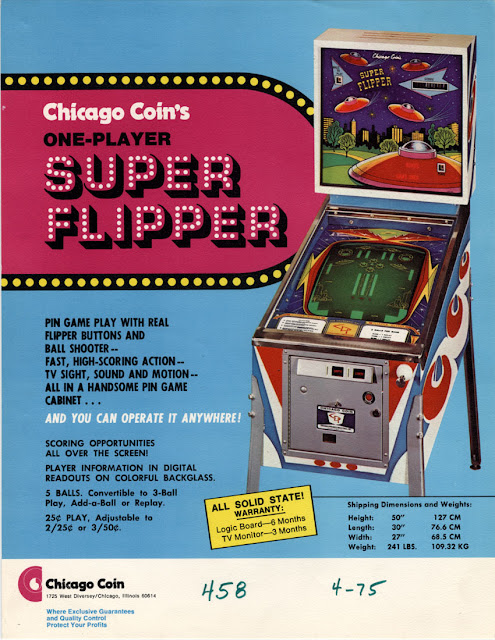
Super Flipper (Chicago Coin, 1975)

Chicago Coin made just about every type of coin-op game under the sun but they were rarely the top producer in any genre. During the 60s they ranked well behind Gottlieb, Williams, and Bally in pinball (though they might have been a distant fourth). Looking at this thing from a distance, you wouldn't know that it wasn't a pinball machine. It had an honest -to-gosh pinball cabinet complete with backglass, flipper buttons,  and plunger. When you got closer, however, you knew there was something amiss when you saw the playfield.
I hate to admit it, but this thing actually looks pretty darned interesting to me. The ball started off moving left and right across the playfield. Pulling the plunger caused it to shoot downwards into play (OK, that part doesn't sound so interesting). The flipper buttons consisted of a sliding mechanism with a hole in it , that separated a light and a photocell. The further you pressed the buttons, the more the flippers moved.


Star Shooter (Meadows Games, 1975/Unreleased)

This was the same basic idea as Super Flipper. Meadows took it to the 1975 MOA show where it flopped and they never released it. Designer David Main ha this to say about it:

[David Main] When we went to the MOA show, the game was a total dud. We thought it was cool because we were in love with the technology but it was a dud because the people who like pinball play it because of the mechanical aesthetics of it. They like the sound of the ball, and you can’t just pretend to have a ball – it has to be a real ball.

            So we went from having a video game version to a mechanical version. In fact I had a patent for a way of sensing the position of the ball on the playfield by having the ball roll over coils. I would send out energy pulses to these different coils that were located in different places on the playfield. When a ball rolled over it, depending on how close it was, the ball would absorb some of the energy that was sent out through this coil. There was one capacitor that switched from coil to coil so that when you hit it with a pulse it would cause a circuit to ring and by counting how many rings there were before the level fell below a threshold I could determine how much energy had been absorbed.


I actually saw a photo of this game (I think in Vending Times) but don't have a copy handy (I'll have to see if I can find one).

3)    Video/Pinball Combinations

These games combined an actual (usually poor) pinball game with an actual (usually poorer) video game. The result was not pretty. At certain points, the pinball action would stop, then you'd have to take your eyes off the pinball table and look up at the video monitor mounted above it to play a simplified video game.

Baby Pac-Man (1982, Bally/Midway)
Designed by Dave Nutting Associates and Bally (much to Namco's chagrin, since they hadn't authorized the game), this is probably the most well-known  video/pinball combination.  The pinball portion was designed by Claude Fernandez with art by Margaret Hudson. Bally sold 7,000 units and the game reached #5 on Replay's Player's Choice charts.
 

Granny and the Gators (1983, Ballly/Midway)
Bally's second attempt at the genre. The pinball portion was designed by Jim Patla with art by Margaret Hudson and Pat McMahon. This game was not without its charms. Some claim that the video game portion led to Toobin' but I don't know if that's true or not.

Caveman (1982, Gottlieb)
With only 1,800 produced this one wasn't much of a success. The pinball portion was designed by John Buras with art by Terry Doerzaph, David Moore, and Rich Tracy. The video portion was a simple maze game in which a caveman is pursued by dinosaurs. It was designed by Joel Krieger with hardware by Jim Weisz and art by Jeff Lee (it was actually Lee's first work at Gottlieb and he designed the graphics on an Apple II computer).

New York Defense/Defence (1981, E.G.S./Telemach 3)

This one was shown at the Forainexpo show at Le Bourget in Paris in December, 1981. It was made by the Italian company E.G.S. and Telemach 3 (a company about which I know next to nothing, other than that they had a booth at the show). It made its debut earlier at the Emada show in Rome. I have seen almost nothing on this game anywhere. The Internet Pinball Database lists it as New York and gives only the name, company, and year of release. The other databases (pinside, arcade museum, arcade history) seem to take their info from IPD. I'm not even sure it IS a video/pin combo.
All of the information comes from the January, 1982 issue of Replay, from which the following photo was taken (please excuse the very poor quality - I scanned it in black and white several years ago because, at the time, I was only interested in the text. I threw the actual issue away since I didn't have the space for it).
 

The Cube/Paparazzi? (unreleased?, Gottlieb)

Designed by Harry Williams. See the previous post for details.

Monday, October 15, 2012

Harry Williams - Video Game Designer???

I recently came across an interesting article about pinball legend Harry Williams (founder of Williams Electronics)
http://archive.ipdb.org/russjensen/harryw.htm

On September 14, 1982, a year before Williams died, Russ Jensen talked to him on the phone.
During the conversation, Williams said that he was currently designing video games for Stern and for an unnamed Japanese company.

That is interesting enough in its own right, but he also mentioned that he had designed a video game/pinball combination that he sold to Gottlieb.
The video game portion had a Rubik's Cube theme and he thought that Gottlieb was going to call the finished game The Cube or Paparazzi.
AFAIK none of Williams' video game creations were ever released. Gottlieb did release the video/pin combination Caveman but that doesn't sound anything like the game Williams' described.

The two things that really jump out at me are that he said the game "used mirrors" and that the pinball and video game portions were "fully integrated".

From the description, that sounds an awful lot like the Pinball 2000 concept that Williams developed in the late 90s (chronicled in the documentary Tilt).

For those who don't know, Harry Williams was one of the absolute legends of pinball.
He started in the coin-op industry in 1929 and over the years he designed pinball games for just about every major manufacturer. His two most famous innovations were probably the first tilt device and Contact (often credited as the first machine with electricity, sound, and a kicker - though there were actually other machines that used them first).

It's hard to pick just one story from his career, but how about the tilt device?

Harry's first game was 1932's Advance, a 10-ball game that featured a number of mechanical gates that could be opened and closed with a well-place shot. The game also included a visible coin chute to discourage the use of slugs. One day, Williams noticed a player in a nearby drugstore hitting the bottom of an Advance machine to make the gates open without hitting them with the ball. Furious, Williams pounded five sharp nails into the machine to discourage such tactics. Knowing that he needed a more practical (and humane) solution he created a device consisting of a steel ball mounted atop a pedestal. If the machine was jarred too violently, the ball would fall off the pedestal and make contact with a metal ring, closing a circuit and bringing the game to a premature end. He called the device a "stool pigeon". After returning the machine back to the drugstore, one of the players activated the device and said "Oh look, I hit it and it tilted. [1]" Williams quickly renamed his creation the tilt device.


[1] Roger C. Sharpe Pinball, p.28