Friday, February 15, 2013

The Ultimate (So Far) History of Cinematronics/Vectorbeam - Pt. 11


With World Series Cinematronics had finally found a winner and was seemingly (yet again) on the road to financial recovery. Yet again, it was not to be so.  In May of 1986 Cinematronics released another sports game as a follow-up to World Series. The idea had come not from the designers but from a company sales rep.
[Dana Christianson] …we had a meeting at Jim Pierce's house to talk about what kind of games we were going to do in the future…the thing that a lot of us wanted to do was a skateboarding game…and I remember sitting in a meeting with a sales guy - sitting in JP's office and he said "You know, I don't think u guys have your finger on the pulse of what the player's want"

Instead of skateboarding, the sale rep wanted them to do a video version of that hippest of sports - bowling.  Like World Series, Alley Master allowed the player to store their stats from game to game.


[David Dentt] - Alley master….[was at one time] called Up your Alley. A name I came up with. I liked the multiple interpretations of it. The game also had the data chips that World Series had. When we took the early version of this game to the Chicago show, we had a special chip we could stick in the slot during attract mode, and it would make the sounds of a turkey gobble
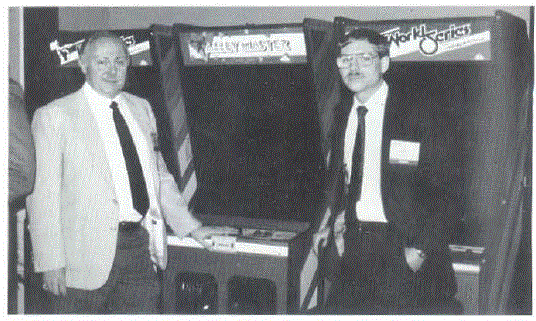
Cinematronics executive Ken Anderson and engineer Alex McKay (creator of the Cinemat system) in front of Alley Master (courtesy Play Meter)

The gobble sound made it into the final version of the game when the player scores three consecutive strikes (known as a "turkey" in bowling parlance). While the game did appear briefly on Replay's popularity charts it only peaked at #20 - a far cry from the success of World Series
 

            Danger Zone fared a bit better. A shooting game in which the player manned a gun to defend a desert base from incoming missiles, helicopters, fighters, and other enemies the game feature a cabinet in which the entire top half swiveled with the screen scrolling in response.

[Dan Viescas] . Jim Pierce wanted a shooting game were the player could move the gun like you would in a gun ship. Jim came to me and asked me to design the cabinet so I did. It won Video Game Cabinet design of the year in Replay magazine.

As with World Series, Danger Zone was an "all-hands-on-deck" effort with most of the programmers, engineers, and artists pitching in. The game just barely made it into Replay's top ten, though it did top the new game charts twice, indicating that it probably wasn't widely distributed. The game did appear in an exhibit at the Smithsonian.
Contrary to what the caption says, Bob Loney was the designer of Danger Zone. I don't think he was ever a member of the USNVGT.


            Redline Racer
continued Cinematronics string of sports games. A multi-player racing game with 16 different tracks, the game never really caught fire in the arcades. More significantly it served as the basis for a later car racing hit - Ivan Stewart's Super Off-road. Leading the design effort was newcomer John Morgan, who'd arrived at Cinematronics after working at Taito America, where he'd designed Zookeeper. Morgan reportedly had an ego but also the ability to back it up. He drew some resentment by finagling a then outrageous (at least for Cinematronics) $40,000 salary. Morgan would go on to design the company's Cinemat II system.

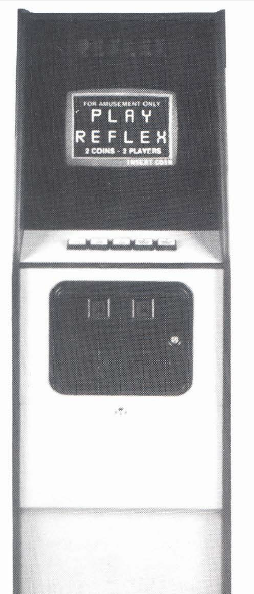
            One game that may never have made it into full production was  Info-Mania/Reflex - an attempt to enter the countertop game market.


[David Dentt] …at some point it was decided that we should do a bar top trivia game. So we came up with Info-Mania. When we were ready to go with it, someone in the Ivory Tower decided it should be a two-in-one game. So in a week I did a second game that was called Reflex. You pressed the buttons to match the ones indicated on the screen.

The idea for a trivia game had come from the same sales rep that suggested a bowling game.

[Dana Christianson]  He was some guy that you'd picture in some dive bar with red naugahyde booths, smoking cigarettes…he had a view of the operators of what he thought he could sell but he tot did not und the players…that was at the time when You Don't Know Jack was popular - he thought "Yeah, I can do that"...he may have come from selling horoscope and love meters at bars.

During the Cinemat years the design process had evolved somewhat from the days when a single programmer handled all the tasks. Teams generally included two programmers and two artists. Most of the programmers and designers loved their work..

[Phil Sorger] If you like working on really hard problems around the clock with brilliant people, you would have loved the work environment…We built a new game every 3 months or so. Seems incredible to me now, considering some games I've worked on have taken closer to 3 years…Needless to say, there was incredible freedom to innovate and create games that people would love to play, that would make lots of money.
There was almost an adversarial environment between teams, it was typical to have someone try to hack your account or game or terminal in some unexpected way, so it was a combination of defensive and retaliatory programming, in addition to the game development itself.

Working for a company in constant Chapter 11 had its challenges.

[Phil Sorger] Even with all the innovation, we still worked in a factory-like atmosphere. After writing code, it would not be uncommon for us to go "down on the floor" and help assemble the cabinets, stuff EPROMs (takes practice), align monitors, validate controls, wrench monitors, and box and band machine after machine. I liked doing that, knowing the machine would work when powered up, appreciating the liminal time between projects, working with the rest of the company (literally) who sometimes resented our crazy work hours and behavior.

In 1987, Cinematronics Chapter 11 issues would finally be solved, though not perhaps in a way that anyone expected. On March 30th, Cinematronics was purchased by Tradewest. Tradewest was headed Leland Cook (a Texas millionaire whose ever-present cowboy hat never failed to charm Japanese video game executives). Cook had gotten into the coin-op business in 1974 when he bought Cranford Vending and renamed it Master Vend. He later added a music and games route and, in 1982, an amusement sales division. The following year, Master Vend entered the distributing business. Master Vend started out distributing Konami and Interlogic games and soon became the biggest kit distributor in the state. Not bad for a company headquartered in Corsicana - a rural town of 25,000 best known for its fruitcake. Cook (along with his son Byron) did it by getting into conversion kits at a time when most distributors were reluctant to do so (making money on dedicated units was especially difficult for rural operators) Other lines carried by Master Vend included Capcom, Arachnid (electronic darts), Dynamo, and Romstar. Master Vend was the exclusive Texas distributor for Romstar and the relationship led to the formation of a new company. In February of 1986 Byron and Leland Cook, along with John Rowe of Romstar formed a manufacturing company in Corsicana called Tradewest. Tradewest's first offering was Alpha Mission, a kit licensed from Japan's SNK (Rowe had a relationship with SNK president E. Kawasaki). It was the next game, however, that put Tradewest on the coin-op video game map. In February of 1986, SNK sent Tradewest some boards for a new game called Ikari Warriors for testing. Tradewest agreed to license the game and John Rowe went to Japan for five days of negotiations. In the end, Tradewest decided to manufacture an upright version of the game (Dynamo actually built the games) and ended up with a #1 hit. The follow-up, Victory Road, was almost as successful.
Ken Anderson, Jim Pierce, Leland Cook, and John Rowe sealing the Tradewest deal

Tradewest also had a relationship with Cinematronics (a relationship that had reportedly started when Leland Cook got a look at World Series) - having licensed Redline Racer in late 1986. At the ACME show in New Orleans in March of 1987, Leland Cook approached Jim Pierce about the possibility of purchasing Cinematronics and making it a wholly owned subsidiary of Tradewest. Reports that other companies were going to try to outbid Cook proved false and on March 30th the deal was struck and in just 45 minutes, Cinematronics - a company that had been part of coin-op history since 1975 was no more. Cinematronics became a subsidiary of Tradewest and was renamed The Leland Corporation (they originally wanted to call it Westron but the name was in use). After almost 4 1/2 years in Chapter 11, Cinematronics was finally out of bankruptcy. There were not, however,  out of hot water. Tradewest now had to deal with large lawsuits filed by Pioneer and ESR (in addition to creditors wanting to get paid). In addition they had to deal with Major League Baseball, who had contested Cinematronics' use of the phrase "World Series" in a video game. In response, Tradewest changed the name of the game from World Series: The Season to Baseball: The Season II (they made some minor changes, including adding errors and control of fielders and runners - though some sources seem to incidate that they renamed the game Baseball: The Season and that Baseball: The Season II was a different game).

Jim Pierce (along with Ken Anderson) stayed on during a transition period. John Rowe took over the day-to-day operations at Leland (Leland and Byron Cook remained in Corsicana) but the design staff remained basically the same. Among the games released by Leland were Quarterback (perhaps the first game with "micro transactions" that allowed a player to buy items and power-ups in exchange for quarters) Ivan Stewart's Super Off-road (an off-road racing game that had started out at a dune buggy game until a group of Leland's designers and artists encountered Ivan Stewart in a sushi restaurant), and Pig Out (one of Leland's only non-sports game - an idea from an accounting department employee who suggested doing a game based on the three little pigs).
Leland lasted into the 90s before being sold to WMS in 1994. Many of the designers went on to form Blue Sky Software. Others went into different fields completely. Byron Cook is currently a Texas state legislator. And Jim Pierce? He disappeared into the mists of video game history. Rumor has it he retired to the Pacific Northwest but if so, he hasn't been heard from since.

Sunday, February 10, 2013

Updates/Odds and Ends

I have found more information on two posts I made earlier.
Both posts have been updated with the new info, but I'll give a summary here.

Simutron Tournament Center

First is this post on the Simutron Tournament Center:
http://allincolorforaquarter.blogspot.com/2012/09/the-simutron-tournament-center-ultimate.html

I found two articles in Play Meter about the project. It even made the cover of the April 1, 1983 issue.


You can read the details in the previous post, but among the new things I discovered:
  • The company that came up with the initial idea and funded the project was Simutron, Inc. (incorporated in Escondido on November 24, 1981)
  • Perceptronics was originally to deliver the final product on June 30, 1982 - well before Astron Belt or Dragon's Lair (recall that the first Simutron game used laser disc technology).
  • Other Torunament Centers were slated to be opened and players from different locations would be able to play one another live.
  • A library of games was planned and would be delivered over phone lines.
  • The project was cancelled around October of 1983.
  • A demo scheduled for May 1, 1982 had been delayed. A year later negotiations to salvage the project broke down.
  • Simutron claims the delays were because Perceptronics didn't have the technology they claimed to have. Perceptronics says it was due to changes in scope.
  • Perceptronics launched a suit against Simutron for $150,000 (they had been paid $315,000).
  • Simutron countersued for $48 million charging breach of contract and fraud (and claiming that Perceptronics had violated a non-compete agreement by working on NFL Football)
Here's another version of the above photo showing mutliple players playing at once:

 
Atari Tournament Fiasco
http://allincolorforaquarter.blogspot.com/2012/11/the-atari-50000-centipede-fiasco.html

The Febuary 1, 1982 issue of Play Meter had another very long article on this torunament that revealed a number of additional details. Again, the full details are in the post, but here are new facts I added.
  • Tournament Soccer Inc actually sold the other games in the tournament (besides Centipede): Tournament Soccer, Tournament Mark Darts, Tournament Eight Ball, and Tournament Table Hockey. The last three were manufactured by Arachnid, U.S. Billiards, and Sutra.
  • Lee Peppard claimst that each of these companies agreed to pay him $20,000 and didn't. At least two of them claim they never promised anything.
  • Peppard claims that Atari wrote him a $40,000 purchase order to pay for the decorator. Atari says he refused the order and they told him to rip it up.
  • Peppard claims that the original contract called for Atari to pay hi $240,000 but this was reduced to $100,000 when he was forced to renegotiate.
  • Atari paid him the $100,000 but Peppard appartenly thought that their final $20,000 payment was actually "confidence money" and that the final payment would come in the form of 184 blank checks for prize money.
  • Peppard claim that Atari failed to help him market the tournament kits. He was projected to sell 5,000 at $5 but only sold 600.
  • An unapproved (by Atari) ad gave them impression that they were cosponsoring the entire event (rather than just the video game portion). Here is the ad:
 

Finally, here are a few other interesting photos I came across in Play Meter:

First is one from the August 15, 1981 issue. It doesn't name the programmer but surely that's Dona Bailey working on Centipede (look at the screen shot). I don't know if I've seen a photo of her before.


Speaking of the Simutron Tournament Center, here's a similar idea from the Starcade arcade in Disneyland's Tomorrowland. I don't know when the photo was taken (the arcade was there when Tomorrowland opened in 1977). One interesting fact in the article from which this was taken is that the first video game at Disneyland was Atari's  Indy 800.


A photo of Exidy's Vertigo. I've seen this one before but don't remember where.


Lastly. Here are some more photos of games that either are not in TAFA/Arcade History or that are listed but don't have cabinet photos

From SamyRa


From New Technology Computer Inventions
It appears that this was not a game but rather a cabinet with 30 existing games


PGD's Progressive Music Trivia
 

Wednesday, February 6, 2013

More Un-TAFA'd/KLOV'd games

Another utilitarian (read boring) post today.
I recently bought the 1986 summer catalog issues of Replay and they had a number of games that were either not on Arcade Flyers, not in KLOV, or not in either one.

Here are the ones that were listed.
Most are gambling or trivia games and there's probably little interest in those among collectors, but someone could still enter them in KLOV. Most (if not all) were likely released in 1985 and 1986.


Friday, February 1, 2013

The Ultimate (So Far) History of Cinematronics/Vectorbeam - Pt. 10

Today's post covers one of my favorite Cinematronics games - World Series: The Season. A game that I consider one of the best, if not the best, arcade baseball games ever. Sadly, it seems to be almost forgotten today. I'm not sure why. Perhaps because it came out in that brief period after the crash of 1983/84 and before of games like Gauntlet and Hang On spurred an arcade comeback.
First, however, I have updated a number of past installments in this series with new information from Bob Skinner, Dennis Halverson, and Brooke Jarrett, including new info about Cosmic Chasm and the DARPA tank simulator project plus a couple of fun stories/rumors about subliminal messages in Dragon's Lair and employees feeding marshmallows to geese with slingshots.

The parts that had the most changes were parts 3,6, and 7

On to Part 10


            So far, Cinematronics' attempts to follow up on the success of Dragon's Lair and Space Ace had met with dismal failure. Scion, Freeze, Cerberus, Express Delivery, Mayhem 2002, and Power Play had gone nowhere and the situation had gone from grim to borderline disaster. But Jim Pierce had an ace up his sleeve. He had long wanted to create a video version of baseball and in 1985 he would finally get his chance with World Series: The Season - a game that would give the company its first hit since the laser disc days. It almost didn't happen however.
            The game was a team effort with most of the design staff contributing in one way or another. Spearheading the effort was programmer Medo Moreno, who had come to Cinematronics in January of 1985, after a stint at Gremlin/Sega where he worked on games like Carnival and Eliminator.  A Strat-O-Matic baseball fanatic, Moreno was a natural choice to lead the programming effort.  Moreno started working on the game in February but the idea had come about before he got there. Joining him on the project were David Dentt, Dan Viescas,  Jerry Huber, Dana Christianson, Phil Sorger, Steve Hostetler (and, eventually, many others). 
 
 
            The game was developed on the relatively new Cinemat system. The team experimented briefly with digitized graphics but the poor resolution and limited color capabilities of the Cinemat hardware made that impractical. Instead, artists turned to a crude but effective means of creating the game's graphics. Using standard SLR cameras the trooped out to the company parking lot and took photos of one another going through the motions of batting and pitching.  

[Dana Christianson] We didn't have scanners, we didn't have digital cameras. We did all the animation with a camera with a motor drive [using] slide film and we projected those up on graph paper [then] we basically took a black sharpie on the graph paper and did outlines of all the characters. But there were hundreds of animations so we would hand these piles of graph paper to these women in the engineering group where they were burning EPROMs and have them hand enter [the data from] these sheets of graph paper. Then they'd have to burn the EPROMs. So to see animation we'd have to wait until the EPROMS were burned  and then I'd see all the flaws and I'd have to go back and reedit it on graph paper - it was absolutely Neanderthal.
Eventually someone created a graphics tool and the artists no longer had to rely on assembly line workers hand entering the data.
With the company banking on World Series to pull them out of the doldrums, many of the designers worked almost nonstop on the game. Medo Moreno and Dana Christianson practically lived in the Cinematronics building for 9 months working from 10 in the morning until at least midnight. Both of them had sleeping bags and would often stay the night (living at work was hardly unknown at Cinematronics.  Sound designer Dave Cartt had a house in the mountains an hour away and would drive in on Mondays and stay for a week, living out of a camper on the back of his truck and showering at a nearby gym). Before long, almost everyone in began to pitch in on the game. Then disaster struck. The company was still in Chapter 11 (as they had been off and on since 1982) and Jim Pierce found himself unable to make payroll. A number of employees were laid off and it looked like the end of the line for Cinematronics. Wanting to see the project through to the end, some employees agreed to work on the game for several weeks without pay (some were asked to do so while others apparently volunteered).

[Dana Christianson] Because they were in Chapter 11, we needed to get baseball done for that show - it was make or break for Cinematronics. Jerry Huber and I worked for 6 weeks, maybe 2 months, for no money…Some of the women from work brought us groceries - not only was our job eventually at stake but there was a spirit of - it was like we were at war we were trying to survive so everybody joined in.

[Jerry Huber] Jim Pierce pulled me into his office and asked me to help finish off the game. The plan was to get the game out ASAP, sell enough units to raise the money reserves and then hire everyone back. Long story short… we did it. Everyone got rehired and the company lived to fight another day. I was totally broke at that time… so working without pay was tough. But the thing that I remember the most about that time was that the people that were still employed all chipped in and bought me groceries so I wouldn't starve to death. How awesome is that?

[Bob Skinner] I only remember going without pay for 30-60 days. We had a meeting where JP basically said. “I need your keys.” He explained he could not make payroll, because the product wasn’t finished or ready to sell. So we all said we would work for free. Weighing risk/reward, we all felt good about it. This was a real gung-ho time as everyone was in survivor mode and wanted to be thought of as valuable to the effort.

[Phil Sorger]
At one point Jim Pierce said he would have to lay me off (among others) and not be able to ship World Series. When I told him I believed in the company, the game and him and would work for free (just health insurance) I saw him get very emotional and thank me personally. He later repaid me once the game was a "home run".
Thanks to a superhuman effort by the design team, World Series: The Season was ready in time for the 1985 AMOA show in October. Then, just when it seemed like things were finally looking up, disaster struck yet again. In the middle of the show, a police officer came in with an injunction and forced Cinematronics to turn off their games.

[Dana Christianson]
We went and [the game] made a huge, huge splash. I think it was the first or second day when the police came in and forced us to turn all of our cabinets toward the wall of our booth because somebody had filed a suit against Cinematronics for stealing an idea.
The problem was a lawsuit filed by Roland Colton of Electronics Sports Research. According to Colton, he had met with Jim Pierce in May of 1984 to discuss his idea for a baseball game and the possibility of Cinematronics manufacturing the game. According to Colton (details can be found at  http://bulk.resource.org/courts.gov/c/F2/916/916.F2d.1444.89-55297.89-55296.html) Pierce had signed a confidentiality agreement and only then did he explain the game's "secret design" to Pierce. Pierce eventually turned down the game only to release it on their own (without paying Colton a dime).. Whether this meeting occurred and what exactly Colton's idea was is unknown. Medo Moreno recalls that the initial concept involved a player coming to bat in certain pre-determined game situations. The design staff had been unaware of the Colton situation and was surprised (if not panicked) when the games had to be turned to the wall. In any event, the injunction was eventually lifted (though the legal case stretched at least into 1989) and Cinematronics was able to begin selling their game. Dana Christianson speculates that the controversy may even have helped in the end.
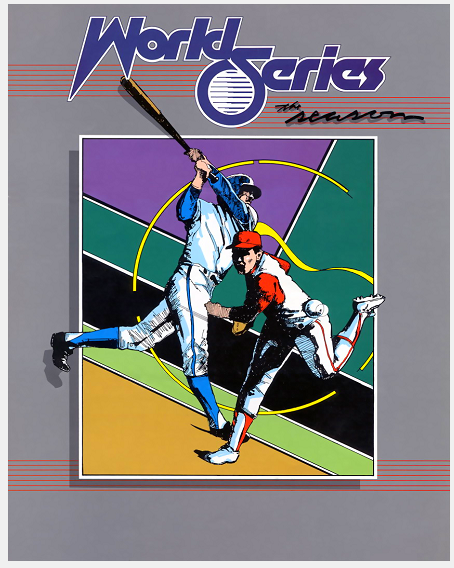
   
         When it finally became available, World Series proved to be the hit that Cinematronics so desperately needed. The game reached #2 on the Replay charts and #4 on Play Meter. The controversy may have helped but it was the gameplay that really made the game a success. World Series was one of the best arcade baseball games ever created. In the game, the player alternately controlled a batter and a pitcher in a semi-first person simulation of the national pastime. The player could face off against a computer opponent or another player. While the game included a number of excellent features, two stand out. First was the controls - which included a pair of tiny spring-loaded joysticks the player used to control the batter and pitcher. The player could use the stick to precisely position the bat or (by means of a white aiming dot) the location of the pitch. In addition, the farther the player pulled the stick back, the harder they swung (or threw).  While the joystick in many ways made the game, it was prone to break.
  
[Phil Sorger] I remember I used to bring handfuls of steel springs to trade shows and give them out to distributors and operators. The spring-loaded analog stick (usually the baseball bat one) would break springs from time to time, and they liked the springs much more than pens or other typical booth giveaways.
 
            The second key feature was that the game kept track of the player's stats. When the player started the game, they entered their initials and birthdate and the game tracked a host of pitching and batting stats over time. The game's "high score" board was a statistical leader board that could be sorted on a variety of different stats. For the stats obsessed baseball fan (and is there any other kind?), it was pure heaven. I personally remember logging in with multiple birthdays so that I could make the leader boards in  multiple categories (if you were "leading the league" in batting average, you didn't want to risk losing your top spot).
 
One idea that didn't go over so well was to allow the player to store their stats on a "stat key" and take them from location to location.
[Phil Sorger] I showed [Jim Pierce] once that I could make a "key" that players could insert into the games that would store the players' stats so they could play the same game on another cabinet and have their information transferred. The key was really just an EEPROM but it worked more like magic. He bankrolled the idea, we tested it in a few arcades, but the keyhole got used more often for chewing gum than account transfer, but he never blamed me for having a boneheaded idea. Hey, it might have worked...

The idea was that operators could sell the keys or give them away as promotions. While some operators liked the idea, they didn't want to support selling the keys (or cleaning the gunk out of the keyholes).
Overall, however, World Series was a hit (it was later redone as Baseball: The Season II) and got Cinematronics (temporarily at least) back in the black, even allowing them to rehire some of the employees they'd had to let go (though some had had enough and never returned).  The game remains one of the best coin-op baseball simulations ever made, even if few now remember it.

[Phil Sorger]
I was in a pizza place in Florida one evening, and I was bummed to see an old World Series with the power turned off in the corner. I asked the guy working there why it wasn't turned on and he said it was broken. I asked him for the keys and in a few minutes had the game up and running again. The door switch was broken (the power turns off when you take the back off) so that was the first thing. Also, the EEPROM was dead, but there was a bookkeeping/diagnostics option, accessible via the service button/menu system, that could be used to reset it. I realigned the monitor, reseated the background EPROMs (one was loose) and checked everything out. I played a couple games on free play with the family, before returning it to 1coin/credit mode. So I got to play my old game AND they gave us free pizza..


Saturday, January 26, 2013

Play Meter Operator/Industry Surveys

I don't know how much interest there is in this kind of information but the various industry trade magazines published yearly operator/industry surveys with a number of statistics on the coin-op industry.

I was recently reviewing the surveys from Play Meter and thought I'd publish some of the stats I found most interesting. Play Meter published its first survey in 1976.

First up - average weekly earnings per machine by machine type:

1976 1977 1978 1979 1980 1981 1982 1983 1984 1985 1986
Video Games 40 44 50 64 102 140 109 70 53 57 57
Jukeboxes 49 46 52 54 50 55 51 50 40 47 55
Pinball 35 44 62 65 63 66 55 38 41 52 51
Pool Tables 41 41 53 57 66 67 63 58 60 58 61
Foosball 39 39 41 31 20 28 31 * 26 * *
Shufleboards 23 29 32 41? * * * * 30 31 *
Wallgames * 33 34 29 25 26 28 * * * *
Cocktail Tables * * * 49 * 115 97 * * * *
Air Cushion Games * * * 27 34 40 39 * * * *
Arcade Games 26 * * 33 36 46 * 59 55 55
Shuffle Alleys 30 29 32 41 28 31 48 * 36 * *
Counter Games * * * * * 37 49 * 52 57 *

A few other categories  that weren't reported regularly:

Ball Bowlers: 1976-$25
Video Phonographs: 1984-$176
Laser Disc Video games: 1984-$120
Bar Roll-Up Games: 1984-$98
Electronic Dart Games: 1984-$55, 1985-$57, 1986-$44
Kiddie Rides: 1982-$37, 1984-$50, 1985-$21, 1986-$33

Total Machines On Location

Video Games

1980: 540,000
1981: 780,000
1982: 1,375,000
1983: 1,491,359
1984: 1,095,361

Total Coin-Op Machines (includes coin-op games, kiddie rides, and jukeboxes)

1982: 1,793,000
1983: 1,876,389
1984: 1,652,324
1985: 1,500,741
1986: 1,450000

Total Coin-Op Industry Dollar Volume (in billions)

1980: 7.15
1981: 8.2
1982: 8.9
1983: 6.4
1984: 4.5
1985: 4.5
1986: 4.0

Operators' Preferred Video Game Manufacturer

1977: Atari (59%), Bally/Midway (31%), Other (10%)
1978: Atari (69%), Bally/Midway (27%), Exidy (1%), Other (3%)
1979: Bally/Midway (49%), Atari (47%), Other (4%)
1980: Atari (54%), Bally/Midway (43%), Other (3%)

Arcade Video Game Market Share

1981: Atari (30%), Bally/Midway (26%), Williams (12%), Stern (8%), Centuri (6%), Cinematronics (5%), Sega/Gremlin (4%), Taito/Taito America (2%), Exidy (2%), Other (5%)

1982: Bally/Midway (33%), Atari (23%), Williams (11%), Nintendo (10%),  Taito/Taito Ameria (6%), Sega/Gremlin (6%), Stern (3%), Centuri (3%), Cinematronics (2%), Exidy (1%), Other (3%)

1983: Bally/Midway (25%), Atari (19%), Williams (12%), Nintendo (9%), Sega/Gremlin (6%), Gottlieb (6%), Taito/Taito America (5%), Centuri (4%), Stern (3%), Universal (2%), Rock-Ola (1%), Data East (1%), Other (7%)

1984 (Dedicated): Bally/Midway (21%), Atari (19%), Nintendo (19%), Konami/Centuri (7%), Gottlieb (7%), Cinematronics (6%), Williams (5%), Taito/Taito America (4%), Merit (3%), Coin-It (2%), Stern (1%), Exidy (1%), Universal (1%), Data East (1%), Konami/Interlogic (1%), Other (4%)

1984 (Conversion Kits): Universal (18%), Taito/Taito America (14%), Nintendo (13%), Bally/Midway (10%), Konami/Centuri (7%), Konami/Intelogic (7%), Atari (5%), Crown Vending (4%), Data East (3%), Stern (2%), Centuri (2%), Magic/Eagle (2%), SNK (2%), Cinematronics (1%),
Other (9%)